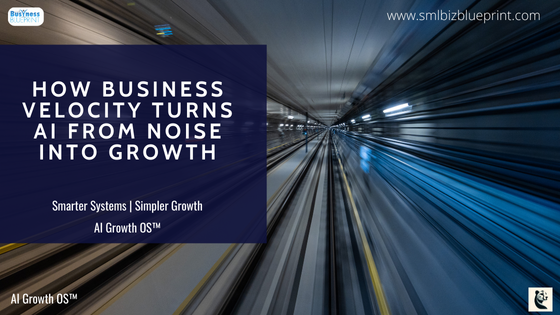

Business velocity is the combination of speed and direction—not just doing more, but moving faster toward the right goals.
When speed aligns with strategy, momentum builds, compounding progress over time.
AI and automation accelerate waste without alignment, leaving businesses busy but not closer to growth.
You’re working harder, moving faster, adopting the newest tools—yet the results don’t match the effort.
Deadlines still slip. Projects multiply but don’t compound.
Dashboards are full of activity, but the outcomes feel thin. It’s like running at full sprint and realising you’re still on the treadmill.
The pressure is real: competitors flood the market with AI-generated output, teams chase speed for its own sake, and leadership keeps asking for “more.”
But more isn’t the answer. Without direction, speed only amplifies noise.
The risk?
Wasted resources, burned-out teams, and a business that appears busy while quietly drifting off course.
Here’s the shift: velocity isn’t just speed—it’s speed plus direction. And when those two align, momentum builds.
AI doesn’t have to be a treadmill; used wisely, it’s an accelerant that turns aligned action into lasting momentum.
In this post, we’ll break down what business velocity really means, why the default “just move faster” approach fails, and how to design a system where AI adds thrust only after you’ve set the right vector.
By the end, you’ll have a sharper lens: one that strips away wasted motion and channels your effort into growth that actually compounds.

What Is Business Velocity? Speed × Direction, Not Just “Go Faster”
Most businesses confuse speed with progress.
You’ve probably felt it: the endless push to “move faster.” More campaigns, more output, more meetings packed into the same week. The team is sprinting, but the finish line never seems closer.
It’s exhausting—and quietly demoralising.
Relief: Velocity isn’t about raw speed. It’s about speed with direction.
In physics, velocity combines speed and direction. Business works the same way. A team running at 100 mph but 30 degrees off-course doesn’t arrive faster—it drifts further from the goal.
Real velocity is when effort lines up with the intended trajectory.
That’s why businesses with less activity but tighter alignment often outpace those with more hustle.
Example:
Two companies launch AI-driven content initiatives. Company A publishes 50 posts a month on every trending keyword. Company B publishes 10 posts a month focused on their core customers’ pain points. Six months later, Company A has bloated dashboards and minimal impact. Company B owns its niche. That’s velocity.
Businesses that understand velocity see themselves not as busy operators but as focused navigators. They measure progress by distance toward the destination, not by how many steps they’ve taken.
The longer you equate speed with success, the more energy you waste compounding in the wrong direction. Every week this continues, you’re investing in distance from your goal.
Because every initiative you launch without checking direction adds invisible cost. Time, energy, and capital are being burned at scale—often without showing up in your financials until it’s too late.
Pro Tip:
Before adding AI to any workflow, ask: Does this output move us closer to our defined destination?
Because speed isn’t the edge—alignment is. The faster you can confirm that energy is pointed in the right direction, the more each step compounds into momentum. That’s how market leaders win.
Stay ahead of the curve!
Subscribe to our newsletter and never miss the latest in business growth and marketing strategies.
Why the Default Approach Fails: AI Accelerates the Wrong Things by Default
AI makes it easier than ever to move fast—but often in the wrong direction.
Most teams rush to adopt AI as a productivity booster: more blog posts, more campaigns, more dashboards filled with data.
But if the foundation is flawed, all AI does is help you fail faster. Instead of clarity, you end up with volume. Instead of traction, you drown in noise.
The illusion of progress masks the reality of wasted resources.
AI should be treated as an amplifier, not a strategy.
Like a megaphone, AI magnifies whatever you point it at. If your direction is aligned, AI accelerates results. If your direction is off, AI amplifies the mistake.
That’s why companies that “scale without steering” often burn months of effort without moving meaningfully closer to their goals.
The fix is simple but overlooked: clarify the target vector first, then let AI accelerate execution.
Example:
A retail brand used AI to auto-generate discount campaigns. Sales volume rose—but profits fell sharply because margins evaporated. They didn’t lack speed; they lacked direction. A competitor applied AI to refine customer segmentation before launching campaigns. Fewer emails, tighter targeting, higher profits. Both used AI, but only one had velocity.
Businesses that win with AI don’t see it as a race to automate—they see it as a lever to extend already-aligned strategy. They are curators, not just producers.
The longer you let AI run without a vector, the more waste it compounds. Every day, it creates outputs that don’t serve its destination, adding drag disguised as productivity.
Because most companies don’t realise they’re paying to accelerate misalignment. What that means for your business is silent cost: content that never converts, campaigns that erode margins, dashboards that reward activity instead of outcomes.
I once believed the answer was speed. More tools, more automation, more dashboards.
For a while, it felt impressive—until I noticed we were creating 10x the work but not 10x the results. The mistake? Scaling misalignment.
The fix was slowing down just long enough to ask: Are we accelerating the right thing?
Pro Tip:
Before deploying AI to scale, run a “vector check” — one sentence that connects the initiative directly to a strategic outcome (e.g., revenue, retention, or differentiation).
Because speed isn’t the risk—direction is. The faster AI gets, the more unforgiving misalignment becomes. Leaders who build the habit of steering before scaling will avoid noise and build true momentum.
How Do You Align Speed and Strategy in Your Business? (The Alignment Coefficient)
Speed without alignment is just waste at scale.
It’s frustrating: your team works harder, AI makes output faster, yet progress feels shallow. You hit deadlines, but results don’t connect to strategy.
The truth?
Execution without alignment doesn’t just underperform—it creates drag. Energy pours out, but little compounding progress returns.
Alignment multiplies the impact of every action.
Think of alignment as a coefficient—a number between 0 and 1. At perfect alignment (1.0), every unit of speed converts into progress. At 0.3 alignment, 70% of your effort is wasted.
That’s why businesses with smaller teams and tighter focus can outperform giants: they lose less to misalignment.
The secret isn’t more speed—it’s increasing your alignment coefficient before turning up the throttle.
Example:
One SaaS company automated lead capture forms and celebrated a surge in sign-ups. But sales conversion rates stayed flat—because the sales process wasn’t tuned to handle new volume. They had scaled inefficiency. Another firm took the opposite path: aligning marketing automation to a refined customer journey. With fewer leads but higher fit, conversion doubled. Same tools, different alignment.
Businesses with velocity see alignment as their first responsibility.
They’re not obsessed with “moving fast”—they’re obsessed with pointing energy toward the right outcome. They define success not by busyness, but by compounding progress.
The faster your business moves, the higher the cost of misalignment. The longer you delay aligning speed with strategy, the harder it becomes to recover. Every misaligned step today compounds into tomorrow’s detour.
Because most companies don’t measure waste from misalignment, it hides behind activity metrics. What that means for your business is simple: you might be celebrating speed that’s secretly pulling you further from the goal.
The marketing team was proud—they had doubled their campaign output with AI.
But sales was drowning in unqualified leads, frustrated that none of it was converting. After a hard reset, they narrowed focus to only two aligned customer segments.
Suddenly, fewer campaigns delivered more closed deals—and the team realized alignment, not activity, was the real win.
Pro Tip:
Before automating, ask: Does this initiative connect directly to revenue, retention, or a unique advantage? If the answer is fuzzy, pause.
Because speed isn’t scarce anymore—alignment is. The businesses that thrive are the ones that measure, improve, and protect their alignment coefficient. That’s how momentum compounds instead of evaporates.

How Does Velocity Lead to Momentum in Business?
Speed without compounding feels like running on repeat.
You’ve seen it before: projects finish, campaigns go live, and results appear for a moment—only to vanish the next quarter. The cycle restarts from zero, leaving teams exhausted.
Without momentum, every gain must be rebuilt from scratch. That’s the treadmill most businesses can’t escape.
Momentum turns velocity into a flywheel that compounds over time.
When speed and direction align, energy doesn’t dissipate—it stacks. Every cycle creates assets that make the next cycle easier: data sets that sharpen decisions, customer relationships that lower acquisition costs, and brand equity that attracts without effort.
Velocity becomes self-sustaining momentum, and that’s when businesses grow without burning out.
Amazon’s famous flywheel is built on this principle. Lower prices → more customers → more sellers → lower costs → even lower prices. Every loop strengthens the next. Similarly, a small consultancy that refines and reuses its AI playbooks sees productivity gains compound with each project. They don’t just move faster—they move faster with less effort each time.
Businesses with momentum stop living project-to-project. They shift from chasing results to building systems that store energy.
They measure wins not only by today’s output but by how much easier tomorrow’s becomes.
The longer you treat business as isolated sprints, the harder it becomes to compete with companies building compounding flywheels. Every quarter without momentum is another reset button you can’t afford.
Because most people don’t realise that lack of momentum is an invisible loss. That means hidden costs for your business: campaigns that disappear, assets that don’t build, knowledge that isn’t retained. Without momentum, speed burns out instead of paying forward.
Pro Tip:
Build every initiative with a re-use rule—content libraries, customer playbooks, or data models that improve with each cycle.
Because momentum, not speed, is the ultimate edge. The faster you turn one-off activity into reusable energy, the sooner you escape the treadmill and build compounding growth.
What’s the Overlooked Factor That Affects Business Velocity? (Organisational Mass)
Too much weight slows even the fastest engine.
You might feel it already—endless approvals delay projects, tools overlap in function, and teams are burdened by processes that add work instead of removing it. The more your business grows, the more “mass” it carries. And not all of that mass helps.
Instead of momentum, you get drag. Instead of compounding, you get resistance.
Some mass stores energy, but some mass creates friction.
Physics reminds us: momentum = mass × velocity. In business, that mass can be a brand reputation, customer base, or intellectual property—assets that store energy and accelerate you forward.
But bureaucracy, bloated tech stacks, and redundant reporting? That’s dead weight.
The key isn’t to eliminate mass—it’s to distinguish flywheel mass (useful weight that stores energy) from friction mass (drag that slows everything down).
Example:
IBM’s turnaround in the 1990s wasn’t about “adding speed.” It was about shedding drag—selling off non-core divisions, simplifying decision layers, and focusing mass where it compounded. Today, many startups hit the opposite problem: they scale fast, but internal complexity balloons. PwC found 42% of executives cite internal complexity as the #1 barrier to execution speed.
The lesson? You don’t lose velocity from lack of effort—you lose it to hidden friction.
Businesses with true velocity design themselves to be light where they need to pivot and heavy where they need to anchor. They know which mass is ballast and which mass is baggage. They carry weight that stabilises momentum, not weight that drags it down.
The longer you ignore friction mass, the more it compounds as an invisible cost. Every extra tool, meeting, or process adds drag. And the faster you try to move, the more that drag multiplies your loss.
Because most companies don’t realise their biggest enemy isn’t competition—it’s their own organisational weight. What that means for your business is wasted time, slow reactions, and opportunities slipping away while you untangle bureaucracy.
Here’s the uncomfortable truth: many $10M businesses are slower than when they were $2M.
Growth piled on layers of reporting, tools, and approvals that now drag on every decision. It’s not a lack of speed—it’s too much weight.
The bold move isn’t adding more horsepower; it’s cutting the dead weight so the engine can run free again.
Pro Tip:
Audit your business mass quarterly. Ask: Which systems or processes add energy back into the flywheel, and which only absorb it? Cut or redesign the latter.
Because velocity isn’t just about adding thrust—it’s about reducing drag. The lighter your organisation runs, the more every ounce of speed compounds into momentum. Leaders who strip friction mass move not just faster, but further.
Don’t miss a beat in your business growth journey!
Join Pulse and stay ahead with expert tips and actionable advice every month.
Subscribe to Pulse Today
Practical Guardrails: How to Use AI Without Losing Direction
AI without guardrails creates chaos at scale.
It’s tempting to unleash AI everywhere—content creation, customer service, operations—because the promise of speed is intoxicating.
But when AI runs without boundaries, you end up with misaligned campaigns, bloated costs, and decisions that look efficient on paper but deliver little impact in reality.
Teams get buried under outputs that don’t move the business forward.
Guardrails keep speed aligned with purpose.
Think of guardrails as the steering system that ensures acceleration points in the right direction.
Rule one: steer before you throttle—define the vector before automating.
Rule two: measure signal-to-noise—if AI outputs don’t move KPIs, pause.
Rule three: iterate for alignment—use feedback loops to refine direction and prevent wasted cycles.
AI becomes a precision tool instead of a blunt amplifier.
Example:
One SaaS company cut its AI-generated blog volume by 60% after realising most posts didn’t convert. Instead, they focused AI on customer-driven topics tied to clear metrics. Result: fewer posts, triple the conversions. Another firm let AI drive volume unchecked and ended up with hundreds of low-value assets cluttering their ecosystem. Same technology, different outcomes—guardrails made the difference.
Businesses with real velocity don’t treat AI as autopilot. They use it as a co-pilot—accelerating execution while staying firmly in control of direction.
They know that speed is only valuable when guided.
The longer AI operates without guardrails, the more costly the course correction becomes. Every misaligned output compounds into wasted time, diluted brand, and missed opportunities.
Because most people don’t realise that AI’s biggest risk isn’t failure—it’s false success. What that means for your business is celebrating impressive metrics but hiding the fact that you’re accelerating in the wrong direction.
Pro Tip:
Before launching any AI project, define one non-negotiable metric it must move (e.g., conversion, retention, margin). If it doesn’t, stop.
Because AI isn’t the edge—alignment with AI is. The businesses that thrive are those that install steering mechanisms before pressing the accelerator. That’s how you prevent speed from becoming noise and turn it into lasting momentum.
Conclusion
You’ve been told to “do more, go faster, automate everything.” And maybe you’ve tried. But the pressure never lifts. The faster you run, the further you drift. Work piles up. Noise multiplies.
Your team feels busy but not closer to the finish line. It’s exhausting, and it’s not sustainable.
Velocity changes the equation. Speed alone drains you; speed with direction frees you. Alignment strips away wasted effort. Guardrails keep AI from amplifying mistakes.
Momentum turns today’s effort into tomorrow’s advantage. When you reduce drag and point energy in the right direction, business starts to feel lighter, not heavier.
Progress compounds, and growth stops being a grind.
Businesses with true velocity aren’t just faster—they’re freer. They trade hustle for clarity, busyness for momentum, pressure for progress.
They don’t measure themselves by output—they measure by how much easier each next step becomes.
The longer you confuse speed with success, the more invisible costs you pay—lost time, wasted resources, missed opportunities. If this pattern continues week after week, you’ll build drag instead of momentum. But you don’t have to stay on that treadmill.
The state you’re in right now—overloaded, misaligned, exhausted—is optional. You can keep running harder and getting the same result.
Or you can slow down just long enough to steer, then accelerate with clarity. That’s where freedom lives. That’s where growth compounds.
Stay stuck, or move forward—the decision is yours.
Action Steps
Run a Vector Check
Ask: Does this project or initiative clearly connect to revenue, retention, or a unique advantage?
If the link is fuzzy, pause or reframe it before adding speed.
Audit Your Alignment Coefficient
Score each initiative from 0–1 on how well it aligns with strategy.
Cut or adjust low-alignment work, even if it looks “busy.”
Differentiate Mass: Flywheel vs. Friction
List the “weight” in your business—tools, processes, approvals.
Keep flywheel mass (assets that store energy, like customer data, brand, playbooks). Strip friction mass (layers that slow you down).
Install AI Guardrails
Never deploy AI without a defined target metric.
Ask: If this accelerates, what outcome does it amplify? If the answer is unclear, hold back.
Shift from Projects to Flywheels
Recast initiatives so each cycle builds reusable assets: content libraries, customer knowledge bases, data sets.
Momentum compounds when today’s work makes tomorrow’s easier.
Measure Signal-to-Noise
Replace “activity dashboards” with outcome metrics.
Example: instead of tracking posts published, track qualified leads, retention rates, or margin impact.
Adopt the Simplicity Protocol
Collapse priorities until the direction is obvious.
Every extra vector splits your energy and cancels progress.
Why take these steps now?
Because the longer you run fast without direction, the more invisible costs pile up—time, energy, and capital that never return. Minor adjustments today prevent compounded waste tomorrow.
FAQ’s
Q1: What is business velocity?
A1: Business velocity means speed with direction. It’s not just about doing more or moving faster—it’s about aligning effort with strategy so progress compounds into momentum.
Q2: How is business velocity different from business growth?
A2: Growth measures outputs (like revenue or headcount), while velocity measures the rate of progress toward strategic goals. A business can grow in size but still lack velocity if its actions are misaligned.
Q3: Can AI help improve business velocity?
A3: Yes—but only if direction is clear first. AI amplifies whatever you point it at. If aligned, it accelerates progress; if misaligned, it multiplies waste. Guardrails are essential to make sure AI drives velocity, not noise.
Q4: What slows down business momentum the most?
A4: The biggest culprit is organisational drag: too many approvals, bloated tool stacks, or processes that add friction. Every layer of unnecessary complexity reduces velocity and drains energy from momentum.
Q5: How can I align speed and strategy in my business?
A5: Start with a “vector check”: every initiative should connect directly to revenue, retention, or competitive advantage. Score initiatives on alignment (0–1). Cut or adjust anything that doesn’t clearly contribute.
Q6: What’s the difference between speed and progress in business?
A6: Speed is activity. Progress is distance moved in the right direction. Velocity ensures that speed is applied in alignment with your goals—otherwise you’re just running faster on a treadmill.
Q7: How do I create momentum in my business?
A7: Shift from one-off projects to flywheels: systems, assets, or relationships that make each
next cycle easier. Examples: a content library that ranks for years, customer relationships that lower acquisition costs, or playbooks that cut decision time.
Bonus Section: Three Unconventional Levers for Business Velocity
Most people assume that building velocity means doing more, adding tools, or chasing every new technology.
But sometimes the biggest gains come from the places you don’t expect.
Here are three surprising practices that can quietly accelerate your business by stripping away drag and multiplying what really counts.
Measure “Friction Cost,” Not Just Output
The default metric is output—sales closed, campaigns shipped, meetings held. But the hidden enemy of velocity isn’t output; it’s friction. Every hand-off, rework cycle, and approval queue leaks energy. When left unmeasured, these leaks grow silently.
Example: A team that ships projects fast but spends 30% of its time waiting on approvals is losing more velocity than it gains.
Why it matters now: The longer this drag goes unmeasured, the more invisible cost you pay in missed opportunities and frustrated talent.
Subtracting Work as a Growth Strategy
Velocity isn’t always about adding fuel—it’s often about shedding weight. The instinct to add more dashboards, more reports, and more campaigns creates bloat that cancels out speed. Sometimes the fastest path forward is subtraction.
Example: A firm eliminated 40% of its internal reporting and doubled project throughput because teams could focus on execution instead of interpreting numbers.
Why it matters now: Every unnecessary tool or process steals cycles of attention. The longer you carry it, the harder your team has to sprint just to stay level.
Run a Momentum Audit: What Actually Compounds?
Not all progress compounds. A seasonal discount campaign disappears the moment it ends. But an evergreen playbook, a library of customer data, or a referral engine builds momentum that lasts.
The difference?
One resets to zero, the other keeps paying forward.
Example: A company that built a knowledge base for sales calls found that each rep improved faster, cutting training time in half. That asset created momentum long after the first investment.
Why it matters now: Most companies discover 70% of their work produces results with no half-life. What that means is you’re running hard but always starting from scratch.
Velocity isn’t about “more”—it’s about directing energy where it matters, stripping away the drag, and investing in compounding loops.
By measuring friction, subtracting unnecessary work, and auditing what truly builds momentum, you create the conditions for growth that feels lighter, faster, and freer.
Other Articles
Proven Ways to Use AI to Build Authority in Your Niche
5 Strategic Clarity Questions to Refocus Your Business
5 AI Tools That Keep Your Business Visible 24/7 — Without Adding Hours to Your Day