
AI can now execute business decisions, but creating measurable value depends on having the right context, decision rules and operational controls in place.
A business context layer for AI makes the operational information, commercial priorities, decision rules and authority boundaries accessible to AI agents so they can execute business decisions reliably rather than simply retrieve accurate data.
As AI moves from advising employees to taking action, businesses must make previously implicit management judgment explicit, current and enforceable, or risk accelerating mistakes, creating inconsistent customer outcomes and shifting constraints elsewhere in the organisation.
The commercial value comes from enabling defined decisions to be executed with less routine human intervention while demonstrating improvements in profitable throughput, operating capacity, margin or customer performance after implementation and ongoing costs.
When Business Context Becomes Operational Infrastructure
Your business already makes hundreds of decisions that depend on information no single system fully understands.
Customer commitments influence delivery priorities. Margin requirements shape discount approvals. Capacity constraints determine which orders should be accepted. Experienced managers reconcile these competing considerations every day, often without referring to a formal decision framework.
The business functions because people supply the judgment that connects information to action.
That arrangement becomes fragile when AI begins executing decisions.
An AI agent can retrieve accurate inventory records, check customer history and apply a pricing policy. Yet it may still approve an order that displaces a more valuable commitment, offer a discount that undermines contribution margin or promise delivery that operations cannot reliably fulfil.
The information can be correct while the decision is commercially wrong.
The structural failure occurs when decision execution becomes automated while the context governing those decisions remains dependent on informal human interpretation.
This is not simply a data-quality problem.
Business systems record transactions, maintain information and enforce selected rules. They rarely contain the complete operating logic that determines how competing commercial interests should be resolved.
That logic is distributed across policies, contracts, departmental practices, management decisions and employee experience.
People compensate for these gaps. They recognise exceptions, interpret incomplete instructions and question circumstances that do not fit established patterns.
When AI acts without that interpretation, the gaps become operational risks.
The conventional response is to improve data quality, connect systems and provide AI with more information. Those improvements matter, but they rest on an incomplete assumption: that access to business information establishes sufficient understanding to execute a business decision.
It does not.
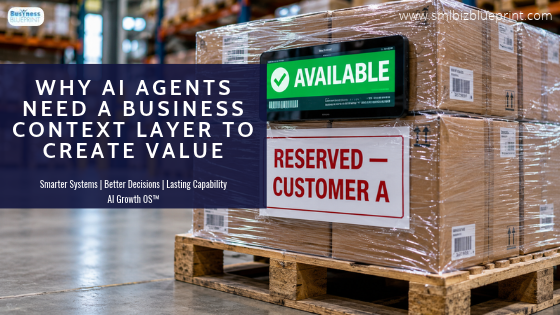
A customer record may show preferential pricing without explaining the conditions under which that preference should be suspended. An inventory system may show available stock without reflecting an informal commitment to another customer.
A policy may define approval limits without explaining how to handle competing priorities.
Adding more information does not necessarily resolve these conflicts.
The missing element is often the relationship between operational facts, commercial priorities and permissible actions.
Business context becomes infrastructure when it must support repeatable execution rather than occasional human interpretation.
An AI business context layer makes those relationships accessible and usable when decisions are executed.
It establishes which information matters, which rules apply, what authority exists and when a decision must return to a person.
This changes the economics of automation.
AI can potentially execute certain decisions at a lower marginal cost than repeated human intervention. But realising that advantage may require the business to formalise judgment that previously existed only through experience.
That work has a cost.
Rules must be defined. Conflicting practices must be resolved. Decision boundaries need ownership. Operating information must remain current. Exceptions require a reliable response.
Some decisions will justify that investment. Others will not.
There is also a less visible consequence.
When AI accelerates one decision process, it can increase pressure elsewhere. Faster quotation approvals may generate more orders than fulfilment can handle. Automated scheduling may improve utilisation while reducing flexibility for higher-margin work.
Local efficiency can improve while overall business performance deteriorates.
AI changes the cost of executing decisions. It does not eliminate the economic consequences of those decisions.
For an established business, the opportunity is therefore not maximum automation.
It is to identify where decisions consume scarce judgment, determine which can be executed reliably within defined boundaries and establish whether the resulting change improves commercial performance.
The business context layer is not necessarily another software platform. It is the operating capability that connects information, commercial intent, decision authority and execution.
Without that capability, AI may reproduce existing dependencies or accelerate mistakes.
With it, some decisions can proceed without requiring experienced people to interpret the same conditions repeatedly.
The distinction matters because the objective is not to remove judgment from the business.
It is to reserve judgment for decisions where it materially improves outcomes.

What Changes When AI Moves From Advising to Acting
Traditional business automation follows predefined instructions. When an invoice is approved, a system schedules payment. When inventory reaches a threshold, it generates a replenishment alert.
The conditions and actions have already been specified.
AI agents introduce a different capability. They can interpret requests, retrieve information from multiple sources, evaluate conditions, and initiate actions without programming every variation individually.
An agent might assess a customer’s request for earlier delivery, examine stock and transport capacity, identify alternatives and execute an authorised change.
Previously, an employee often had to connect those pieces of information and determine the response.
The shift is from automating predefined steps to automating bounded decisions.
That distinction matters because decisions involve consequences beyond the immediate task.
An expedited order may be technically feasible but commercially undesirable. Available inventory may already support a more valuable commitment. Spare transport capacity may exist only because another delivery is at risk.
An AI agent can correctly evaluate the information available to it and still reach the wrong commercial conclusion.
This creates a different design requirement.
The business must define not only what an agent can do, but the conditions under which doing it is acceptable.
Those conditions may involve contribution margin, customer obligations, capacity, financial exposure and the consequences for other operations.
The system must also recognise when available information is insufficient.
An agent that cannot establish whether a decision is authorised should not treat uncertainty as permission.
For business owners, the practical implication is significant.
AI can reduce the need for people to handle routine decisions, but it can also remove the human interpretation that previously prevented unsuitable actions.
The opportunity and the risk come from the same capability.
You may recognise this in customer service, quoting, scheduling, or purchasing processes, where employees routinely make small adjustments based on circumstances formal systems don’t capture.
Those adjustments are part of how the business operates.
Before AI can execute them reliably, the business must establish which judgments can become explicit operating rules and which still require human involvement.
Otherwise, faster execution simply speeds up incomplete decisions reaching customers and operational systems.
I thought the difficult part would be getting an AI agent to access the right systems.
The first tests looked promising, until a perfectly reasonable delivery decision conflicted with a customer commitment that existed only in someone’s memory.
The information was accurate; our understanding of what constituted a correct decision was incomplete.
That changed how I approached automation: before asking what the agent could execute, I needed to establish what the business would authorise.
Which Business Decisions Become Worth Automating—and Why
Not every decision that consumes time deserves automation.
The strongest opportunities arise where repeated decisions depend on accessible information, follow sufficiently stable commercial boundaries, and create meaningful costs when delayed.
Consider a business processing hundreds of customer orders each week.
Most orders follow standard conditions. Others require approval for discounts, substitutions, delivery changes or credit exceptions.
Managers repeatedly resolve similar requests because employees lack sufficient authority or the relevant conditions are not clearly established.
The business experiences this as an approval bottleneck.
The underlying constraint is more precise: decisions that could potentially be resolved using known information are consuming scarce management judgment.
The economic opportunity is to increase reliable decision throughput without proportionally increasing management involvement.
But not every recurring decision requires AI.
Some decisions follow fixed conditions and can already be handled economically through conventional automation. Others require interpreting variable requests, combining information across systems and applying commercial rules to circumstances that cannot be exhaustively predefined. AI changes what is economically possible for this second category.
A third category involves genuinely discretionary judgment, where uncertainty, commercial consequences or competing priorities make human involvement worth its cost.
The opportunity created by AI sits between decisions that conventional systems can already execute and decisions where human judgment remains economically justified.
That distinction prevents businesses from treating every manual process as an AI opportunity.
Throughput only matters when it changes a commercial outcome.
Saving a manager ten minutes does not automatically create ten minutes of financial value. If the freed capacity produces no measurable improvement, the saving remains operational, not financial.
The economics change when faster decisions let you process additional profitable orders, prevent avoidable customer losses, or reduce the need for additional management capacity.
This requires examining decisions differently.
Frequency matters, but so do delay costs, error consequences, information requirements and the value of human discretion.
The useful opportunities are those where AI changes the economics of a genuine business constraint.
Look at recurring approval queues, unresolved exceptions and management meetings where familiar operational questions keep returning.
Ask what happens while those decisions wait.
Orders may remain unprocessed. Customers may receive slower responses. Employees may stop work until authority becomes available.
But an approval queue alone doesn’t create an AI opportunity. It may indicate poor delegation, unclear policies, inadequate systems or decisions that genuinely require management judgment.
The commercial opportunity emerges when the business can establish that a decision is sufficiently repeatable, its context can be made reliable and removing the delay will improve performance.
Every repeated approval that adds no meaningful judgment preserves a dependency the business may no longer need.

Why Accurate Data Alone Cannot Support Reliable AI Decisions
Most AI-readiness advice begins with data quality.
That advice is correct, but incomplete.
Incorrect stock records, outdated prices and duplicated customer information can undermine automated decisions. Reliable information is essential.
However, accurate data establishes what is true. It does not necessarily establish what the business should do.
Consider a salesperson preparing a quotation.
The CRM contains purchasing history. The ERP contains product costs and inventory. The pricing system contains approved discount bands.
All three systems may be accurate.
Yet the salesperson knows that the customer is negotiating a broader agreement. Operations knows that capacity is constrained. Management knows that preserving the relationship matters, but not at the expense of consistently unprofitable work.
Those considerations shape the decision.
Some may exist in documents. Others may be understood through experience or recent conversations.
Business data describes conditions. Business context explains how those conditions should influence action.
Connecting AI to existing systems does not automatically make that context available.
Adding more documents doesn’t necessarily solve the problem.
Additional information can introduce conflicting policies, outdated exceptions and uncertainty about which source takes precedence.
The challenge is establishing which information governs a decision, how current it must be and what happens when sources disagree.
This often exposes inconsistencies that experienced employees have learned to manage informally.
Different departments may apply different versions of the same rule. Managers may approve exceptions without recording the commercial reasoning. Account managers may understand customer commitments, but operational systems may not.
A manager may be the only person who knows why a policy is regularly overridden. The written rule looks complete until someone tries to apply it without that manager’s involvement.
Automating the policy doesn’t close the knowledge gap. It removes the person who was compensating for it.
These practices can function while people remain responsible for interpretation.
They become less dependable when AI executes decisions without that interpretation.
AI doesn’t just automate decisions. It exposes how much of your business still depends on judgment your systems cannot see.
If employees must telephone a manager to interpret information already available across several systems, giving AI access to those systems may not remove the dependency.
It may simply reproduce the uncertainty through automated execution.
What a Business Context Layer Must Make Explicit
A business context layer for AI connects operational information with the commercial logic governing its use.
It is not necessarily a separate technology platform.
The required capability may involve existing systems, structured policies, controlled access to current information and explicit decision authority.
What matters is whether AI can determine which action is acceptable given the conditions at the time of the decision.
A business context layer connects operational facts to commercial intent and decision authority.
Consider a customer requesting priority delivery.
The inventory system confirms stock availability. Transport scheduling shows capacity. Finance confirms the order’s contribution margin.
Those facts support the decision, but may not settle it.
The business must also establish whether another customer has priority, whether the additional delivery cost is acceptable and whether approving the request would breach an existing commitment.
Reliable execution requires these relationships to be available.
The context must identify relevant facts, applicable rules, commercial priorities and the limits of authorised action.
It must also establish ownership.
Someone must remain accountable for maintaining the conditions under which AI operates.
This introduces a frequently overlooked problem: business context changes at different speeds.
Inventory availability may change continuously. Customer agreements may remain stable for months. Commercial priorities may change after a management decision.
A context layer that treats all information as equally current can produce decisions based on conditions that no longer apply.
Context is not reliable merely because it has been documented. It must remain valid at the moment of decision.
This changes the nature of the infrastructure requirement.
Documenting business knowledge is a one-time activity until something changes. Maintaining executable business context is an ongoing operating responsibility. Changes to policies, customer commitments, capacity or commercial priorities must reach the decisions they govern before AI acts on outdated assumptions.
An AI agent can continue functioning exactly as designed while its decisions become progressively less appropriate for the business.
The failure may not appear as a technical error. It may emerge as margin erosion, inconsistent customer treatment or commitments made under conditions that no longer apply.
This creates a practical limit to automation.
Making every possible exception explicit may be expensive and unnecessary. Some situations will remain too uncertain or commercially sensitive for autonomous execution.
The difficulty is that some of the judgment worth preserving is precisely the judgment that cannot be economically formalised.
A business may understand its decision process well enough to run it successfully without justifying the cost of making every condition AI-executable.
The right design makes enough context available for a defined decision category and escalates when that context is incomplete.
For an established business, the question is not how much information can be connected.
It is how much operating logic must become explicit, who will maintain its validity and whether the decisions it enables justify that continuing responsibility.
Without that distinction, the business risks investing in increasingly complex infrastructure without establishing what commercial capability the investment actually enables.

How to Design Decision Authority, Exceptions and Operational Controls
Access to business information does not confer authority to act.
An AI agent may be technically capable of changing prices, approving orders or altering delivery schedules. That does not mean the business should permit it to execute those actions without conditions.
The correct starting point is the commercial decision, not the technology.
Design decision authority around consequences, not technical capability.
Suppose AI can approve customer discounts.
The business might authorise discounts within a defined range when contribution margin remains above an agreed threshold, and the order meets standard fulfilment conditions.
Requests outside those boundaries require review.
But the design must also address uncertainty.
What happens when cost information is outdated? When customer terms conflict with standard policy? When an apparently acceptable discount becomes unprofitable after delivery costs?
The system needs clear conditions for execution, escalation and refusal.
These are not technical details added after implementation. They determine whether autonomous execution is commercially acceptable.
The same applies to reversibility.
An incorrect internal recommendation may be easily corrected. An unauthorised customer commitment can create consequences that are difficult to reverse.
The level of autonomy should reflect that difference.
A reliable design also distinguishes genuine exceptions from recurring evidence that existing rules are inadequate.
If managers repeatedly override the same policy, automating the policy may preserve a flawed process.
Sometimes the manager is overriding the policy because the policy is wrong. Sometimes the exception is commercially justified. And sometimes the manager is simply applying a preference nobody has challenged.
Those are three different problems. Automating the existing behaviour will not distinguish between them.
The business may need to examine why decisions are being made before deciding which parts of that judgment should become executable rules.
The purpose is not to remove human judgment. It is to stop consuming judgment where it adds little value.
This changes the owner’s role.
Instead of repeatedly resolving familiar exceptions, management establishes the boundaries within which those decisions can proceed.
Human attention remains available for unusual circumstances, conflicting priorities and decisions with material consequences.
The business becomes less dependent on individual availability without surrendering control.
That is a structural improvement, not simply a faster approval process.
The owner of a $14 million distribution business is still approving routine customer exceptions between supplier calls and operations meetings.
Rather than immediately automating every approval, the business defines which requests can be resolved using current stock, margin thresholds and existing customer commitments.
Routine cases become eligible for controlled execution, while unusual requests continue to reach management.
The owner begins to see a different possibility: a business where experience shapes the rules instead of being required to repeat every decision.
When Building the Context Layer Is Worth the Cost—and When It Isn’t
A business context layer creates value only when the improvement it enables exceeds the cost of building and maintaining it.
This is where conventional automation business cases often become misleading.
They estimate time saved, multiply it by an hourly labour cost and present the result as financial benefit.
But released time is not automatically recovered expenditure.
Suppose a business processes 1,000 orders monthly. Twenty percent require management intervention, averaging ten minutes each.
That represents approximately 33 hours of management attention.
If AI reliably resolves half those cases, it could free up about 17 hours each month.
Useful, certainly.
But the financial value depends on what happens next.
Does the business process additional profitable orders? Avoid another management hire? Improve customer retention? Or does the freed-up time get absorbed into other activities?
The economic value of AI depends on what the business can do differently after the decision process changes.
The cost calculation must be equally complete.
Implementation may require integration, documentation, testing, training and operating changes.
But one of the highest costs may never appear in the technology budget.
The people whose judgment AI could reduce dependence on are often the same people required to make that judgment explicit.
They already manage customers, resolve exceptions, and keep operations moving. Extracting their decision logic competes with the work the business needs them to perform today.
The business may need to consume scarce management capacity now to reduce its dependence on that capacity later.
That disruption belongs in the investment case.
Continuing costs include maintaining decision rules, monitoring performance, handling exceptions and correcting errors.
These obligations matter because the context governing decisions will change as the business changes.
A process with frequent decisions and stable rules may justify substantial investment.
A process dominated by unusual circumstances, shifting priorities and expensive exceptions may not.
A simpler alternative also deserves consideration.
Could clearer delegation remove the approval bottleneck? Would a conventional workflow solve the problem? Could employees act reliably if the right information were available at the point of decision?
If these changes deliver the same outcome at lower cost and risk, AI is not the stronger choice.
The decision is not between using AI and doing nothing. It is between alternative operating designs capable of removing the same business constraint.
A recurring approval problem may require clearer authority. A predictable transaction may require conventional automation. A variable, context-dependent decision may justify AI if the required operating logic can be made reliable at an acceptable cost.
This distinction matters because AI can make a previously uneconomic decision process viable, but the infrastructure required to support it can also eliminate that advantage.
There is no strategic benefit in reducing the cost of individual decisions while introducing greater costs through maintenance, oversight or downstream disruption.
The investment decision must therefore compare the expected commercial improvement with the full cost of the changed operating state.
If the business case relies entirely on theoretical time savings, the financial justification remains incomplete.
How to Measure Whether AI-Driven Decisions Improve Business Performance
An AI agent can execute more decisions, respond faster and reduce manual approvals without improving financial performance.
Activity is not value.
Consider a business reducing quotation turnaround from eight hours to twenty minutes.
The operational improvement is clear.
But the commercial outcome remains uncertain.
Did faster responses increase conversion? Were the additional orders profitable? Did fulfilment absorb the extra demand without increasing delays or costs?
Perhaps faster quoting generated more orders, but at the cost of increased discounting or overwhelmed production capacity.
The approval queue may disappear from the sales manager’s inbox and reappear as rework in operations.
The automation report will still show an improvement.
AI performance must be measured at the level of the business outcome, not simply the automated activity.
This requires defining the expected changed state before implementation.
For quotation automation, the objective might be to reduce routine approvals while protecting contribution margin and increasing profitable order conversion.
That establishes both the desired improvement and the conditions that must remain intact.
Measurement must then connect decision performance to operational and commercial results.
Decision measures include speed, accuracy, escalation rates and compliance with authorised boundaries.
Operational measures include throughput, rework, service reliability and the effect on downstream capacity.
Commercial measures include contribution margin, incremental profitable revenue, avoided expenditure and other financial outcomes relevant to the investment.
These measures cannot be evaluated independently.
Faster decisions matter when they improve an operating constraint. Reduced management involvement matters when released capacity produces a useful result. Additional revenue matters when the associated contribution exceeds the costs required to generate it.
Where possible, compare results with a suitable baseline or phased implementation to distinguish the effect of AI from changes in demand, staffing or pricing.
Include implementation, maintenance, oversight and correction costs.
Continue measuring after launch.
Decision context can become outdated, and an improvement in one function may shift the constraint elsewhere.
The strongest evidence of AI value is not that people intervene less. It is that the business performs better because they no longer need to intervene in the same way.
If the only evidence is a dashboard showing completed AI actions, the business still does not know whether the investment paid for itself.
A Practical Starting Point
Find one recent customer, pricing or operational decision that required someone to interpret circumstances beyond the information recorded in your business systems.
Identify what that person knew, why it influenced the outcome and what would have happened if the decision had been executed using only the documented information and rules.
Then establish whether that missing context can be made reliable and whether doing so would remove a commercially meaningful constraint.
You may discover that the issue is unclear authority, incomplete information, an outdated policy or judgment that genuinely needs to remain human.
Each finding points towards a different operating decision.
Identifying context that AI cannot currently access does not establish a reason to automate. It shows what the business needs to evaluate before deciding whether automation is worthwhile.
Imagine a business celebrating an AI agent that has cut quotation turnaround from eight hours to twenty minutes.
Sales activity rises, but the operations meeting becomes increasingly uncomfortable as urgent orders displace more profitable work and delivery commitments become harder to meet.
The agent is performing exactly as designed; the business has optimised the wrong boundary.
The shift comes when management stops measuring how quickly AI makes decisions and starts measuring what those decisions do to the entire operating system.
Conclusion
The pressure to adopt AI can make the technology seem like the starting point.
It isn’t.
Established businesses already contain substantial operating knowledge, commercial judgment and established decision practices.
Much of that knowledge allows the organisation to function despite gaps between systems, policies and daily reality.
AI changes the consequences of those gaps.
When technology begins executing decisions, the business can no longer assume that experienced people will silently supply missing context at every step.
That creates both an opportunity and a responsibility.
Some decisions can now be executed more economically, with less delay and less routine management involvement.
But the business must establish the context, authority and controls required to make that execution reliable.
The investment is worthwhile only when the resulting improvement exceeds the cost of designing and maintaining the changed operating state.
That may mean building new capabilities. It may mean improving existing systems, clarifying decision rights or redesigning workflows.
Sometimes it will mean deciding not to use AI.
The objective is not maximum automation. It is a business where routine decisions proceed reliably, important exceptions receive appropriate judgment, and operating improvements translate into measurable commercial value.
Start with one decision process that repeatedly creates delays, escalations or avoidable costs.
Determine what constrains it today, what AI makes possible, and what must change before that possibility becomes commercially useful.
You can keep letting familiar decisions consume scarce management attention, or design an operating system that no longer depends on that attention at every step.
AI creates the possibility of a different business. The value comes from how deliberately you design it.
Action Steps
Identify decisions consuming management judgment
Examine recurring approvals, exception queues and decisions that delay orders, customer responses or operational progress. Distinguish genuinely discretionary decisions from those repeatedly resolved using established conditions. This determines whether the opportunity is to automate a decision, improve employee authority or redesign the process before introducing AI.
Establish the commercial outcome before defining the automation
Specify which operating constraint the decision process currently creates and what measurable improvement would justify changing it. Distinguish released employee time from financial value, including additional profitable throughput, avoided costs or improved customer outcomes. This determines whether the opportunity deserves investment rather than merely being technically achievable.
Map the context required for reliable execution
Identify the operational facts, commercial rules, customer commitments and decision boundaries that govern the selected decision. Establish where each originates, who owns it and how current it must be. This reveals whether existing systems contain sufficient context or whether undocumented judgment makes autonomous execution unreliable.
Define the changed decision state
Specify which decisions AI may execute, which require approval and which must stop when information is missing or contradictory. Establish acceptable error exposure and responsibility for exceptions. This determines the appropriate level of autonomy and prevents technical capability from becoming uncontrolled commercial authority.
Test the decision system against operational reality
Evaluate proposed AI decisions against representative historical cases, difficult exceptions and changing business conditions. Examine consequences for customers, margin, fulfilment and downstream capacity, not merely whether the decision matches an expected answer. This determines whether the operating design is ready for controlled implementation or requires further refinement.
Measure realised value and continuing context costs
Compare decision performance, operational outcomes and financial results against the pre-implementation baseline. Include integration, maintenance, oversight, corrections and downstream effects in the calculation. This determines whether to expand the capability, redesign its boundaries or discontinue an initiative that improves activity without improving business performance.
FAQs
A business context layer for AI makes the information, commercial rules, relationships and decision authority governing business actions accessible to AI systems. It allows an AI agent to determine not only what the business knows, but which actions are permissible under current operating conditions. Begin by identifying one decision process and establishing what context must be available before the agent can act reliably.
Why do AI agents need business context if they already have access to accurate data?
Accurate data establishes facts, but it does not necessarily explain commercial priorities, contractual exceptions or how conflicting conditions should be resolved. An AI agent can correctly retrieve inventory, pricing and customer information while still making an unacceptable decision. Examine where employees currently interpret or override system information before assuming connected data is sufficient for automation.
How is a business context layer different from a CRM, ERP or knowledge base?
A CRM records customer information, an ERP manages operational transactions and a knowledge base stores reference material; none necessarily establishes the complete authority governing a decision across those systems. A business context layer connects relevant information with the rules and conditions required for authorised execution. Determine whether existing systems can provide this capability before investing in additional infrastructure.
Which business decisions should be automated using AI agents?
Decisions are stronger candidates when they occur frequently, consume substantial human attention, depend on accessible context and can be executed within defined risk boundaries. High volume alone does not justify automation if the decision is inexpensive, unpredictable or already manageable through simpler rules. Prioritise decisions where removing delays or unnecessary escalation changes a measurable business constraint.
How can a business prevent AI agents from making commercially damaging decisions?
Define the information required, the conditions permitting execution and the circumstances requiring escalation or refusal. Apply controls proportionate to the financial, contractual and operational consequences of each action, including whether mistakes can be reversed. Authorise live execution only after testing the decision process against representative cases and exceptions.
When is investing in a business context layer for AI financially worthwhile?
The investment is justified when improvements in profitable throughput, operating capacity, avoided expenditure or customer outcomes exceed implementation and continuing operating costs. The calculation must include maintaining business rules, monitoring decisions, handling exceptions and correcting errors. Compare the proposed AI design with simpler workflow or delegation changes before committing resources.
How do you measure whether AI-driven business decisions actually create value?
Measure the change in decision performance, the resulting operational improvement and its demonstrated financial consequence. Faster decisions or fewer approvals are insufficient evidence unless they contribute to outcomes such as improved contribution margin, profitable throughput or avoided costs. Establish a baseline before implementation and continue measuring after launch to detect shifting constraints and deteriorating decision quality.
Bonus Section – Three Uncomfortable Truths About AI and Business Context
The mistake is treating AI readiness as a question of whether your systems contain enough information. You can connect every database, document every procedure and still lack the operating logic needed for AI to make commercially acceptable decisions.
The deeper shift is recognising that AI changes the relationship between knowledge, authority and execution. Three implications deserve more attention.
Your most experienced people may be compensating for a system that cannot explain itself.
When employees repeatedly consult the same manager, the business often interprets that dependence as evidence of the manager’s value. Sometimes it is evidence that essential decision logic has never become part of the operating system.
AI exposes that dependence because it cannot reliably reproduce judgment that remains implicit.
Without change, experienced people remain the hidden infrastructure supporting routine decisions.
Making business context explicit may create more value than automating the decision.
When a business defines why exceptions occur, it can discover contradictory policies, unnecessary approvals or commercially outdated practices.
Resolving those weaknesses may improve performance before AI executes anything.
This changes the investment question. The objective is not necessarily to automate the existing process, but to determine which operating design produces the strongest commercial result.
Without change, AI may preserve inefficiencies that the business should have eliminated.
The most valuable AI agent may be the one authorised to do less.
Autonomy is not inherently valuable. An agent that reliably handles defined decisions while escalating genuine uncertainty can create more commercial value than one attempting to resolve every situation.
The limiting factor is often not intelligence, but the cost of incorrect execution.
The better ambition is controlled decision capacity, not maximum independence.
Without change, businesses risk increasing automation faster than their ability to govern its consequences.
The opportunity is to build a business where more decisions can proceed without unnecessary intervention, while the judgment that genuinely matters remains deliberate, visible and accountable.
Other Articles
How AI Turns Business Data Into Signals You Can Act On