

If you’ve ever looked at your marketing funnel and thought, “Where are we losing people?” — you’re not alone.
Most businesses are flying blind when it comes to understanding why leads drop off or where prospects stall.
With conversion rates averaging just 2–3% for most digital funnels, there’s a silent killer at work: funnel leakage.
And manual audits? Slow, inconsistent, and often inconclusive.
That’s where AI tools for marketing funnel audits come in.
AI doesn’t just analyse your data — it finds hidden patterns, reveals weak points, and offers actionable recommendations to optimise every stage of your funnel.
Whether you’re losing traffic at the awareness stage, seeing form abandonment during consideration, or struggling to close sales at the conversion point, AI-powered tools help you fix those problems fast, with precision and scale.
In this post, we’ll explore 5 of the best AI tools for small businesses looking to audit their marketing funnel.
Each tool is chosen for its specific strengths: understanding visitor behaviour, enriching leads, and closing the feedback loop between sales and marketing.
You’ll get an overview of each tool, key features, pros and cons, and most importantly, real-world use cases that show you how to apply them.
Let’s dive in and turn your marketing funnel into a well-oiled, AI-optimised growth machine.

#1 Clearbit – Enrich Your Funnel with Real-Time Intelligence
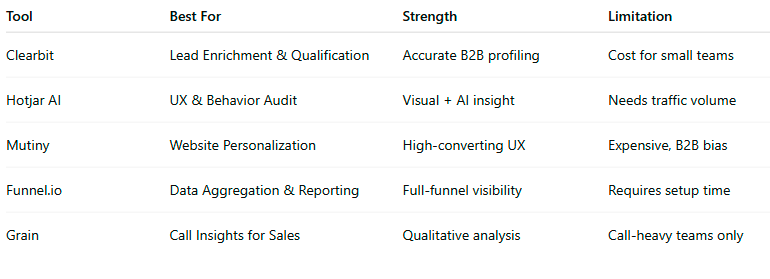
Clearbit is a powerful AI-powered data enrichment tool designed to help businesses better understand who’s entering their funnel.
When a visitor lands on your site or fills out a form, Clearbit taps into a massive database of company and contact details to give you a complete customer profile — in real time.
Key Features:
Visitor identification by company, role, and location
Automatic enrichment of CRM leads with verified data
Lead scoring based on firmographic fit and intent signals
Integration with tools like Salesforce, HubSpot, and Slack
Pros:
Removes the guesswork from lead qualification
Enhances segmentation for better targeting
Supports personalised outreach based on real buyer profiles
Cons:
Higher pricing can be a barrier for startups
Geared more toward B2B companies than B2C
Ideal Use Case:
Imagine your funnel has a solid lead volume, but poor conversion. With Clearbit, you can qualify leads faster, route them intelligently, and reduce the manual legwork. For example, instead of wasting time on low-fit leads, your team can focus on high-intent visitors from ideal companies — the ones more likely to convert and close.
If you’re leaking leads at the top or middle of the funnel, Clearbit helps you stop chasing ghosts and start converting real prospects.
Be the first to know!
Join our newsletter for cutting-edge strategies and tools tailored for ambitious business owners like you
#2 Hotjar AI – Understand Why Visitors Drop Off
Hotjar AI brings clarity to user behaviour with a suite of smart tools: heatmaps, session recordings, surveys, and AI-generated insights.
Where traditional analytics show what happened, Hotjar AI helps you understand why, without wading through endless data.
Key Features:
AI-powered summaries of session recordings
Heatmaps to identify attention drop-offs
On-site polls and feedback widgets
Conversion funnel visualisation
Pros:
Great for non-technical marketers
Saves time analysing user behaviour
Combines visual and voice-of-customer data
Cons:
Requires traffic volume to be effective
The free version lacks deeper segmentation
Ideal Use Case:
Hotjar AI is ideal for auditing pages where users bounce or fail to convert, such as product pages, lead forms, or checkout flows. For example, if users consistently abandon a quote form, the AI might surface friction points like slow-loading buttons or confusing copy. That insight can directly inform design tweaks or A/B tests that improve performance.
This tool excels at the interest and consideration stages of your funnel, helping you bridge the gap between attention and action with actionable behaviour insights.
#3 Mutiny – Personalise Your Funnel Experience in Real Time
Mutiny is a no-code website personalisation platform that uses AI to dynamically adapt your website to each visitor.
Unlike static landing pages, Mutiny empowers marketers to create hyper-relevant experiences based on industry, company size, traffic source, and behaviour — all without a developer.
Key Features:
No-code personalisation editor
AI-based audience segmentation
Playbooks with proven personalisation strategies
Performance tracking by segment
Pros:
Boosts conversion rates by tailoring content
Easy to use for marketers, no dev help needed
Proven to improve time-on-site and form fills
Cons:
Premium pricing model
Requires a strong base of customer data to segment well
Ideal Use Case:
You’re driving traffic from Google Ads, LinkedIn, and your newsletter, but conversion rates are flat. With Mutiny, you can tailor your homepage headline, CTA, and visuals based on where each visitor came from. B2B visitors from LinkedIn might see a case study relevant to their industry, while newsletter readers see a personalised offer based on past interest.
Mutiny is ideal for the bottom of the funnel, where personalised messaging can nudge prospects into action.

#4 Funnel.io – Connect, Consolidate, and Visualise Your Funnel Data
Funnel.io isn’t just another dashboard—it’s an AI-powered data integration and visualisation platform that centralises all your marketing data. From Google Ads to CRM data to e-commerce platforms, Funnel pulls everything into a single unified view so you can audit your funnel stages with clarity and speed.
Key Features:
500+ native data connectors (Google Ads, Meta, Shopify, HubSpot)
Automatic normalisation and cleaning of data
Custom dashboard creation
Real-time reporting alerts and AI recommendations
Pros:
Saves hours spent compiling reports manually
Highly customizable dashboards for each funnel stage
Powerful integrations for scaling businesses
Cons:
Requires a clear understanding of KPIs and funnel stages to set up well
Setup may take a few hours to fine-tune
Ideal Use Case:
If your data lives across spreadsheets, ad dashboards, and CRM exports, Funnel.io eliminates silos. For example, you can trace how LinkedIn ad impressions convert into webinar sign-ups, email opens, and eventually purchases across the full funnel.
This tool is powerful for full-funnel auditing, giving you the bird’s-eye view you need to prioritise changes and allocate budget more effectively.
#5 Grain – Unlock AI Insights from Sales Calls and Demos
Grain uses AI to extract insights from your Zoom or Google Meet calls — turning sales conversations into valuable feedback loops.
While most businesses record calls and forget them, Grain indexes everything by keyword, intent, and objection to help marketing and sales close the loop.
Key Features:
Auto-generated call summaries and timestamps
Tags for objections, features requested, or competitor mentions
CRM integration for seamless syncing
Team collaboration and sharing of highlight reels
Pros:
Great for aligning sales and marketing
Reduces onboarding time for new reps
Captures language and pain points in the customer’s voice
Cons:
Only valuable for teams that conduct frequent calls
Best used when combined with CRM and sales enablement workflows
Ideal Use Case:
Say you’re noticing a drop in proposal acceptance. Grain helps you identify recurring objections — like unclear pricing or missing case studies — across multiple calls. That data then feeds back into marketing: fixing website copy, building new assets, or reworking email sequences.
Grain shines in the bottom-of-funnel phase, helping you close the gap between lead and deal with customer-driven intelligence.
Don’t miss a beat in your business growth journey!
Join Pulse and stay ahead with expert tips and actionable advice every month.
Subscribe to Pulse Today
Conclusion:
Your marketing funnel isn’t leaking because you don’t care.
It’s leaking because you can’t see what’s broken.
That’s the shift AI tools deliver — from data overload to diagnostic clarity.
Instead of combing through spreadsheets, guessing which channel is underperforming, or running test after test with no clear result, these five AI-powered platforms allow you to audit your funnel in real-time.
From identifying qualified traffic with Clearbit, to tracking user behaviour through Hotjar AI, personalising experiences with Mutiny, consolidating performance data in Funnel.io, and extracting sales insights via Grain, each tool addresses a specific stage of the funnel — and fixes it with precision.
Whether you’re a solo founder or a growing team, adopting even one of these tools can eliminate blind spots, unlock bottlenecks, and help you convert more with less friction.
AI won’t replace smart strategy. But it will multiply your impact faster than human effort alone ever could.
Ready to Stop the Leaks?
If you’re serious about plugging funnel gaps and turning traffic into conversions, now’s the time to make AI part of your marketing stack.
FAQs
Q1: What are the best AI tools to audit a marketing funnel?
A1: Some of the top AI tools for auditing your marketing funnel include Clearbit (for lead enrichment), Hotjar AI (for user behaviour analysis), Mutiny (for website personalisation), Funnel.io (for performance data aggregation), and Grain (for call insight analysis). Each tool targets a different stage of the funnel for a comprehensive audit.
Q2: How does AI improve marketing funnel performance?
A2: AI improves funnel performance by identifying weak points, automating analysis, and providing actionable insights. It detects patterns humans miss, personalises user experiences, and enables faster decision-making, helping you convert more leads and reduce funnel drop-offs.
Q3: Can small businesses afford and benefit from these AI tools?
A3: Yes. Many AI tools offer flexible pricing tiers for startups and small businesses. Even using just one tool—like Hotjar AI or Clearbit—can uncover critical gaps in your funnel that lead to better ROI and conversion rates.
Q4: Which stage of the funnel should I audit first with AI?
A4: Start where you see the biggest drop-off:
Awareness issues? Use Clearbit.
Engagement or drop-offs? Use Hotjar AI.
Conversion problems? Try Grain or Mutiny.
Let performance data guide where to begin, then layer in tools as you grow.
Q5: Do I need a developer or technical skills to use these AI tools?
A5: Most tools featured here—like Mutiny and Funnel.io—offer no-code or low-code interfaces. They’re built for marketers and business owners, not engineers, making it easy to set up and act on insights without technical barriers.
Q6: How can I measure ROI from using AI tools in my funnel?
A6: Track improvements in KPIs tied to each funnel stage, such as:
Increased qualified leads (Clearbit)
Lower bounce or form abandonment rates (Hotjar AI)
Higher on-site conversion rates (Mutiny)
Better lead attribution (Funnel.io)
Shorter sales cycles (Grain)
Compare performance before and after implementing each tool to determine the impact.
Q7: Can these tools integrate with my existing marketing platforms?
A7: Yes. Tools like Clearbit and Funnel.io offer integrations with CRMs (HubSpot, Salesforce), ad platforms (Google Ads, Meta), and email tools (Mailchimp, ConvertKit), ensuring smooth integration into your current tech stack.
Other Articles
How to Reset Your Business Systems in 30 Days Without Burning Out