
In today’s fast-paced business world, perception matters.
Customers are more likely to trust, buy from, and refer established, responsive, and well-resourced businesses.
But what if you’re a lean team or a solo operator?
That’s where AI steps in.
With the right tools, you can automate time-consuming tasks, deliver polished content, provide instant support, and scale your impact—all while maintaining a small overhead.
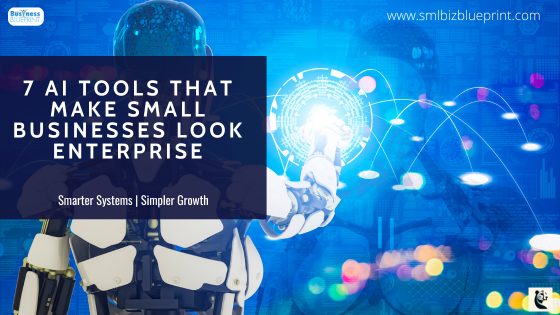
This article walks you through 7 AI tools that help you appear larger, more capable, and more professional than you are, without faking it. These tools don’t just create the illusion of scale—they give you the systems to back it up.

Tool 1: Jasper AI – Content Creation at Scale
Overview:
Jasper is an AI-powered writing assistant designed for marketing, blog content, ad copy, emails, and social media. It helps you generate polished, branded content in minutes.
Key Features:
Templates for blog posts, ads, product descriptions, and emails
Brand voice training for consistent messaging
Long-form content generation with SEO optimisation
Collaboration features for teams
Pros:
✅ Speeds up content production
✅ Maintains consistent voice and tone
✅ Great for SEO blogs, landing pages, and lead magnets
Cons:
❌ Can feel formulaic without customisation
❌ Higher pricing tiers for team features
Ideal Use Cases:
Solopreneurs or small teams who need weekly content
Agencies that deliver marketing copy for clients
E-commerce stores producing product descriptions at scale
Tool 2: Tidio – Live Chat + AI Chatbot for 24/7 Support
Overview:
Tidio combines live chat and AI chatbot capabilities to ensure your website visitors get immediate help, even when you’re offline.
Key Features:
AI chatbot trained on FAQs
Integration with email and Messenger
Drag-and-drop chatbot builder
Live visitor tracking and proactive messages
Pros:
✅ Makes your business look available 24/7
✅ Captures leads even when you’re not online
✅ Improves customer satisfaction and response time
Cons:
❌ Requires initial setup to train bot
❌ AI quality depends on input quality
Ideal Use Cases:
Service providers needing to qualify leads before a human response
E-commerce sites reducing cart abandonment
Coaches or consultants capturing inbound questions
Stay ahead of the curve!
Subscribe to our newsletter and never miss the latest in business growth and marketing strategies
Tool 3: Descript – Video + Audio Editing Like a Studio
Overview:
Descript is a multimedia editing platform powered by AI. It allows you to edit video and audio like a text document—no experience required.
Key Features:
Overdub (AI voice cloning)
Automatic transcription
Podcast editing tools
Screen recording and video publishing
Pros:
✅ Makes you look like a polished content studio
✅ Easy edits, repurposing, and captioning
✅ Great for YouTube, Reels, Podcasts
Cons:
❌ Not ideal for advanced video effects
❌ Requires good mic input for quality overdub
Ideal Use Cases:
Content creators looking to batch videos
Course creators producing lessons
Small agencies offering content services
Tool 4: Durable – Build a Website in 30 Seconds
Overview:
Durable uses AI to instantly generate a branded, professional website with copy, layout, and images—all from a few basic prompts.
Key Features:
Instant site builder
AI-written headlines and sections
Built-in CRM and contact forms
Industry-specific templates
Pros:
✅ Makes you look instantly legit
✅ Useful for launching MVPs or landing pages
✅ No coding, no delays
Cons:
❌ Limited design control for advanced users
❌ Needs ongoing edits for SEO and UX polish
Ideal Use Cases:
New businesses needing a fast web presence
Side hustlers testing new offers
Local service businesses

Tool 5: Ocoya – Social Media Scheduler with AI Copywriting
Overview:
Ocoya combines scheduling, content creation, and analytics, letting you manage social media like a full team would.
Key Features:
AI copywriting for captions
Hashtag generation
Post scheduling across platforms
Basic analytics dashboard
Pros:
✅ Saves hours each week
✅ Keeps your brand active daily
✅ Works across Facebook, LinkedIn, Instagram, Twitter
Cons:
❌ Not ideal for teams with complex approval workflows
❌ Lacks deep analytics compared to platforms like Sprout Social
Ideal Use Cases:
Founders managing their brand voice
E-commerce stores posting daily
Coaches building visibility through content
Tool 6: Browse AI – Turn Any Website into a Data Source
Overview:
Browse AI lets you automate web scraping without code. Set up “robots” to monitor competitors, extract product listings, or track reviews, and then feed the data into Sheets or CRMs.
Key Features:
Monitor price changes, product listings, and leads
Integrates with Zapier
Visual UI for training robots
Export to Google Sheets or Airtable
Pros:
✅ Makes you feel like you have a research team
✅ Competitive intelligence without grunt work
✅ Smart workflows for niche insights
Cons:
❌ Limited runs on free/low tiers
❌ Some complex sites block scraping
Ideal Use Cases:
Agencies tracking client competitors
SaaS teams monitoring pricing pages
E-commerce tracking Amazon, Etsy, or competitors
Hungry for more insights?
Subscribe to Pulse and get cutting-edge marketing and business strategies delivered right to your inbox!”
Subscribe to Pulse Now
Tool 7: Otter.ai – Turn Every Meeting Into a Transcripted Asset
Overview:
Otter records and transcribes meetings or voice notes in real time—making it easy to look organized and responsive.
Key Features:
Real-time transcription
Speaker identification
Summary generation
Integration with Zoom, Google Meet
Pros:
✅ Instantly professional follow-ups
✅ Saves time on notes and documentation
✅ Makes remote teams more effective
Cons:
❌ Transcription errors in noisy environments
❌ Premium features locked behind paywall
Ideal Use Cases:
Solopreneurs documenting client calls
Coaches turning sessions into notes
Agencies managing multiple clients
When to Choose What: Quick Comparison

Conclusion
The line between a 2-person startup and a 20-person company is blurrier than ever.
With the right AI tools, you can:
- Build trust by looking established
- Deliver results faster
- Stay consistent and visible
- Scale without stress
If you want your small business to look and operate like a larger, more powerful operation—without inflating your overhead—start integrating these tools now.
FAQs
Q1: What are the best AI tools for small businesses to look more professional?
A1: Some of the most effective tools include Jasper for content creation, Tidio for 24/7 customer support, Descript for polished video and podcast editing, and Durable for building a clean, fast-loading website instantly.
Q2: How can AI help a small business appear larger than it is?
A2: AI tools automate and enhance tasks that usually require teams—such as writing content, handling customer service, scheduling posts, and managing data. This creates a consistent, high-output presence that mirrors the systems of larger companies.
Q3: Are these AI tools affordable for solo entrepreneurs or startups?
A3: Yes. Most tools offer free trials or entry-level plans. For example, Tidio, Otter.ai, and Ocoya have generous free tiers. As your business grows, upgrading unlocks advanced features without requiring additional hires.
Q4: Can I use these tools even if I’m not tech-savvy?
A4: Absolutely. All tools featured are built with non-technical users in mind. Platforms like Durable and Descript use drag-and-drop editors, while Jasper and Ocoya use intuitive prompt systems that guide you step-by-step.
Q5: What’s the first AI tool I should start with?
A5: Start with the tool that removes your biggest bottleneck. If you’re struggling with content, try Jasper. If you’re missing leads due to lack of responsiveness, set up Tidio. If your website doesn’t exist or looks outdated, go with Durable.
Q6: How do these tools help with lead generation and customer conversion?
A6: Tools like Tidio and Ocoya improve lead capture through automation and consistent touchpoints. Browse AI helps track competitors or collect leads, while Descript helps you produce high-conversion video content that builds trust and authority.
Q7: Do I need to integrate all 7 tools to see results?
A7: No. Even using 2–3 strategically can dramatically improve your perceived scale. Focus on where you lack capacity—whether that’s content, customer response, or visibility—and build from there. Start lean, expand with purpose.
Other Articles
From Chaos to Control: How To Automate Your Small Biz Workflows