
Build a sales system that turns faster research, qualification and follow-up into better decisions and growth.
AI can make sales research, qualification, personalisation and follow-up dramatically faster, but faster activity does not automatically create growth.
To redesign sales processes with AI without adding complexity, businesses need to look beneath pipeline stages and redesign the decisions, boundaries and feedback loops that actually move opportunities forward.
The goal is not to automate every sales task, but to build a growth system where routine decisions move within clear boundaries, human judgement focuses on consequential exceptions, and customer outcomes continuously improve future marketing and sales decisions.
The structural weakness in many AI-enabled sales systems is straightforward: execution capacity is increasing faster than the business’s capacity to absorb, direct and convert it.
Research becomes faster. More prospects can be analysed. Personalisation becomes economical at greater scale. Follow-up becomes more consistent. Proposals can be assembled sooner. Customer conversations can be analysed almost immediately.
Each improvement looks productive on its own.
The tension appears downstream. More researched prospects require prioritisation. More qualified leads create additional sales choices. Faster proposals reach pricing and approval decisions sooner. More customer signals create more information to interpret.
The business has increased what the sales system can produce without necessarily changing how the system decides what should happen next.
This is why AI can create complexity even when individual implementations work exactly as intended.
Most teams misdiagnose this as an automation problem. They look for more activities to automate, more handoffs to remove or more productivity improvements that allow employees to process greater volumes. That diagnosis assumes execution remains the principal constraint.
Increasingly, it does not.
A sales pipeline is a decision architecture disguised as a sequence of activities.
Pipeline stages describe where an opportunity appears to be. Decisions determine whether it moves. A lead becomes qualified because the business decides it deserves attention. A proposal progresses because commercial conditions are accepted. A discount is offered because someone determines the economics remain acceptable. An opportunity is escalated because its potential value justifies additional judgement.
Once AI increases execution capacity, these underlying decisions become more visible.
The design problem therefore changes. The business needs to determine which decisions are repeatable enough to operate within boundaries, which can be supported by AI, which require escalation and where human judgement genuinely changes the economic or customer outcome.
Without that redesign, management often becomes the hidden throughput constraint.
The financial consequence extends beyond wasted AI investment. Valuable leads wait while low-value opportunities consume attention. Salespeople seek approval for decisions the business has effectively made dozens of times before. Marketing increases lead volume without improving revenue quality. Faster proposal creation simply produces a larger approval queue.
Local productivity improves while system economics remain largely unchanged.
There is another structural weakness. Marketing, sales and customer outcomes often remain separate information environments. Marketing learns which messages generate response. Sales learns which prospects convert. Customer teams learn which expectations create problems. Management sees the eventual margin and commercial outcome.
If those outcomes do not change future decisions, the system may be technically integrated without being operationally connected.
A growth system is connected when an outcome in one part of the business changes a future decision somewhere else.
That is the deeper opportunity. AI can do more than accelerate existing work. It can help a business apply accumulated knowledge repeatedly: qualification improves from previous losses, messaging improves from objections, commercial boundaries improve from approved exceptions, and future decisions become better because the system retains what the business has learned.
Ignoring this shift leaves an uncomfortable outcome: more AI capability to supervise, more activity to process and potentially little improvement in the economics of growth.
The redesign therefore begins below the visible workflow—with the decisions controlling movement, the boundaries determining when work can proceed, the exceptions deserving human attention and the feedback loops allowing outcomes to improve what happens next.
AI leverage is not created by making every part of the sales process faster. It is created when greater intelligence changes how the whole growth system moves, decides and learns.
Why Adding AI to Your Sales Process Can Increase Complexity
AI does not automatically simplify a sales process. It increases the capacity of whatever system you give it.
The conventional approach is additive. Keep the existing CRM, qualification process, handoffs and approval rules. Then add AI research, lead scoring, follow-up, meeting summaries and proposal generation.
Every addition makes sense individually. The problem appears when faster upstream activity reaches downstream decisions that have not changed.
Imagine a company receiving 200 enquiries each month. AI makes it practical to analyse all 200, enrich their data and identify buying signals that previously went unnoticed. Instead of 25 prospects appearing worthy of attention, there are now 70.
Who determines which ones sales pursues? What happens when the AI score and salesperson disagree? Which offers can change? Which discounts require approval? When does a stalled opportunity deserve intervention?
AI did not create those decisions.
It increased the frequency at which the business must make them.
In practice, those decisions rarely sit neatly inside the process map. Sales knows unusual pricing goes to the sales manager. The sales manager sometimes checks with the owner. A large opportunity gets treated differently because everyone knows it matters.
None of this may be documented, but the business has learned how to work around it.
That informal decision system can function surprisingly well when volume is manageable. AI changes the pressure placed on it.
This is the hidden assumption behind much AI automation advice: that the task being accelerated is also the constraint. Sometimes it is.
But once that task becomes faster, the constraint may immediately move to prioritisation, approval, coordination or exception handling.
You can automate follow-up and still have poor qualification. Generate proposals in minutes and still wait two days for approval. Produce more leads while sales continues rejecting them.
Every increase in execution capacity creates downstream demand for decision, coordination and exception-handling capacity. If those capacities remain unchanged, AI does not remove the bottleneck—it delivers more work to it.
That distinction matters because a successful AI implementation can still produce a disappointing business result. The technology may be working perfectly while the surrounding growth system becomes harder to manage.
Observable behaviour: Your team produces more AI-assisted sales activity, yet opportunities still stall at familiar handoffs and approvals.
Business consequence: You pay for greater production capacity while preserving the constraints that prevented the old system from moving faster.
The first sign of AI complexity is therefore not necessarily a failed tool. It is more work arriving faster at the same unresolved decision point.
It is easy to mistake a slow activity for the problem because it is the part you can see. Imagine spending weeks improving proposal production, then watching polished proposals appear in minutes—only to discover they still sit waiting for the same commercial approval as before.
The work got faster; the customer didn’t.
The lesson is uncomfortable but useful: improving the visible task means little if you haven’t identified what actually controls movement.
AI Changes What Your Sales System Can Produce
The deeper change AI brings to sales is not automation. It changes the economics of intelligence: work that once required hours of human attention can now be applied across far more prospects, conversations and decisions.
Research once required someone’s time. Personalisation required attention. Sales-call analysis meant listening to calls. Proposals required knowledge to be gathered and assembled. Comparing hundreds of customer interactions for patterns was often impractical.
Because those activities were expensive, businesses rationed them.
Salespeople researched their most promising accounts. Marketing used a manageable number of segments. Managers reviewed samples of calls. Follow-up became standardised because individualisation did not scale.
The old architecture was not badly designed.
It was a rational response to scarce human intelligence.
That point matters because it changes how we should think about redesign. The existing sales process was built around a real economic constraint: there was only so much human attention available, so businesses had to decide where to spend it.
AI changes that constraint.
It becomes practical to research every serious prospect, analyse every sales conversation, detect objections across hundreds of interactions, compare opportunities with historical wins and losses, personalise communication and recommend what should happen next.
The question is no longer simply: What can we now do faster?
It becomes: What would we design differently if intelligence no longer had to be rationed in the same way?
That does not mean applying AI everywhere.
Cheap intelligence can still be wasted intelligence.
The strategic task is to decide where additional intelligence changes an outcome enough to matter.
Perhaps every viable prospect can now receive meaningful research before the first conversation. Perhaps every lost opportunity can contribute to future qualification. Perhaps routine proposals no longer deserve the same level of manual inspection because the business can identify the conditions that actually require attention.
The point is not maximum AI usage.
It is recognising that processes created to conserve scarce human attention should not automatically survive once that scarcity changes.
You can still see the old assumption in ordinary business practices.
A salesperson deeply researches only the largest opportunities because research takes time. A manager samples five calls because listening to fifty is impossible. Marketing uses four customer segments because maintaining forty would once have been absurd.
Those were not necessarily poor practices. They were sensible compromises made under limited capacity.
Some of those compromises may still be right.
Others may simply have outlived the constraint that created them.
The question now is which compromises are still necessary.

Why Faster Sales Activity Doesn’t Automatically Create Growth
Growth is not the amount of activity a sales system produces. It is the system’s ability to convert the right opportunities into economic value.
Yet many AI measures still concentrate on output: prospects researched, messages generated, calls summarised, leads scored, response times reduced and hours saved.
All can matter. None proves the growth system has improved.
Suppose AI increases outbound capacity from 500 prospects each month to 5,000.
If the additional activity attracts poorly matched prospects, overwhelms salespeople with apparent opportunities or produces irrelevant outreach at scale, the business has become more efficient at creating noise.
There is a subtler problem. AI can improve local metrics while weakening the whole.
Marketing generates more leads. Automated qualification passes more prospects to sales. Proposal production accelerates. Follow-up rates increase.
But conversion remains unchanged.
Where did the productivity go?
Into the spaces between the metrics.
A growth system is not a collection of optimised stages. It is the set of relationships that determines whether demand becomes revenue.
A lead-scoring system optimised for volume can burden sales. Content optimised for engagement can attract the wrong demand. Automated follow-up optimised for persistence can damage trust.
This makes objective design more important as AI becomes more capable.
Before accelerating something, ask what happens if the system becomes exceptionally good at producing it.
Ten times more of the wrong outcome is not leverage.
The better measures sit downstream: qualified opportunity movement, conversion, margin, customer relevance and the amount of human attention required to produce those outcomes.
Observable behaviour: Marketing celebrates increasing lead volume while sales complains that lead quality has deteriorated.
Business consequence: The business spends more resources processing activity that was never likely to become profitable revenue.
Faster activity matters only when the system knows what deserves to move.
Redesign the Decisions That Move Opportunities Forward
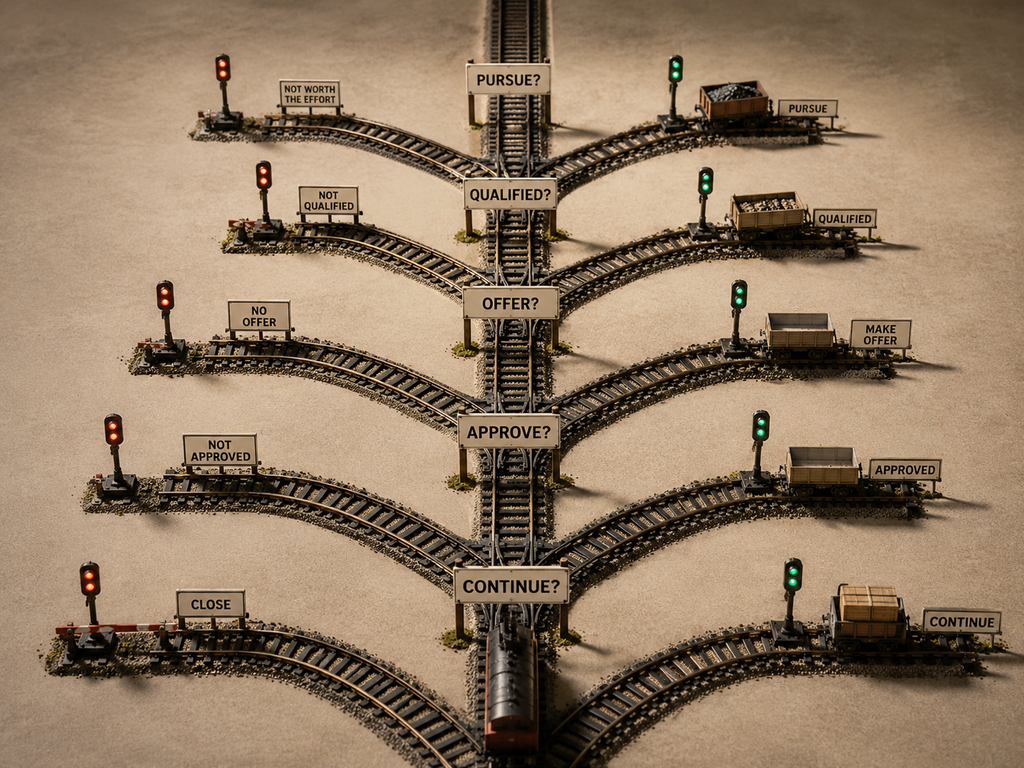
Sales pipelines do not really move through stages. They move through decisions.
A CRM shows lead, qualified, discovery, proposal, negotiation and closed. But an opportunity does not progress because a stage exists.
Something has to be decided.
Is this prospect worth pursuing? What problem matters? Is there enough intent? Which offer fits? Can this price be offered? Should we follow up again? When should we stop?
That is the machinery underneath the pipeline.
The sales system is a decision architecture disguised as a sequence of activities.
Once you see it this way, redesigning sales processes with AI becomes much more practical.
Consider discount approval.
In many businesses, the real rule is not even the rule written in the CRM or sales manual.
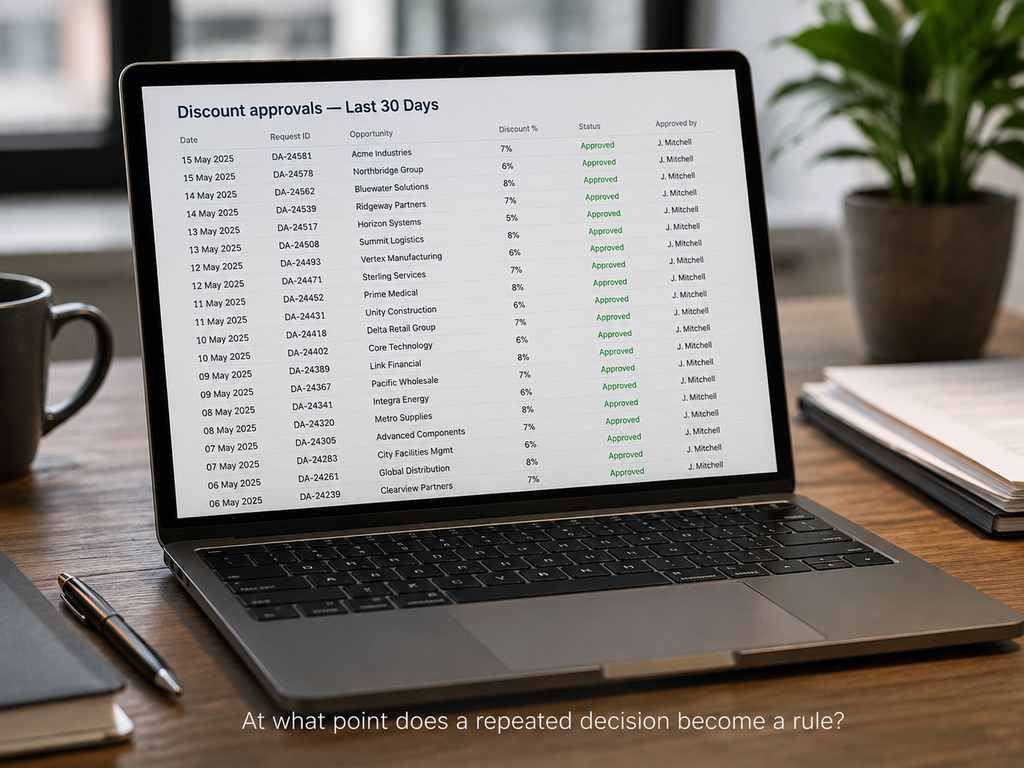
Salespeople learn that 5% is usually fine, 7% probably needs checking, and anything unusual gets sent to the manager who “knows what the owner will accept.”
The decision architecture already exists. It is simply stored in people’s experience, habits and understanding of where the invisible boundaries sit.
That can work—until volume increases, experienced people leave, or the business expects technology to operate inside rules nobody has actually defined.
Suppose every discount above 5% currently goes to the sales manager. That rule may have made sense when the salesperson had limited visibility into margin, customer history and comparable deals.
Now suppose those conditions can be evaluated consistently.
Discounts up to 8% might proceed when margin remains above an agreed threshold, payment terms are standard and defined customer conditions are satisfied. Anything outside those boundaries goes to the manager.
The manager has not lost control.
The business has converted repeated judgement into a reusable decision boundary.
This leads to an important principle:
A decision made repeatedly under similar conditions should eventually leave something behind—a rule, threshold, precedent, signal or escalation condition.
Otherwise, the business keeps renting the same judgement from the same person.
Stop automating the work around a decision while refusing to redesign the decision itself.
Faster proposal creation saves little if every proposal still waits for the owner.
Observable behaviour: Owners and managers repeatedly approve variations almost identical to decisions they made last week.
Business consequence: Customers wait, salespeople hesitate and management becomes the throughput limit of an increasingly capable system.
The practical unit of redesign is therefore not the task. It is the decision controlling what happens next.
Decide What AI Can Handle and Where Human Judgement Matters
The useful boundary between AI and people is not task versus decision. It is bounded judgement versus consequential ambiguity.
The familiar rule that AI performs routine tasks while humans make decisions is already too crude.
Some decisions are highly repeatable. Others contain uncertainty where relationships, commercial consequences, reputation or unusual context make judgement valuable.
Consider qualification.
If a prospect falls outside your service geography, below your minimum viable size and needs something you do not provide, the business may already know the answer. A salesperson does not need to rediscover it.
Now consider a long-standing customer requesting something outside your normal scope where the strategic value of the relationship could justify a different response.
Same category. Different judgement.
The difference is consequential ambiguity.
This suggests three practical conditions: some decisions can proceed automatically because their boundaries are understood; some can receive an AI recommendation but require confirmation; others should deliberately remain human.
The mistake is keeping humans involved everywhere simply because AI is involved.
If a person reviews every AI action regardless of consequence, the business has automated execution while institutionalising an approval bottleneck.
If your people check every AI recommendation before acting, you haven’t really delegated anything. You’ve created a faster way to ask permission.
Human attention should become increasingly exception-driven.
Normal work moves within boundaries. Unusual conditions and consequential uncertainty reach people.
The redesign therefore follows a clear logic: identify the decision, define what normal looks like, establish the boundary, escalate the exception, and use the outcome to improve the next decision.
That does not diminish human judgement. It makes it more valuable by concentrating it where it changes the outcome.
Observable behaviour: Employees review AI-supported decisions they almost never change.
Business consequence: The business pays for AI speed and human review simultaneously, capturing the cost of both operating models without the full advantage of either.
The goal is not removing people from sales. It is stopping the business from spending scarce judgement where it already knows what good looks like.
A fictional $12 million services business had a sales manager reviewing almost every non-standard proposal because the team believed that was how commercial discipline was maintained.
When they examined the decisions, most fell inside patterns the manager had approved dozens of times before. Clear boundaries allowed normal decisions to move while unusual commercial situations still reached the manager.
She stopped being the approval mechanism and became the person whose judgement was reserved for situations that actually deserved it.
Connect Marketing, Sales and Customer Signals Into One Growth System
A growth system becomes intelligent when what happens in one part of the customer journey changes what happens elsewhere.
Most established businesses already possess enormous amounts of useful commercial information.
Marketing knows which messages generate enquiries. Sales knows which enquiries become serious opportunities. Management knows which deals produce acceptable margins.
Operations knows which promises are difficult to deliver. Customer teams know what people misunderstand or value after purchase.
Yet those signals frequently remain separated.
Marketing can therefore optimise for leads sales does not want. Sales can sell work operations struggles to deliver. The same objection can appear in hundreds of conversations without changing the marketing that created the expectation.
The information exists.
The system does not learn from it.
A growth system is not connected because its software integrates. It is connected when an outcome in one part of the business changes a future decision somewhere else.
If six opportunities are lost because prospects expect a service you do not provide, recording six lost deals is not learning.
Learning occurs when the pattern changes something: marketing clarifies the message, qualification changes, sales receives a different signal or the business reconsiders the offer.
The loss becomes an input.
This is one of AI’s less obvious advantages. Similar technology can be purchased by competitors. Your accumulated knowledge of why customers buy, hesitate, object, leave, expand or become profitable cannot be acquired so easily.
Businesses that merely automate work get faster. Businesses that capture outcomes can become better.
Observable behaviour: The same objections, poor-fit leads and proposal exceptions continue appearing month after month.
Business consequence: The business keeps generating valuable experience without converting that experience into better future decisions.
That is the difference between a sales process that executes and a growth system that learns.
Measure Whether AI Is Creating System-Level Leverage
Productivity measures what AI does to work. Leverage measures what AI does to the system.
Hours saved matter. So do faster responses and reduced administration.
But these are capacity measures. They show what became cheaper or faster, not whether that capacity became growth.
Look further downstream.
Are qualified opportunities moving faster? Has conversion improved? Are fewer poor-quality leads reaching sales? Are routine approvals declining? Are exceptions reaching the right people sooner? Are customer outcomes changing future qualification and messaging? Has dependence on senior management decreased?
Ultimately, has the economics of acquiring and converting customers improved?
Imagine AI saves every salesperson five hours a week.
If those hours disappear into more internal review, low-quality opportunities or checking AI-generated work, the productivity exists mathematically but has created little leverage.
This is why baseline measurement matters.
Know where opportunities currently wait. Count repeated approvals. Track qualification-to-conversion rates. Identify the decisions consuming senior attention. Understand the relationship between marketing volume and sales quality.
Then look for structural change.
Sometimes the strongest evidence will not appear first in an AI dashboard.
The owner stops approving routine discounts. Sales stops complaining about marketing leads. Customer objections change the next campaign. Managers spend meetings discussing genuine exceptions instead of reconstructing what happened.
Observable behaviour: AI reports show impressive usage and time savings, but management cannot explain what changed in conversion, velocity, margin or customer acquisition economics.
Business consequence: AI adoption grows while its commercial value remains ambiguous.
The measure of successful redesign is not how much AI the business uses. It is how much more capable the business becomes because of it.
The most impressive AI-enabled sales team may eventually look less busy, not more.
Fewer routine approvals reach managers, fewer poor-fit leads reach salespeople, and fewer people spend their day moving information between systems.
What increases isn’t visible activity but the proportion of human attention spent where judgement actually changes an outcome. A more capable business doesn’t necessarily do more work; it needs less work to create the right movement.
Conclusion
The biggest risk in applying AI to sales is not that the technology fails.
It is that it succeeds inside a system that was never redesigned to use what it makes possible.
Then everything gets faster.
More prospects can be researched. More leads can be analysed. More messages can be personalised. More proposals can be produced. More follow-up can happen.
And the same decisions still wait for the same people.
That is complexity disguised as progress.
The alternative begins with a different understanding of the sales process.
It is not primarily a chain of tasks waiting to be automated. It is a system that uses information and judgement to decide which opportunities deserve attention, what should happen next, when work can move and what the business should learn from the outcome.
AI changes that system because intelligence is becoming less scarce.
Some old activities can disappear. Some repeated decisions can become boundaries. Human attention can move toward exceptions and relationships. Marketing and sales signals can connect. Wins, losses and customer outcomes can improve what happens next.
That is where leverage begins.
Not with more AI.
With a business designed to use intelligence well.
Established businesses already possess years of customer knowledge, pricing experience, objections, decisions and commercial judgement.
AI creates new ways to apply that knowledge repeatedly and at scale—but only if the existing process is no longer treated as fixed.
The sales system you have today was built around yesterday’s constraints. Keeping it unchanged is now a choice.
You can keep adding AI to the existing pipeline and become faster at producing activity.
Or you can redesign how intelligence becomes decisions, how decisions become action and how outcomes become learning.
One path gives you more capability to manage.
The other gives the business more capability of its own.
Action Steps
Map the decisions underneath your pipeline
List the recurring decisions that actually move an opportunity from initial interest to revenue, rather than simply documenting CRM stages and activities. This matters because stages describe status while decisions control movement; the immediate decision is which of those decisions genuinely requires human judgement and which exists only because the process has always worked that way.
Find where increased AI capacity will create downstream pressure
Identify where faster research, qualification, proposals or follow-up will send more work into an unchanged approval, review or handoff. This exposes where productivity gains could become queues; decide whether downstream capacity needs a new boundary, different ownership or deliberate constraint before increasing upstream volume.
Convert repeated judgement into decision boundaries
Review decisions managers repeatedly make in similar circumstances and define the conditions under which work can proceed without another approval. The strategic value is not merely speed but removing unnecessary dependence on scarce senior attention; decide what constitutes normal, what can proceed and what must become an exception.
Reserve human judgement for consequential ambiguity
Separate predictable decisions from situations where commercial risk, customer relationships, reputation or unusual context genuinely matter. Human oversight everywhere recreates the bottleneck AI was supposed to remove; decide explicitly where AI can act, where it recommends and where a person must own the outcome.
Make outcomes change future decisions
Connect wins, losses, objections, exceptions and customer outcomes back to qualification, messaging and commercial rules. Without this loop, the business repeatedly experiences valuable evidence without accumulating capability; decide which outcomes should trigger a change in future behaviour rather than merely appear in reporting.
Measure leverage downstream
Track opportunity quality, conversion, movement, repeated approvals, exception rates and dependence on management alongside conventional productivity metrics. Hours saved reveal efficiency, not necessarily business value; decide whether AI investment is improving the economics and independence of the growth system rather than simply increasing its activity.
FAQs
Start by mapping the decisions that move opportunities rather than identifying tasks AI can perform. Determine which decisions are predictable enough to operate within defined boundaries, which AI should support, and which exceptions still justify human judgement; redesign around those distinctions before increasing automation.
Why can AI make a sales process more complex?
AI can increase research, qualification, personalisation, proposal and follow-up capacity faster than downstream decision and coordination capacity. If the underlying approvals, handoffs and decision rules remain unchanged, the business produces more activity for the same structural bottlenecks to process.
What parts of a sales pipeline should be automated with AI?
Prioritise work and decisions where the required information, acceptable outcome and boundaries are sufficiently understood. Where uncertainty has significant commercial, customer or reputational consequences, AI can support the decision while human judgement retains ownership.
Should AI replace human decision-making in sales?
Not as a general rule. The stronger design is to use human attention where ambiguity and consequences make judgement valuable, while allowing routine decisions to move within established boundaries; requiring human approval everywhere simply turns oversight into another bottleneck.
How does AI improve a sales pipeline beyond saving time?
AI creates greater value when information changes what the system does next: which leads receive attention, when opportunities escalate, how offers are shaped and what future decisions learn from previous outcomes. The decision path is therefore to measure changes in conversion, movement and decision quality alongside hours saved.
How can marketing and sales work as one AI-enabled growth system?
The connection occurs when outcomes from one area alter future behaviour in another. Sales objections should influence marketing, lost opportunities should refine qualification, and customer outcomes should improve future offers; decide which signals must cross functional boundaries and what each signal is expected to change.
How do you know whether AI is creating sales leverage rather than more activity?
Look downstream from AI usage and output. If qualified opportunities move faster, repeated approvals decline, conversion or economics improve, and senior attention shifts toward genuine exceptions, the system is gaining leverage; if only volume and activity rise, the underlying architecture probably has not changed enough.
Bonus Section
Three Ways to Think Differently About AI and Sales
Most businesses are still evaluating AI by asking where it can save labour. That is understandable, but it keeps attention on the visible work rather than the architecture determining whether that work creates value.
The more interesting opportunities appear when you stop treating the existing sales process as fixed. Three shifts become particularly useful.
Stop automating around decisions you refuse to redesign
This is what many businesses are getting wrong. They automate research, proposals and follow-up while preserving every approval sitting between those activities.
The result is faster work arriving sooner at the same human bottleneck.
If nothing changes, management becomes increasingly responsible for processing the productivity AI creates.
Repeated approvals are information
A manager approving the same type of discount or proposal variation for the twentieth time isn’t simply completing work. The repetition is evidence that the business may already know enough to define a boundary.
Look at repeated decisions as potential organisational knowledge waiting to be encoded.
If nothing changes, valuable judgement remains trapped in individual people instead of becoming business capability.
Your losses may become more valuable than your AI outputs
AI-generated emails, research and proposals can be reproduced by competitors using similar technology. Your accumulated reasons for winning, losing, discounting, escalating and disappointing customers cannot be purchased so easily.
The opportunity is to make those outcomes change future qualification, messaging and decisions.
If nothing changes, the business keeps generating experience without systematically becoming more experienced.
AI may ultimately matter less because it lets businesses produce more and more because it makes learning from what they already produce economically possible.
That is a different ambition: not simply a faster sales system, but one that becomes more capable through use.
Other Articles
AI Accountability Framework: Who Really Owns AI?
AI Growth System Architecture Is Replacing Marketing Funnels