
AI is changing far more than lead generation. Learn why growth now depends on redesigning the system that connects marketing, sales, operations and decision-making.
AI Growth System Architecture connects marketing, sales, operations and decision-making so customer and market intelligence strengthens the entire growth system rather than remaining trapped inside individual functions.
Traditional marketing funnels still describe parts of the customer journey, but they were built for conditions where intelligence, analysis and personalisation were expensive; AI changes those constraints and allows growth to become a continuous learning system.
The advantage therefore comes not from adding more AI tools to existing processes, but from redesigning how signals become intelligence, decisions, action and organisational learning.
A strange thing is happening inside many established businesses.
Marketing can create more campaigns than ever. Sales can research prospects faster. Proposals can be produced in minutes. Customer conversations can be analysed almost instantly. Competitor activity can be monitored continuously.
Yet the growth system often looks almost exactly the same.
Marketing generates leads. Sales qualifies them. Sales follows up. Managers review important opportunities. Operations receives whatever Sales eventually wins. Customer feedback reaches Marketing intermittently, if at all. Leadership reviews performance after the fact and decides what should change next.
AI has accelerated pieces of the system without necessarily changing the system itself.
You can see it in businesses where Marketing is producing more, Sales has more information and reporting has never been better—yet the same conversations about lead quality, conversion and pipeline performance keep returning to the leadership meeting.
That is the tension.
The conventional explanation is that businesses need better AI adoption: better tools, stronger automation and greater AI capability inside Marketing and Sales.
There is truth in that. Better tools can improve execution.
But the explanation is incomplete because it protects one important assumption:
The existing growth system is fundamentally correct.
It may not be.
Marketing funnels developed in an environment where intelligence was expensive, customer information travelled slowly, personalisation required labour and continuous market analysis was unrealistic for most businesses. Growth had to be divided into functions because people could only apply limited attention and expertise to limited parts of the customer journey.
Those constraints shaped the funnel.
AI changes those constraints.
The strategic opportunity is therefore larger than improving lead generation or producing more marketing.
Businesses can expand what they know about customers and markets, build growth capabilities that were previously uneconomic and connect intelligence across Marketing, Sales and Operations continuously.
The question is no longer simply:
How can AI improve our funnel?
It is:
Would we design our growth system this way if we were building it today?
That is the shift this article explores.

Marketing Funnels Were Designed for a Different Business Environment
The traditional marketing funnel was not a mistake. It was an intelligent response to scarcity.
Businesses needed a practical way to move unknown prospects towards purchase. Marketing created awareness and demand. Sales applied more expensive human attention to qualified opportunities. Operations became involved once a customer committed.
Each function specialised because expertise, information and time were constrained.
That structure made economic sense.
Marketing could communicate with thousands of people, but it could not deeply understand each one. Sales could understand individual prospects, but salespeople could only manage a finite number of conversations. Customer Service knew what happened after purchase, but feeding every insight back into Marketing and Sales required meetings, reports and manual coordination.
So businesses created stages.
Awareness. Interest. Consideration. Conversion.
We normally look at a funnel and see the customer moving through those stages. Look instead at how the business organised itself around the funnel and something else becomes visible.
Marketing handled the many. Sales applied deeper human attention to the few. Management became involved as judgement, value, or risk increased. Customer Service learned what happened after the sale.
The architecture wasn’t only mapping customer behaviour.
It was allocating scarce intelligence.
The funnel was partly a model of customer behaviour. But it was also a model of organisational limitation.
That distinction matters because many growth practices we now consider normal were created around what businesses could not economically do.
Marketing could not continuously analyse every buying signal.
Sales could not deeply research every prospect before contact.
Leadership could not examine every lost opportunity for patterns.
Customer Service could not turn every conversation into organisation-wide learning.
Businesses concentrated intelligence where they could afford it.
AI challenges that assumption.
The underlying principle is simple:
Growth architecture reflects the constraints under which growth was organised.
When those constraints change, the architecture deserves to be reconsidered.
This also changes how leaders should think about established growth practices. Before treating a process as a best practice, ask whether it exists because customers genuinely require it or because the business historically lacked the capacity to do something better.
AI will not invalidate every established practice. But it does make the assumptions underneath those practices visible.
Some will survive that test.
Others will not.
That does not mean the customer journey suddenly disappears. Customers still become aware, investigate, evaluate and commit. Funnels remain useful for understanding parts of that progression.
What changes is the business system surrounding the journey.
A company no longer has to wait until a lead reaches Sales before applying deeper intelligence. It does not have to wait for quarterly research to understand changing customer concerns. It does not have to treat post-purchase feedback as knowledge belonging only to Customer Service.
The customer journey may still resemble a funnel. The business operating around it no longer needs to.
You can see the old architecture whenever Marketing celebrates lead volume while Sales separately discovers why those leads do or do not buy.
The consequence is larger than poor alignment. The business repeatedly pays to rediscover intelligence it already possesses somewhere else.
The longer that separation remains, the more AI simply accelerates individual stages rather than improving the Growth System connecting them.
For a long time, the obvious response to a disappointing campaign was to improve the campaign: better targeting, stronger messaging, another offer.
The uncomfortable shift came when the campaign stopped looking like the whole problem. Sales already knew which objections were increasing, while customer conversations elsewhere in the business contained clues Marketing never saw.
The lesson was simple: sometimes we keep improving one part because we have never looked closely enough at the system around it.
AI Changes How Growth Moves Through the Business
AI changes growth because intelligence can now be applied earlier, more continuously and across more of the customer relationship.
That is more important than its ability to generate content.
For most of modern business history, intelligence had to be rationed. Skilled analysis took time. Research required people. Personalisation increased cost. Managers could review only a limited number of decisions.
Continuous market monitoring was unrealistic for most businesses.
AI makes many forms of intelligence dramatically cheaper and more available.
That changes what a Growth System can do.
A market signal can be identified before it becomes obvious in revenue data.
A prospect can be researched before Sales speaks to them.
Sales conversations can reveal patterns that improve positioning.
Proposal outcomes can expose recurring commercial objections.
Customer interactions can reveal expectation gaps before they become broader retention problems.
Operational delivery can influence what Marketing promises next.
The important change is not that every department can now use AI.
It is that intelligence no longer needs to remain concentrated at the stages where businesses historically had enough people, time or expertise to apply it.
Three things happen as a result.
Awareness expands. The organisation can see more of what is happening across customers, competitors and markets.
Capability expands. Work that was previously too expensive or time-consuming—continuous competitor monitoring, conversation analysis, account research, pattern detection—becomes economically viable.
Constraints move. The limitation becomes less about obtaining intelligence and increasingly about deciding how that intelligence should change action.
These are not three separate benefits of AI. Together, they change the conditions under which growth can be designed.
This is why producing more leads is an incomplete response to AI.
A business might double campaign output while leaving qualification unchanged. It might generate better proposals without feeding win/loss patterns back into Marketing. It might analyse every customer conversation while allowing the resulting intelligence to sit unused.
More intelligence enters the business.
Growth barely changes.
An AI-enabled Growth System moves intelligence to the point where the next growth decision is made.
That point might sit in Marketing today, Sales tomorrow and Operations the day after.
Growth therefore becomes less dependent on a rigid sequence and more capable of responding continuously to what the business is learning.
When Sales discovers the same objection across ten conversations but Marketing continues running unchanged messaging, the problem is no longer lack of intelligence.
The organisation knows.
The system has failed to learn.
That distinction will become increasingly important. Businesses will possess more information than ever while still making decisions at yesterday’s speed.
The advantage comes from shortening the distance between signal, understanding, decision and response.

Why Adding AI to Existing Processes Produces Limited Results
The default AI strategy is additive.
Take the current process.
Add AI.
Make it faster.
That works—up to a point.
Marketing creates more content. Sales writes prospecting emails faster. Teams summarise meetings automatically. Proposals appear sooner. Reporting improves.
Each activity becomes more efficient while the Growth System surrounding those activities can remain largely untouched.
This is where productivity gets mistaken for growth capability.
And it can create a strange result.
Marketing reports that AI is working because campaign production has increased. Sales reports that AI is working because prospect research and proposals are faster. Leadership can point to genuine productivity improvements across several functions—and still sit in the monthly meeting frustrated that conversion, sales cycles or growth have barely changed.
Nobody is necessarily wrong.
They are measuring improvement inside the parts rather than improvement of the Growth System.
If Marketing can produce twice as many campaigns but the business still cannot identify which customer signals matter, additional output may simply increase noise.
If Sales can produce proposals in minutes but qualification remains weak, the business creates poor-fit proposals faster.
If customer conversations are analysed but those insights never change Marketing, Sales or Operations, the organisation has created information without creating learning.
The hidden assumption is that every existing growth activity deserves to survive.
It doesn’t.
This behaviour needs to be challenged directly: do not automate a growth process simply because it can be automated.
First ask why the process exists.
Consider lead qualification. Historically, Marketing generated a broad pool and Sales applied human judgement later because deep evaluation of every prospect was too expensive.
If intelligence can now be applied earlier and continuously, does qualification still need to occur at the same point, in the same way?
Consider customer research. Businesses traditionally relied on periodic surveys and interviews because analysing thousands of interactions was impractical.
If every interaction can now contribute to customer understanding, should learning about customers remain an occasional research project?
This is the difference between augmentation and redesign.
Augmentation preserves the architecture and improves execution.
Redesign asks whether the architecture still reflects current constraints and capabilities.
AI creates greater leverage when it changes the design of the Growth System, not merely the speed of an existing step.
This is why more campaigns, faster proposals and better dashboards can coexist with stubborn conversion rates, long sales cycles and weak customer learning.
The technology is working.
The system hasn’t changed.
And the longer businesses measure AI primarily by output, the easier it becomes to miss that distinction.
The Components of an AI Growth System Architecture
An AI Growth System is not a larger marketing funnel.
It is an architecture connecting signals, intelligence, decisions, action and learning across the business.
Growth is no longer created in one place.
Marketing sees market response.
Sales sees buying behaviour.
Operations sees whether customer expectations match delivery reality.
Customer Service sees where value or expectations break down after purchase.
Leadership sees strategic trade-offs.
Each function holds part of the growth picture.
The architecture determines whether those fragments become organisational intelligence.
A useful way to understand the system is through six connected components.
Signals are changes worth noticing: customer behaviour, competitor movement, sales objections, changing demand, margin pressure or recurring service issues.
Intelligence turns those signals into meaning. A declining win rate is data. Understanding that changing competitor positioning has altered buyer expectations is intelligence.
Decisions determine what the business will do differently. Without a decision, intelligence remains interesting rather than valuable.
Action carries that decision into Marketing, Sales, Operations or the customer experience.
Response reveals what happened when the market encountered the action.
Learning captures the result so the next decision begins from a stronger position.
The cycle becomes:
Signals → Intelligence → Decisions → Action → Customer Response → Learning → Better Signals
This is fundamentally different from a funnel.
A funnel primarily describes progression towards purchase.
A Growth System Architecture describes how the organisation learns while creating growth.
The difference becomes clearer when the two models are placed beside each other:
Traditional Growth Model AI Growth System
Marketing generates leads Marketing generates demand and intelligence
Sales qualifies opportunities Qualification develops continuously
Customer feedback is periodic Customer learning is continuous
Functions analyse their own results Learning moves across functions
Performance triggers review Signals influence decisions
Growth culminates in conversion Every outcome improves the next growth cycle
The distinction is not that everything on the left becomes obsolete. It is that the right-hand side adds capabilities that were difficult or uneconomic when the traditional model evolved.
That may be one of AI’s most underestimated contributions.
The real advantage may not be producing the next campaign faster. It may be dramatically increasing the number and quality of learning cycles the business can complete.
A competitor can copy your software.
It can imitate your campaign.
It can hire similar salespeople.
It is much harder to copy an organisation that learns more from every customer interaction than competitors do.
A modern Growth System converts market activity into organisational learning, then converts that learning back into stronger growth decisions.
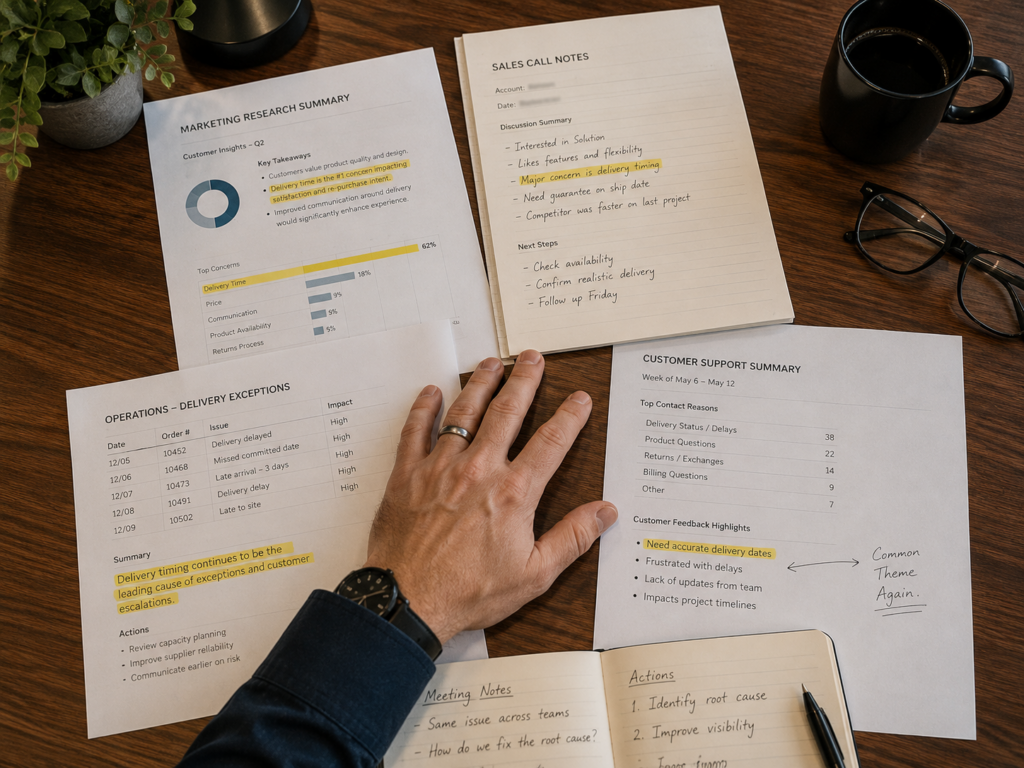
Yet in many businesses, campaign performance, sales objections, delivery problems and win/loss reasons still sit in separate systems and are reviewed on different schedules.
Each function learns.
The business learns slowly.
The leadership challenge is not to connect every piece of data.
It is to decide which signals should improve which decisions.
That is where Growth System Architecture begins.
How Sales, Marketing and Operations Become One Growth System
Marketing, Sales and Operations do not need to become one department.
They need to become one learning system.
Organisational specialisation still matters. Marketing should remain skilled at creating demand and understanding markets. Sales should remain skilled at customer conversations, qualification and commercial commitment. Operations should remain skilled at delivering what the business promises.
The problem begins when knowledge stops at functional boundaries.
Marketing may believe a campaign succeeded because lead volume increased.
Sales may know those leads carried weaker intent.
Operations may know that a promise being made during acquisition creates expensive delivery complexity.
Customer Service may know customers consistently misunderstand the same part of the offer.
Each team can be correct.
The Growth System can still be wrong.
That is why this problem can survive good people, good management and strong departmental performance. Each function can improve what it owns while the connections between those functions continue limiting the overall result.
AI makes that fragmentation increasingly difficult to justify because information can be captured, interpreted and redistributed at a scale that previously required significant human coordination.
Sales objections can reshape messaging.
Lost proposals can improve qualification.
Operational delivery issues can change what Sales promises.
Customer Service patterns can influence positioning.
Margin data can influence which customer segments Marketing pursues.
Market changes can alter sales priorities before the next planning cycle.
The objective is not integration for its own sake.
It is faster organisational learning.
The traditional funnel asks:
Where is the customer?
A Growth System asks something else as well:
What is the business learning from the customer?
That second question changes the value of every interaction.
A customer who does not buy can still strengthen future growth.
A complaint can improve acquisition.
A delivery issue can improve qualification.
A lost deal can improve positioning.
Growth stops being something Marketing produces and Sales converts. It becomes something the organisation continuously learns how to improve.
Strong growth businesses do not merely acquire customers. They become more capable because of every customer they acquire, lose or serve.
Sales, Marketing and Operations become one Growth System when learning in one function changes decisions in another.
Without that connection, local improvements continue creating hidden costs elsewhere. Teams become more productive while growth becomes harder to scale.
Growth is no longer owned by a department.
It is designed across the business.
A fictional $12 million services business had capable Marketing and Sales teams, yet each monthly growth meeting produced the same frustration: Marketing wanted more budget while Sales questioned lead quality.
Instead of trying to settle the argument, leadership began connecting sales objections, lost opportunities and campaign signals into the same review.
The breakthrough was not that either team had been wrong; each had only been seeing part of the system. Growth became easier to improve once the business stopped asking which department owned the problem.
Questions Every Leadership Team Should Ask Before Investing in More AI
Before investing in more AI, leadership should understand what is actually constraining growth.
Otherwise, AI increases activity around an unresolved constraint.
Start with:
What currently limits our ability to grow?
Insufficient demand? Weak qualification? Slow sales cycles? Limited customer understanding? Retention? Delivery capacity? Inconsistent commercial decisions?
Do not assume the answer is Marketing simply because growth is disappointing.
Then ask:
What valuable growth work are we not doing because it has historically been too expensive, slow or difficult?
Perhaps the business has never analysed every lost proposal.
Never monitored competitors continuously.
Never built account-level research for every significant opportunity.
Never systematically compared customer expectations with delivery experience.
Those capabilities may not have been ignored. They may simply have been uneconomic.
Next:
Where does customer intelligence stop moving?
What does Sales know that Marketing does not?
What does Operations know that Sales should know?
What does Customer Service repeatedly learn that never changes acquisition?
Then:
Which growth decisions are still being made with less intelligence than is now available?
Targeting. Qualification. Pricing. Positioning. Proposal strategy. Retention priorities.
More information is not the objective. Better decisions are.
And finally:
Which capabilities should we build rather than which tools should we buy?
A tool is temporary.
A capability is something the business can reliably do.
Continuous market sensing is a capability.
Learning from every lost opportunity is a capability.
Identifying emerging customer patterns is a capability.
Leadership’s role is to identify the constraints, capabilities and learning loops that determine how effectively the business grows.
That leads to the most confronting question:
Would we design our Growth System this way if we were starting today?
If the answer is no, another AI tool is unlikely to be the most important decision.
Growth Will Belong to Businesses That Redesign the System, Not the Tools
AI capability will become increasingly common.
Your competitors will generate content.
They will analyse customer conversations.
They will research prospects.
They will automate parts of sales.
They will create proposals.
They will monitor markets.
As access to intelligence becomes more common, access itself becomes less valuable as a differentiator.
Competitive advantage moves to the system that applies it.
Businesses with stronger Growth Systems will detect useful signals earlier, connect customer learning across functions, make stronger decisions and build capabilities that were previously uneconomic.
But there is another question businesses will increasingly have to ask.
Not:
What growth work can AI do faster?
But:
What valuable growth work have we never done because we couldn’t justify the time, people or cost?
That question opens a very different conversation.
The first AI opportunity is to improve work. The larger opportunity is to expand what the Growth System is capable of doing.
Most businesses currently focus AI on work they already do.
Faster campaigns.
Faster research.
Faster proposals.
But transformational technologies rarely stop at improving existing activity.
They change what becomes possible.
A business that once reviewed competitors quarterly can monitor meaningful changes continuously.
A sales leader who once sampled ten conversations can learn from thousands.
A Marketing team that relied on periodic customer research can develop continuous customer awareness.
A leadership team that reviewed lagging growth reports can increasingly identify emerging signals before they become obvious in results.
These are not simply faster versions of existing activities.
They are examples of growth work that was previously constrained by the economics of human time, attention and expertise.
When those constraints change, the boundary of what the Growth System can economically do changes with them.
This is not simply greater productivity.
It is greater growth capability.
Two businesses can therefore use similar AI and produce very different outcomes.
One produces more.
The other learns more.
Over time, that difference compounds.
Competitive advantage emerges when abundant intelligence is converted into capabilities competitors cannot easily reproduce as an integrated system.
The strategic decision is no longer whether AI belongs in Marketing or Sales.
It is whether AI will be added to the Growth System you inherited—or used as the reason to redesign the Growth System you need next.
Two competitors can buy the same AI tomorrow. Both can generate similar content, research prospects and analyse sales conversations.
Yet one can finish the year considerably stronger because every interaction has improved what the organisation knows and how it decides; the other simply completed more activity.
The difference is not access to intelligence. It is whether the Growth System knows how to learn.
Conclusion
For years, businesses have invested heavily in improving individual stages of growth.
Better Marketing.
Better Sales.
Better CRM.
Better campaigns.
Better reporting.
Those investments made sense because the constraints of the time made functional optimisation logical.
AI changes the conditions.
Intelligence is becoming cheaper. Awareness can become broader. Capabilities that once required significant human effort can increasingly operate continuously. Customer interactions can produce learning far beyond the function where they occur.
That means the traditional question—How can we improve the funnel?—is no longer enough.
The more important question is:
How should our Growth System operate when intelligence is abundant?
That system still needs Marketing.
It still needs Sales.
It still needs Operations.
But sustainable growth increasingly depends on what happens between them: how signals become intelligence, how intelligence changes decisions, how market response creates learning and how that learning strengthens the next growth cycle.
Businesses can continue using AI to make existing marketing and sales activity faster.
They will produce more.
They may reduce costs.
They may improve productivity.
But there is another path.
Businesses can redesign growth around what is now possible.
They can challenge constraints that no longer need to exist.
Build capabilities they could never economically justify before.
Expand their awareness of customers and markets.
And create a Growth System that becomes more capable every time it interacts with the market.
The current system is not wrong because it was badly designed.
It was designed for different conditions.
Those conditions are changing.
Leadership now has a choice:
Use AI to improve the funnel you inherited—or redesign the system through which your business grows.
Action Steps
Identify the real constraint on growth
Determine what currently limits growth before deciding where AI belongs. Separate demand, qualification, conversion, customer understanding, delivery and retention constraints so investment targets the system’s actual limitation rather than simply increasing activity around it.
Map how growth intelligence moves
Follow customer and market intelligence across Marketing, Sales, Operations and Customer Service. Identify where useful knowledge stops, because growth capability increases when learning in one function changes decisions in another rather than remaining locally useful.
Identify growth work that was previously uneconomic
List valuable activities your business rarely or never performs because they historically required too much time, expertise or cost. Continuous competitor monitoring, lost-opportunity analysis or account-level research may now be viable capabilities rather than occasional projects.
Define the growth decisions intelligence should improve
Start with decisions, not data. Identify the recurring decisions around targeting, qualification, pricing, proposals, positioning and retention that would materially improve with stronger intelligence; this prevents the business from accumulating information without knowing what should change because of it.
Connect customer response back into the system
Ensure campaigns, sales conversations, lost deals, delivery issues and customer interactions contribute to future decisions. The strategic objective is not simply collecting feedback but shortening the cycle between market response, organisational learning and the next action.
Evaluate capabilities before buying more tools
Ask what the Growth System needs to become capable of doing reliably before selecting technology. Tools will continue changing; capabilities such as continuous market sensing, opportunity learning and cross-functional customer intelligence become enduring organisational assets.
FAQs
AI Growth System Architecture is the structure connecting market signals, customer intelligence, decisions, actions and learning across Marketing, Sales and Operations. Rather than treating AI as a collection of tools within individual departments, it designs how intelligence should move through the business to improve future growth decisions.
Are marketing funnels becoming obsolete because of AI?
No. Funnels can still describe how customers progress from awareness towards purchase, but they are increasingly incomplete as a model for how the business creates growth. Leaders should retain useful customer-journey stages while redesigning the organisational system surrounding them so intelligence and learning move continuously across functions.
Why were traditional marketing funnels designed the way they were?
Funnels developed partly around customer behaviour, but also around organisational constraints: intelligence was expensive, human attention was limited and deep analysis could not economically be applied to every prospect or interaction. AI changes those constraints, so leaders should reconsider which parts of the traditional growth model remain necessary.
Why doesn’t adding AI to marketing and sales automatically improve growth?
AI can increase campaign production, research, prospecting and proposal speed without changing how the Growth System learns. If Sales insights never change Marketing, customer experience never changes qualification, or operational reality never changes positioning, the business becomes more productive without becoming proportionally better at growth.
How do Marketing, Sales and Operations become one Growth System?
They do not need to become one department; they need to become one learning system. The practical test is whether knowledge discovered in one function changes relevant decisions elsewhere—for example, whether sales objections influence messaging or operational experience changes qualification and customer promises.
What should leaders assess before investing in more AI?
Start with the growth constraint, then identify missing capabilities, unavailable or overlooked intelligence, and the decisions that stronger intelligence should improve. Only after those questions are clear should leadership determine which AI capabilities or technologies belong inside the Growth System.
What creates competitive advantage if every business can access similar AI?
Advantage increasingly shifts from access to intelligence towards the system that applies and learns from it. Businesses that detect signals earlier, connect learning across functions and improve decisions after every market interaction can compound growth capability even when competitors use similar AI technology.
Bonus Section- Three Growth Assumptions AI Forces Us to Reconsider
Most businesses are still approaching AI from inside the growth model they already have.
They ask how Marketing can produce more, how Sales can prospect faster and how existing processes can become more efficient.
That is useful. But it also protects an assumption that deserves scrutiny: that today’s Growth System is the right system and AI’s job is simply to improve it. Three shifts challenge that assumption.
Stop Treating Every Existing Growth Activity as Necessary
This is what many businesses are getting wrong: they automate an activity before questioning why it exists. Some stages, handoffs and periodic research processes exist because intelligence once had to be rationed, not because they represent the ideal way to create growth.
If this doesn’t change: AI will make yesterday’s constraints operate faster.
A Lost Customer Can Create Growth
The traditional funnel treats conversion as the desired endpoint and loss as failure. A learning system sees something else: every lost proposal, objection and failed conversion can strengthen qualification, positioning and future decisions.
The transaction was lost. The intelligence does not have to be.
If this doesn’t change: Valuable market intelligence disappears every time an opportunity leaves the pipeline.
Your Biggest Growth Opportunity May Be Work You Don’t Currently Do
AI is usually aimed at existing activities. The more interesting question is what valuable growth work was previously impossible to justify—continuous competitor sensing, analysing every sales conversation, learning systematically from every proposal or identifying subtle changes in customer behaviour.
This is where AI moves beyond efficiency. It expands growth capability.
If this doesn’t change: Competitors may not simply perform the same work faster; they may begin performing valuable work your Growth System does not yet contain.
The opportunity is therefore larger than improving the funnel. It is discovering what growth becomes possible once old constraints stop defining what the business can see, learn and do.
Other Articles
How to Remove Decision Bottlenecks With AI