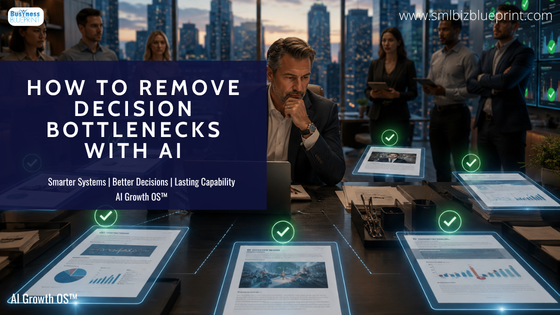

Discover why AI alone cannot increase business capacity and how to redesign approvals, governance and authority to help your business scale.
AI does not automatically remove business bottlenecks—it often exposes them.
As AI accelerates execution, many businesses discover that growth still depends on one person approving decisions, creating longer queues, slower responses and greater founder dependency.
Removing decision bottlenecks with AI requires more than automation; it requires redesigning how decisions flow through the organisation so authority, governance and accountability are built into the operating model, allowing AI to increase organisational capability rather than simply increasing the speed at which work reaches leadership.
Most businesses believe they have an AI implementation problem.
They don’t.
They have a business architecture problem that AI has made impossible to ignore.
AI promised to reduce leadership pressure.
For many businesses, it has increased it.
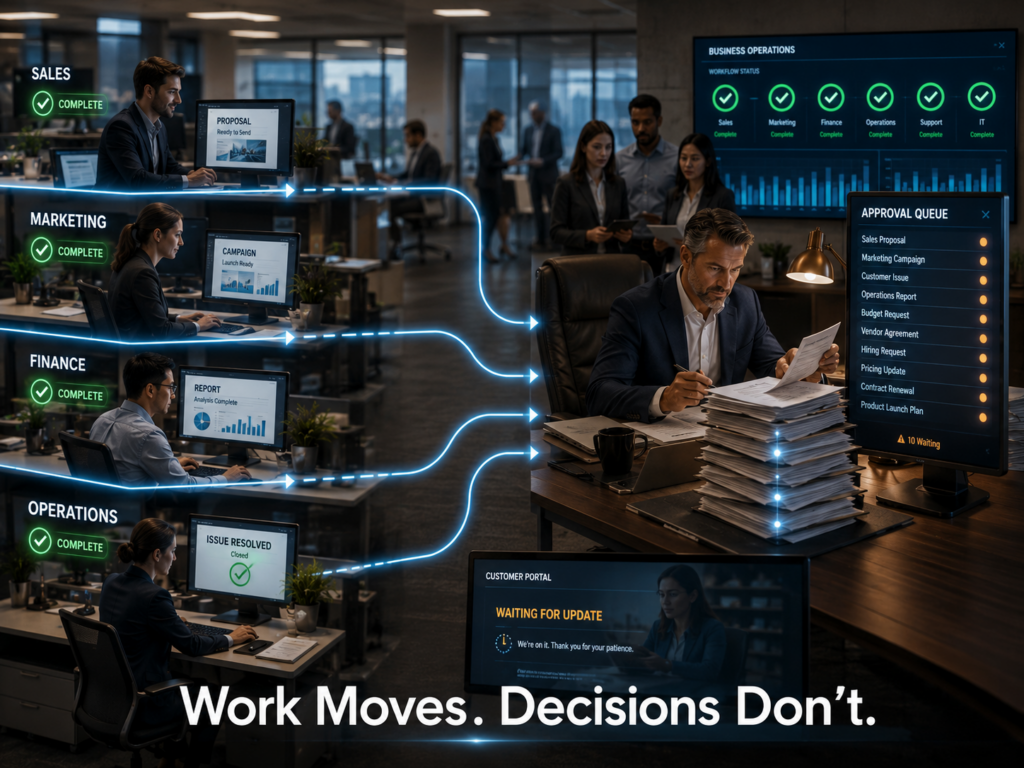
As AI accelerates execution across sales, marketing and operations, work is completed faster than ever before.
Proposals are generated in minutes. Reports appear instantly. Marketing content that once took days now takes hours. Productivity improves almost immediately.
Yet leadership often experiences the opposite of what was expected.
Decision pressure increases. Managers seek more approvals. The founder’s calendar becomes more congested rather than less.
The business appears more productive, but it doesn’t feel more capable.
This is the hidden operational tension.
AI increases the speed of execution, but most organisations leave their decision architecture unchanged.
That distinction matters because work and decisions are fundamentally different.
Work creates activity.
Decisions create progress.
Most businesses have invested heavily in improving how work moves through the organisation. They have documented processes, optimised workflows and implemented systems to increase efficiency.
Those investments matter, but they address only one side of the operating model.
Far fewer organisations have intentionally designed how decisions move.
Instead, decision-making evolves through history rather than design.
A customer exception becomes a permanent approval rule. A mistake introduces another checkpoint. A founder continues approving decisions long after the organisation has developed the capability to make them independently.
Over time, authority quietly concentrates around a handful of people until leadership becomes the default destination for uncertainty.
AI doesn’t create this condition.
It exposes it.
That is why so many businesses misdiagnose the problem.
Another AI tool, another automation or another integration may improve efficiency, but it doesn’t change the underlying structure of the business. It simply delivers more completed work to the same approval points.
The bottleneck remains exactly where it has always been.
Leadership.
More precisely, the business has made leadership responsible for decisions that should already be part of its operating model.
The architectural principle is straightforward.
Businesses do not scale because they automate more work. They scale because they increase their capacity to make good decisions without increasing dependence on individual leaders.
That requires a different way of thinking about growth.
Instead of asking:
“What else can we automate?”
Ask:
“Where does work stop waiting for permission?”
The answer reveals more about the health of the business than another productivity metric ever will.
Every business has a decision architecture.
The difference is that some organisations have designed it deliberately, while others have allowed it to evolve through habit, hierarchy and historical approvals.
Whether intentional or accidental, it determines how authority moves, where work stops and how quickly opportunities become outcomes.
Decision architecture determines whether AI becomes a multiplier or merely a faster conveyor belt.
When decision boundaries are clear, authority is intentionally distributed and governance is embedded into the operating model, AI amplifies organisational capability. Teams move confidently because they understand both the principles guiding decisions and the limits within which they can act.
When those elements are absent, every productivity gain creates another approval. Every automation produces another exception. Leadership absorbs increasing cognitive load while the organisation becomes progressively more dependent on the very people it needs to free.
The financial impact accumulates quietly.
Sales opportunities remain open longer because approvals take time. Customers wait for answers that frontline teams are capable of providing. Managers become increasingly cautious because accountability is unclear.
Leadership spends its most valuable hours resolving routine operational decisions instead of strengthening capability, developing people or shaping future strategy.
The longer this continues, the more expensive growth becomes.
Every new customer, employee, product or market creates more leadership dependency instead of more organisational capability. Revenue can continue growing, but the business becomes progressively harder to manage because decision capacity has remained fixed while operational capacity has expanded.
The business grows.
Its ability to decide does not.
That’s the structural failure AI reveals.
The solution is not more effort.
It is structural redesign.
Not redesigning workflows.
Redesigning the architecture through which decisions move.
Because AI will always amplify the operating system beneath it.
If that operating system depends on leadership making every meaningful decision, AI simply increases the speed at which those decisions arrive.
If it is built on clear decision boundaries, distributed authority and consistent governance, AI becomes far more than an efficiency tool.
It becomes an engine for building organisational capability.
AI Isn’t the Bottleneck—Leadership Is
The common advice is simple: adopt more AI, automate more work and your business will move faster.
The assumption sounds logical.
If technology accelerates execution, growth should naturally follow.
It doesn’t.
AI rarely creates a bottleneck.
It exposes one that has existed for years.
Before AI, the pace of work concealed the problem. Proposals took days to prepare. Reports were assembled manually. Marketing campaigns required weeks of effort.
Slow execution meant slow decisions felt normal because everything else was moving slowly too.
AI changes that balance.
Tasks that once took hours now take minutes. Information flows instantly. Opportunities appear faster than ever. Teams produce more. Customers expect quicker responses. The business gains momentum.
The approvals don’t.
The same owner still approves discounts. The same executive still signs off on campaigns. Managers still hesitate because authority has never been clearly defined. Teams become more productive, but the business doesn’t become more decisive.
The technology has changed.
The operating model hasn’t.
The system works like this: Every increase in execution creates a corresponding demand for decisions. If decision capacity doesn’t increase at the same rate, leadership becomes the constraint on growth.
This is why many businesses feel busier after implementing AI.
The technology is doing exactly what it promised.
The organisation isn’t.
Consider two businesses using the same AI platform.
The first automates workflows but leaves every approval process untouched. Teams become more productive, yet every meaningful decision still returns to the owner. AI generates more proposals, more reports and more recommendations, but they all end up waiting in the same place.
The business becomes faster at producing work that cannot move.
The second business approaches AI differently. Alongside automation, it redesigns how decisions flow. Managers understand where they have authority. Clear principles replace routine approvals. Leadership focuses on strategic judgment instead of operational permission.
Both organisations purchased the same technology.
Only one increased its capacity to grow.
This exposes the flaw in how AI is commonly measured.
Most organisations judge success by hours saved or tasks automated. Those improvements matter, but they don’t determine whether a business can scale.
A business doesn’t become more capable because it completes more work. It becomes more capable because it can make more good decisions without increasing dependence on one person.
That is the constraint AI reveals.
Businesses that scale stop measuring success by how much the owner controls. They measure success by how confidently the organisation can make good decisions without them.
Leadership doesn’t become less important.
Its role becomes more valuable.
Instead of acting as the approval engine for the business, leadership designs the principles, boundaries and governance that allow good decisions to happen consistently across the organisation.
This is where many founders misread what’s happening.
They believe they’re becoming busier because the business is growing.
Often they’re becoming busier because the business hasn’t learned.
Every decision that repeatedly returns to leadership is knowledge that still exists inside one person instead of inside the operating system of the business.
Growth exposes that dependency.
AI accelerates it.
Watch your next leadership meeting.
Count how many times someone says:
“We’ll just check with the owner.”
Or notice how often a proposal is finished, the customer is waiting and everyone in the room already knows the answer—yet the work stops because one approval is still missing.
Every one of those moments is evidence that the business hasn’t learned to make that decision for itself.
Every repeated approval slows response times, reinforces founder dependency and prevents AI from becoming part of the way the business actually operates.
Customers wait longer, opportunities move more slowly and leadership becomes increasingly consumed by decisions the organisation should already know how to make.
Growth becomes limited not by technology, but by the business’s ability to convert leadership knowledge into organisational capability.
For years, the owner believed being involved in every important decision was a sign of good leadership.
The day was filled with quick approvals, pricing questions, customer exceptions and small operational choices that seemed harmless on their own.
It wasn’t until AI shortened every task that the real problem became obvious—nothing moved unless the owner did. The business hadn’t become dependent overnight; AI had simply made the dependency impossible to ignore.
That’s when leadership shifted from making every decision to designing a business that no longer needed every decision to come back
Why Faster AI Creates Bigger Decision Queues
The promise of AI is greater efficiency.
The reality for many businesses is greater congestion.
That sounds contradictory until you recognise what AI is actually accelerating.
AI doesn’t accelerate business.
It accelerates execution.
Every proposal completed, customer enquiry resolved, report generated or marketing campaign produced eventually reaches the same point.
A decision.
If the business can make that decision immediately, momentum continues.
If it can’t, the work waits.
The system works like this: AI increases the speed at which work reaches decision points. If decision capacity remains unchanged, every productivity gain creates a longer queue.
This is the mistake many organisations make.
They assume faster work automatically creates faster outcomes.
It doesn’t.
Faster execution simply exposes whether the organisation can absorb that speed.
Think about your own business.
Your sales team prepares proposals in half the time they once did. Marketing develops campaigns more quickly. Operations identify problems sooner.
AI has removed friction from execution across the business.
None of that creates value until someone decides what happens next.
This is why many business owners feel overwhelmed after implementing AI.
The organisation isn’t producing more problems.
It’s producing more completed work waiting for direction.
AI rarely creates more work.
It finishes the work you already had.
That’s why founders suddenly feel overwhelmed. They’re not making fundamentally different decisions. They’re making yesterday’s decisions much faster than before because the work now reaches them in a fraction of the time.
The business hasn’t become slower.
The queue has become more visible.
Most organisations respond by trying to make leadership faster.
More meetings.
More dashboards.
More notifications.
More reports.
These improve visibility.
They don’t improve decision capacity.
They simply deliver information to the same people more quickly.
That’s why businesses often confuse information flow with decision flow.
They’re not the same thing.
Information supports decisions.
Only decisions move the business forward.
This distinction explains why two organisations with similar technology can produce very different outcomes.
One appears calm.
Routine decisions happen where the work happens because authority is clear and people understand the principles guiding their decisions. Leadership becomes involved only when judgment genuinely creates value.
The business doesn’t move faster because leaders approve work more quickly. It moves faster because fewer decisions require their approval in the first place.
The other feels permanently busy.
Every uncertainty moves upwards. Managers hesitate because authority is unclear. Teams wait because permission has quietly become part of the process.
Meetings multiply, inboxes fill and leadership becomes progressively busier—not because the business is growing, but because too many decisions continue flowing through too few people.
Businesses that scale don’t increase the speed of approvals. They reduce the number of approvals the business requires.
That is the difference between improving efficiency and increasing organisational capability.
One makes people work faster.
The other allows the business to move faster.
It also changes the economics of growth.
When every new customer, product or opportunity generates another founder decision, revenue and leadership workload grow together.
Every stage of expansion demands more attention from the same people, increasing the hidden cost of growth.
When decision capacity grows alongside the business, that relationship changes.
Revenue can increase without requiring the same increase in leadership involvement because the organisation has learned how to make good decisions independently.
Leaders regain the capacity to focus on strategy instead of coordination, and growth strengthens the business instead of placing more pressure on it.
Growth stops creating dependency.
It starts creating capability.
Look at the work waiting in your business today.
Marketing has campaigns ready to launch but waits for routine approval. Sales prepares quotes within minutes using AI, yet pricing exceptions still sit in the owner’s inbox.
Operational issues are identified immediately, but teams delay acting because they’re uncertain who has the authority to decide.
None of the work is unfinished.
The decisions are.
Every unnecessary approval extends response times, weakens customer confidence and concentrates more pressure on leadership. AI creates more momentum than the business can absorb, causing work to accumulate at the very point where growth should accelerate.
Instead of scaling capability, the organisation scales dependency, making every future stage of growth progressively more difficult, more expensive and more reliant on the founder’s availability.

The Decisions AI Should Never Make
As AI becomes more capable, many leaders begin asking the wrong question.
“What else can AI do?”
Capability isn’t the real issue.
Judgment is.
AI can analyse information, identify patterns and recommend actions faster than any person. It can process thousands of variables in seconds and remove enormous amounts of repetitive thinking from daily operations.
That capability is extraordinary.
It is also incomplete.
AI has no stake in the outcome.
It doesn’t carry the consequences of disappointing a long-term customer. It doesn’t understand the strategic importance of protecting your reputation over maximising short-term profit.
It can’t determine the level of risk your business is willing to accept or the culture you are trying to build.
Those aren’t information problems.
They’re leadership decisions.
The system works like this: AI improves the quality and speed of recommendations. Leadership remains responsible for decisions that define direction, values and acceptable risk.
This distinction matters because many organisations unknowingly shift from automating execution to outsourcing judgment.
The difference is subtle.
Using AI to prepare a pricing recommendation is automation.
Allowing AI to determine your pricing strategy is abdication.
Using AI to analyse customer feedback is automation.
Allowing AI to define what your customers should value is abdication.
The more capable AI becomes, the more important this distinction becomes.
AI optimises within the objectives it has been given.
It cannot decide whether those objectives are the right ones.
That responsibility remains entirely human.
This is why businesses with strong leadership become stronger with AI.
Their principles are already clear.
AI simply applies them more consistently.
Businesses with unclear priorities experience the opposite.
AI accelerates inconsistency because there is no coherent thinking for it to amplify.
Businesses that scale don’t delegate judgment. They embed their judgment into the systems that guide everyday decisions.
That’s where leadership creates its greatest value.
Not by approving every operational decision.
By defining the principles that allow thousands of operational decisions to be made consistently without requiring approval.
Leadership moves upstream.
Instead of deciding every exception, it designs the environment in which fewer exceptions occur.
That is how decision capacity grows.
Your team regularly asks AI for recommendations but still waits for leadership to decide every operational issue. In other cases, teams begin accepting AI recommendations without testing whether they align with the business’s strategy, customer promises or appetite for risk.
Both behaviours indicate that the organisation has blurred the boundary between execution and judgment.
When AI replaces judgment instead of supporting it, accountability becomes unclear and decision quality becomes inconsistent. When leadership insists on making every operational decision, AI simply creates more work for the people already carrying the greatest burden.
Businesses that scale understand the difference: AI accelerates execution, while leadership remains responsible for defining direction.
Designing Decision Architecture Instead of Automating Tasks
Most AI initiatives begin with the same question:
“What tasks can we automate?”
It’s a logical place to start.
Tasks are visible. They can be measured, documented and improved. Automation naturally focuses on removing repetitive work because the gains are immediate and easy to quantify.
But productivity isn’t the same as capability.
A business can automate hundreds of tasks and still struggle to respond quickly if every important decision continues flowing back to the same people.
That’s where many AI initiatives quietly lose momentum.
The technology improves.
The business doesn’t.
The system works like this: Workflows move work. Decision architecture moves authority. A business can optimise the first without ever improving the second.
Consider a routine customer issue.
The request is logged. AI analyses the information and recommends the best resolution. The right employee receives everything they need to act.
From a workflow perspective, the system has performed perfectly.
Then the business pauses.
Not because the technology failed.
Because no one knows who owns the decision.
The workflow ended.
The decision architecture didn’t.
This is the hidden layer inside every organisation.
Processes define how work moves.
Decision architecture defines who has the authority to keep it moving.
Every business has a decision architecture.
The difference is that most businesses have never designed it intentionally.
Instead, it develops over time through habits, historical decisions and accumulated exceptions.
A difficult customer introduces another approval. A costly mistake creates another checkpoint. A manager leaves, so decisions move back to the owner “temporarily.” Years later, those temporary decisions have become permanent features of the business.
Leadership doesn’t become the bottleneck because leaders want control.
Leadership becomes the bottleneck because the business has never converted experience into operating principles.
You can see this in almost any growing business.
Ask three managers the same question:
“Can you approve this?”
If each person gives a different answer, the problem isn’t capability.
It’s architecture.
The organisation hasn’t clearly defined where authority begins and ends.
That distinction changes the role of leadership completely.
Instead of becoming the person who answers every question, leadership becomes responsible for designing the principles that answer most questions before they are asked.
This is where decision architecture begins.
Not with another organisation chart.
Not with another approval matrix.
With clarity.
What decisions should happen automatically?
What decisions belong with frontline teams?
Where should managers exercise judgment?
Which decisions genuinely shape the future of the business and therefore remain with leadership?
Until those questions are answered, every AI investment is working around an incomplete operating model.
Businesses that scale don’t build more approval pathways. They build clearer decision boundaries.
When people understand both their authority and the principles guiding it, decisions happen closer to where the work is performed. Leadership becomes involved where experience adds value rather than where uncertainty exists.
The organisation doesn’t just become faster.
It becomes more resilient.
Because capability is no longer concentrated in individuals.
It’s designed into the business itself.
That resilience is difficult for competitors to copy.
AI tools are becoming available to everyone.
A business that has deliberately designed how decisions move has built an advantage that technology alone cannot create. Competitors can buy the same software. They cannot easily replicate years of deliberately embedding judgment, authority and decision principles into the operating system of the business.
Your workflows are documented, your AI tools are performing well and your processes appear efficient, yet routine work still pauses while employees seek clarification or approval.
Different managers give different answers to the same operational question because authority has evolved through habit instead of design. Teams know what to do operationally but remain uncertain about who should decide what happens next.
When decision architecture is left to evolve by habit, every improvement in automation exposes another point of uncertainty.
Leadership becomes the interpreter of the business instead of the designer of it. Growth slows because authority has never been designed with the same discipline as the processes that depend on it.
Over time, that hidden dependency becomes a competitive disadvantage—one that no new AI tool can solve on its own.

How to Remove Leadership Bottlenecks Without Losing Control
Many business owners believe they face a difficult choice.
Maintain control.
Or empower the team.
It’s the wrong choice.
The real choice is between personal control and systematic control.
Personal control depends on leadership being available to make every important decision.
Systematic control depends on the business consistently making good decisions because the principles, boundaries and expectations have already been designed.
Those are fundamentally different operating models.
The system works like this: As a business grows, leadership creates more value by designing how decisions are made than by continuing to make them personally.
This is where many businesses become trapped.
Every routine approval feels justified.
Approving one discount protects margin.
Reviewing one proposal protects quality.
Signing off one customer exception protects the relationship.
Individually, each decision appears sensible.
Collectively, they create an operating model where leadership becomes responsible for work the organisation should already understand.
The issue isn’t capability.
It’s clarity.
Every repeated question reveals a decision the business has never converted into a principle.
Every recurring approval is evidence that leadership knowledge still exists inside people instead of inside the operating system.
This is where AI can create genuine leverage.
Not because it replaces leadership.
Because it reinforces leadership.
When the business has clearly defined pricing principles, customer service standards, approval thresholds and acceptable risk, AI can consistently apply those principles across thousands of operational decisions.
Leadership doesn’t disappear.
It becomes embedded.
That is a profound shift.
Instead of answering the same questions repeatedly, leadership designs the framework that answers them consistently.
Time is no longer consumed interpreting routine situations.
It is invested improving the system itself.
Businesses that scale don’t create organisations that need less leadership. They create organisations where leadership is present in every decision without requiring the leader to make every decision personally.
That’s the transition many growing businesses never complete.
Revenue increases.
Teams expand.
Technology improves.
Yet leadership remains the centre of every important decision.
Eventually, growth creates more dependency instead of more capability.
Removing leadership bottlenecks isn’t about surrendering authority.
It’s about designing authority so the organisation can respond confidently, consistently and intelligently without waiting for permission.
Managers regularly interrupt the owner to approve routine customer requests, pricing adjustments or operational exceptions. Team members understand the work but remain uncertain about the principles guiding the decision, so the safest option is to escalate it.
Every decision that returns to leadership weakens the organisation’s ability to learn, respond and grow independently.
Teams become increasingly cautious, customers wait longer for answers and leadership spends more time maintaining operations than strengthening the capability of the business.
A growing manufacturing business invested heavily in AI to speed up quoting, customer service and internal reporting.
Productivity increased almost immediately, yet the owner finished each day more exhausted than before because every exception still landed on their desk. The turning point wasn’t another technology investment—it was redesigning who could make which decisions and embedding those principles across the business.
Within months, the business wasn’t just moving faster; managers were solving problems confidently, and leadership finally had time to think about growth instead of approvals.
The business stopped depending on one decision-maker and started behaving like a capable organisation
Building a Business That Scales Decisions, Not Just Work
Every growing business eventually reaches a point where working harder no longer produces better results.
More people are hired.
More systems are implemented.
More AI is deployed.
Yet leadership feels busier than ever.
The instinctive response is to increase capacity by adding more resources.
The more effective response is to increase the organisation’s ability to make decisions.
Those are not the same thing.
The system works like this: Sustainable growth occurs when decision capacity grows at the same rate as operational capacity. When work scales faster than decisions, dependency becomes the hidden limit to growth.
This is why two businesses of similar size can produce very different outcomes.
One appears calm.
Teams solve problems where they occur. Customers receive fast, consistent responses. Managers make routine decisions confidently because they understand both the authority they hold and the principles guiding it. Leadership becomes involved where judgment creates value—not where permission is required.
The business feels deliberate.
Not because it has fewer problems.
Because it no longer escalates every problem.
The other feels permanently busy.
Every important decision finds its way back to the owner. Meetings exist to approve work rather than improve the business.
AI produces more information, more recommendations and more activity, but very little of it increases the organisation’s ability to act independently.
Walk through the office and you’ll hear the same phrases repeated.
“Let’s wait until the owner gets back.”
“I’ll send it through for approval.”
“I’m not sure if I can make that decision.”
Those conversations aren’t harmless.
They’re evidence that the business has become dependent on people instead of principles.
The difference isn’t talent.
It isn’t technology.
It’s how the business has been designed.
For decades, organisations have measured growth through revenue, headcount and productivity.
Those metrics still matter.
But they’re outcomes, not capability.
A more revealing question is this:
Can your business make better decisions today than it could twelve months ago without increasing its dependence on leadership?
If the answer is yes, capability is growing.
If the answer is no, growth is placing more pressure on the same people.
That isn’t a leadership problem.
It’s a design problem.
This is where AI delivers its greatest value.
Not by replacing people.
Not by replacing leaders.
By strengthening a business that already knows how it thinks.
When decision principles are clear, authority is intentionally distributed and governance is embedded into the operating model, AI amplifies those strengths across every function.
Sales responds faster because routine decisions no longer wait. Marketing moves confidently because approval boundaries are understood.
Operations solve problems where they occur because people are trusted to act within well-defined guardrails.
Businesses that scale don’t simply automate work. They build organisations capable of thinking, deciding and improving at a pace no single leader could ever sustain.
That is what creates lasting capability.
Not technology on its own.
A business designed to make good decisions long after the founder has stopped being the centre of every one.
The competitive advantage this creates is subtle but profound.
Access to AI is rapidly becoming universal.
Access to better decision systems is not.
Technology will become easier to buy every year.
An organisation that consistently makes good decisions without waiting for permission becomes increasingly difficult to compete against.
It responds faster.
It learns faster.
It adapts faster.
Not because it owns better software.
Because it has built a better operating system.
That is the advantage competitors struggle to copy.
As your business grows, leadership becomes involved in fewer routine decisions while teams confidently resolve operational issues within clearly defined boundaries.
AI accelerates execution, but it no longer creates a growing queue of approvals because the organisation knows how to make good decisions without waiting.
People spend less time asking for permission and more time creating value.
When decision capacity scales alongside operational capacity, growth stops creating founder dependency and starts building organisational capability.
Leadership regains the time to focus on strategy, innovation and future opportunities while the business continues to move with speed, consistency and confidence.
The organisations that outperform in the AI era won’t be those that automate the most—they’ll be the ones that deliberately design how good decisions are made, shared and continuously improved.
Many leaders believe their business depends on them because they make good decisions.
More often, it depends on them because nobody has designed a system that allows good decisions to happen without them. That’s an uncomfortable realisation, but it’s also a liberating one.
The strength of a business isn’t measured by how indispensable the founder is. It’s measured by how confidently the organisation continues to move when the founder isn’t involved in every decision
Conclusion
Many business owners begin their AI journey expecting technology to solve a capacity problem.
Instead, it often exposes one.
Work is completed faster. Information arrives sooner. Teams become more productive. Yet decisions continue to collect in the same place, waiting for the same people.
The technology hasn’t failed.
The business has reached the limits of its decision architecture.
That’s the shift this article has explored.
The real constraint to growth isn’t how quickly your business can complete work.
It’s how confidently your business can make good decisions without increasing its dependence on leadership.
Once you see that, AI looks very different.
It stops being another productivity tool.
It becomes an amplifier.
If your business is built on clear decision boundaries, distributed authority and consistent governance, AI strengthens those capabilities across every function.
If it isn’t, AI simply accelerates work into the same bottlenecks that have always existed.
Businesses don’t scale by automating more work. They scale by increasing decision capacity.
That single shift changes how you evaluate every AI investment.
The question is no longer, Will this save us time?
The better question is:
Will this help our business make good decisions without creating another dependency on leadership?
The businesses that flourish over the next decade won’t necessarily have access to better AI.
They’ll have better operating systems.
They’ll have leaders who have converted experience into principles, authority into capability and routine approvals into systems that allow good decisions to happen throughout the organisation.
They’ll recognise that leadership isn’t measured by how many decisions they personally make.
It’s measured by how many good decisions the organisation can make because of the systems they’ve designed.
Your current situation isn’t the inevitable cost of growth.
It’s the result of how your business has been designed.
And systems can be redesigned.
Tomorrow morning your business will begin producing decisions before you’ve finished your first coffee.
Sales opportunities will need approval.
Marketing campaigns will be ready to launch.
Customers will expect answers.
The question isn’t whether AI will create more of those decisions.
The question is whether they’ll still be waiting for you by lunchtime.
That choice is no longer determined by the technology you buy.
It’s determined by the business you build.
You can continue investing in AI while every important decision returns to your desk.
Or you can build an organisation where good decisions happen every day without waiting for permission—where AI accelerates capability instead of dependency, and leadership is free to shape the future instead of approving the present.
Businesses that endure aren’t built around leaders who make every decision. They’re built around leaders who design businesses that can.
Action Steps
Map every decision that depends on the owner.
Don’t start by mapping workflows. Instead, identify every decision that cannot move forward without leadership approval. This reveals where growth is actually constrained. The decision consequence: You’ll see whether your business is limited by workload or by decision dependency.
Separate execution decisions from judgment decisions.
List the decisions that require strategic judgment and those that simply require consistent execution. AI should accelerate execution; leadership should protect judgment. The decision consequence: Leaders spend less time approving routine work and more time shaping the direction of the business.
Design clear decision boundaries instead of adding more approvals.
Replace vague authority with explicit decision rights. Define which decisions teams can make independently, which require collaboration and which remain leadership responsibilities. The decision consequence: Confidence increases because people know where they can act without hesitation.
Measure decision flow, not just workflow.
Track where work consistently pauses waiting for approval. Every recurring delay is evidence that the business hasn’t yet designed its decision architecture. The decision consequence: You stop treating symptoms and begin strengthening the operating system that drives performance.
Build principles before building automations.
Before deploying AI into any process, define the business principles it should support. AI should reinforce how your business thinks, not invent new ways of operating. The decision consequence: Automation becomes consistent because it reflects leadership intent rather than replacing it.
Review founder-dependent decisions every quarter.
As the business grows, decisions that once required leadership often become operational. Regularly ask, “Does this still need me?” If the answer is no, redesign the system so the organisation can carry that decision confidently. The decision consequence: Decision capacity grows alongside revenue, allowing the business to become more capable rather than simply more dependent on its leaders.
FAQs
AI accelerates execution, but it doesn’t redistribute authority. If every important decision still depends on one leader, AI simply delivers more completed work to the same approval point. The solution is to redesign how decisions move, not just how work gets done.
What is a decision bottleneck in a business?
A decision bottleneck occurs when progress repeatedly stops because one person or a small group must approve routine decisions. Over time, this limits growth, slows customer response times and increases founder dependency, regardless of how efficient the business becomes.
What is the difference between workflow and decision architecture?
A workflow defines how work moves through the business. Decision architecture defines who has the authority to keep that work moving. Businesses often optimise workflows while overlooking decision architecture, which is why work is completed but progress still stalls.
Which decisions should leaders keep?
Leaders should retain decisions that shape strategy, acceptable risk, customer promises, culture and long-term direction. Routine operational decisions should be supported by clear principles and delegated through defined authority so leadership can focus where judgment creates the greatest value.
Can AI make business decisions on its own?
AI can analyse information, identify patterns and recommend actions, but it cannot exercise judgment or accept accountability. The most effective organisations use AI to improve decision quality while ensuring human leaders remain responsible for decisions that shape the future of the business.
How do you remove leadership bottlenecks without losing control?
The objective isn’t to reduce leadership—it is to redesign how leadership operates. By defining decision boundaries, embedding business principles and clarifying authority, leaders create systematic control rather than relying on constant personal involvement.
What is the first step to increasing decision capacity?
Start by identifying every decision that repeatedly returns to leadership. If the same approvals occur week after week, they are rarely leadership problems—they are system design problems. Improving decision capacity begins with making those recurring decisions part of the operating model instead of part of the leader’s daily workload.
Bonus Insight: Three Mental Shifts That Change How You Think About AI and Growth
Most businesses are looking for a better AI strategy.
What they actually need is a better business strategy that AI can amplify.
That’s an uncomfortable distinction because it shifts the responsibility away from technology and back to leadership.
AI is often expected to solve structural problems that existed long before it arrived. When those problems remain hidden, every new tool appears to promise transformation.
When they become visible, it becomes clear that technology can only strengthen the business that’s already been designed.
The following ideas challenge some of the most common assumptions about AI—not to be different, but to build a more capable business.
Stop Measuring AI by Time Saved. Measure It by Decisions Removed.
Many organisations celebrate saving ten hours a week through automation.
That’s useful.
But saving time doesn’t necessarily increase capability.
If those ten hours simply create more work that still requires leadership approval, the business hasn’t become stronger—it has become busier.
A better measure is how many routine decisions no longer require human intervention because the business has designed clear principles for handling them.
Consequence if this doesn’t change: You’ll continue reporting productivity gains while leadership quietly becomes the busiest part of the business.
This Is What You’re Doing Wrong: You’re Treating Every Exception as a Leadership Decision.
Every exception feels safer when it comes back to the owner.
Over time, those exceptions become habits, and habits become the operating model.
The result is a business where leadership spends more time interpreting decisions than improving the system that produces them.
Instead of asking, “Who should decide this today?”, ask, “What principle would allow the business to decide this every time?”
Consequence if this doesn’t change: Every new customer, employee and opportunity will increase dependence on leadership rather than increasing organisational capability.
The Strongest Businesses Don’t Have Better Leaders. They Have Better Decision Systems.
We often admire businesses because their leaders appear decisive.
The deeper truth is that great organisations don’t rely on extraordinary leaders making extraordinary decisions every day.
They rely on ordinary people making consistently good decisions because the business has made those decisions easier to make.
That’s a subtle but profound shift.
Leadership isn’t measured by how many decisions you personally make.
It’s measured by how many good decisions the organisation can make because of the systems you’ve designed.
Consequence if this doesn’t change: Growth will always be limited by the number of decisions leadership can personally absorb instead of the capability the organisation has built.
Other Articles
Business Clarity Before AI: Why Strategy Comes First