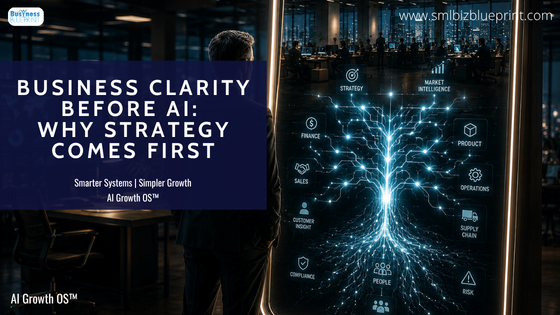

Learn why most AI initiatives struggle before implementation and how clear decision architecture creates scalable results.
Most businesses don’t have an AI problem—they have a business clarity problem.
AI can only execute decisions, priorities, and processes that have already been made explicit, so organisations with unclear decision-making simply automate inconsistency instead of improving performance.
Before investing in AI, business owners should focus on creating clear decision architecture, shared operating principles, and aligned business priorities, because AI doesn’t create organisational intelligence—it amplifies the intelligence that already exists.
The businesses that achieve sustainable growth with AI are not those with the most advanced technology, but those with the clearest thinking.
The conversation around artificial intelligence is dominated by capability. Businesses compare models, evaluate platforms, and search for the next breakthrough feature, assuming better technology naturally produces better business outcomes.
It rarely does.
The organisations creating lasting value from AI are not distinguished by the software they purchase. They are distinguished by the quality of the thinking those systems inherit.
This exposes a structural weakness that has existed long before AI entered the workplace.
Most growing businesses operate through accumulated judgement rather than explicit design. Leaders know which customers deserve priority, when to protect margin instead of revenue, how quality should be assessed, and where exceptions should be made.
These decisions are made consistently because experienced people have internalised them—not because the business has clearly defined them.
That distinction matters.
As a business grows, judgement spreads across more people, departments, and eventually technology. Small differences in interpretation become operational friction.
Marketing defines an ideal customer one way. Sales defines it another. Operations optimises for efficiency while Customer Success protects relationships.
Everyone makes sensible local decisions, yet the organisation slowly loses strategic coherence.
The symptoms are familiar: inconsistent execution, growing management overhead, longer onboarding, conflicting priorities, and AI initiatives that improve individual tasks without improving business performance.
Most leadership teams treat these as execution problems.
They are not.
They are architecture problems.
One pattern appears repeatedly in growing businesses. Leadership teams spend months improving execution while assuming everyone already shares the same understanding of how decisions should be made. They don’t.
The business continues functioning because experienced people quietly bridge the gaps. AI simply removes that safety net.
Every organisation has a decision architecture, whether it has deliberately designed one or not. It is the collection of priorities, principles, decision criteria, and trade-offs that govern how decisions are made throughout the business.
Business clarity is not the asset. It is the outcome of strong decision architecture.
AI doesn’t force businesses to become more digital.
It forces them to become more explicit.
Unlike experienced employees, AI cannot infer unwritten expectations. It executes only what has been made visible. Where decision architecture is coherent, AI reinforces consistency. Where it is fragmented, AI scales fragmentation with remarkable efficiency.
This is why so many AI pilots appear successful while broader transformation disappoints. The technology performs exactly as instructed. The organisation does not.
The implication extends well beyond artificial intelligence.
Businesses have traditionally documented processes while leaving judgement undocumented. Processes describe activities.
Decision architecture explains why those activities occur, how trade-offs are resolved, and which principles remain stable as circumstances change.
That is a fundamentally different organisational asset.
Businesses creating sustainable advantage are not simply implementing AI.
They are making their judgement executable.
Once judgement becomes executable, the business itself changes. Decisions become organisational assets instead of personal expertise.
Growth becomes less dependent on individual capability and more dependent on the strength of the decision architecture everyone inherits.
Technology becomes the amplifier, not the advantage.
The advantage comes from building a business whose knowledge, decisions, and operating principles no longer depend on individual memory. Every future AI investment then compounds instead of competes.
The objective is not simply to automate work.
It is to build a business capable of making consistently good decisions at scale.

Most AI Problems Begin Before AI
The most expensive AI mistake happens before anyone writes a prompt, purchases software, or launches a pilot.
It happens when leaders assume they are introducing AI into a business that already thinks consistently.
Most organisations are more dependent on individual judgement than they realise.
People describe the same customer differently. Departments optimise for competing outcomes. Experienced employees quietly compensate for broken processes because they know how things “really work.” Human adaptability hides structural ambiguity.
Then AI arrives.
Unlike people, AI cannot fill the gaps between inconsistent expectations. It forces the business to make its thinking explicit.
This challenges the dominant conversation around AI adoption.
Businesses keep asking, “Which platform should we choose?” when the more important question is, “What exactly are we asking AI to execute?”
Those are fundamentally different questions.
AI executes explicit business logic. Where business logic is unclear, AI reproduces inconsistency instead of eliminating it.
Imagine a marketing team using AI to create campaigns. Marketing optimises for awareness. Sales wants qualified opportunities. Customer Success wants realistic expectations. Leadership wants profitable growth.
Each prompt reflects a different interpretation of success. The AI performs well every time, yet the outputs conflict because the organisation never agreed on the underlying objective.
The technology didn’t fail.
The business never defined a shared decision.
Interestingly, businesses rarely discover this problem during growth. They discover it the first time AI produces three different answers to what everyone assumed was one straightforward business decision. The disagreement was always there. AI simply removed the ability to hide it.
This is the overlooked reason so many AI initiatives deliver impressive demonstrations but disappointing organisational outcomes.
Demonstrations occur inside controlled environments with clear objectives.
Businesses operate in environments where objectives compete every day.
Perhaps the most surprising insight is this:
AI is not primarily an automation technology.
It is an organisational mirror.
It reflects the quality of a business’s decision architecture back to its leaders.
The clearer the organisation becomes, the more valuable AI becomes. The more ambiguous the organisation remains, the faster that ambiguity spreads.
That shifts the starting point for every AI strategy. Instead of mapping software capabilities, leaders should map recurring business decisions.
Which decisions already have clear criteria?
Which depend entirely on experience?
Which exist only because one person remembers how they have always been made?
Those answers reveal far more about AI readiness than any technology assessment.
Businesses that automate before clarifying how decisions should be made don’t eliminate inconsistency—they industrialise it.
As your business grows, your role changes. You are no longer responsible for making every important decision yourself. You are responsible for designing the decision architecture that produces good decisions consistently.
Every new AI workflow built on unclear foundations becomes another source of operational variation. The longer that continues, the harder the organisation becomes to align, because every new capability inherits a different interpretation of how the business should operate.
Pro Tip:
Before introducing AI into any business function, ask one question: Could three experienced managers explain this decision in exactly the same way?
If the answer is no, don’t optimise the process yet. Clarify the decision first. Speed isn’t the competitive advantage. Shared judgement is.
A business owner spent weeks refining AI prompts because every output felt slightly wrong.
The marketing sounded inconsistent, proposals varied between team members, and customer emails never quite matched the company’s voice.
Eventually, the problem became obvious: every manager described the business differently. The prompts weren’t improving because the business itself hadn’t agreed on how it made decisions.
He stopped chasing better prompts and started documenting better thinking. That was the moment he began building a business instead of relying on memory.
Why Business Clarity Is the Real Prerequisite
Business clarity is often mistaken for better communication.
It is something much deeper.
Communication distributes understanding.
Decision architecture defines it.
Many businesses believe they have communication problems because employees ask questions, departments disagree, or leaders repeat the same messages. In reality, those behaviours often point to something more fundamental.
The organisation has never agreed on how important decisions should be made.
Communication cannot solve that problem. It simply distributes ambiguity faster.
Decision architecture is the collection of priorities, principles, decision criteria, and trade-offs that allow an organisation to make consistent decisions.
Most businesses already possess this architecture.
The problem is that it exists as institutional memory rather than organisational capability.
Founders often underestimate how much of their business exists only inside conversations.
Ask three experienced managers how they qualify a customer, prioritise work, or resolve an exception and you’ll often hear three slightly different answers.
None of them are necessarily wrong. They simply reflect years of personal interpretation rather than one shared operating model.
The business still functions because experienced people compensate for ambiguity.
AI doesn’t compensate.
It executes whatever judgement has been made explicit.
Growth changes that equation.
As decision-making spreads across more people, undocumented judgement becomes organisational risk. Different interpretations emerge naturally because no shared framework exists beneath them.
This is why AI implementation often feels uncomfortable.
The technology isn’t exposing technical weaknesses.
It’s exposing the assumptions leadership never realised were still unwritten.
This is why deals feel close but stall. Marketing, Sales, and Delivery often operate from different definitions of customer value.
AI faithfully reinforces each team’s understanding, making inconsistency more visible rather than less.
Strong organisations recognise something many others overlook.
Documentation is not clarity.
Documentation records decisions.
Decision architecture determines them.
That distinction separates businesses that scale through systems from businesses that continue depending on experienced individuals to hold everything together.
Businesses without explicit decision architecture create AI systems that deliver technically correct outputs but strategically inconsistent outcomes.
The longer important judgement remains trapped inside individuals, the more every new employee, every new manager, and every new AI capability increases organisational complexity instead of reducing it.
Your competitive advantage is no longer the quality of decisions made by your best people.
It is the ability of the whole organisation to make those decisions consistently.
Businesses rarely lose momentum because they stop making good decisions. They lose momentum because good decisions become increasingly inconsistent as responsibility spreads across the organisation.
Pro Tip:
Before documenting workflows, document the decisions that create those workflows.
Processes evolve with the business. Decision principles become the stable foundation every future process—and every future AI system—can inherit.

What Every Business Must Define Before Implementing AI
Most AI implementation plans begin with technology.
They should begin with decisions.
Businesses naturally ask where AI can save time. The more valuable question is where the organisation repeatedly makes the same judgement.
Productivity is a consequence. Decision consistency is the strategic objective.
This is the hidden assumption behind many failed AI initiatives.
Leaders assume AI performs work.
In reality, AI performs judgement that has already been made explicit.
If that judgement hasn’t been defined, AI cannot invent it.
It simply produces different interpretations with remarkable speed.
Before implementing AI, every business should make four elements explicit.
Priorities.
Decision criteria.
Shared language.
Ownership.
Priorities establish which objectives take precedence when trade-offs arise. Decision criteria explain how opportunities are evaluated. Shared language ensures everyone attaches the same meaning to terms like “high-value customer” or “urgent.”
Ownership makes accountability clear even when AI participates in execution.
Together, these elements create a decision architecture that technology can reinforce rather than reinterpret.
AI scales decisions before it scales productivity.
Consider a manufacturing business where Sales promise rapid delivery, Operations optimise production efficiency, and Finance protects margins. Each function behaves rationally.
Yet if leadership has never defined which objective takes precedence when those priorities conflict, AI simply accelerates local optimisation while weakening organisational alignment.
The problem is not automation.
The problem is unresolved judgement.
One of the earliest signs that decision architecture is weak isn’t operational failure.
It’s constant clarification.
Leaders find themselves answering the same questions every week because the organisation hasn’t yet decided how those questions should be answered without them.
The business keeps moving forward, but it does so by repeatedly borrowing judgement from the same people instead of building organisational capability.
This is why your pipeline looks strong but doesn’t convert consistently. Different parts of the business are often working from different definitions of an ideal customer. AI improves every stage individually while widening the gaps between them.
The businesses that scale successfully understand a fundamental shift.
Leadership is no longer measured by how many decisions it makes.
Leadership is measured by how clearly it designs the thinking that everyone else—including AI—can execute consistently.
That is the transition from managing expertise to designing decision architecture.
Businesses that automate unclear decisions create faster inconsistency. Businesses that clarify decisions first create scalable judgement.
Every undocumented decision increases dependence on individual experience instead of organisational capability. Eventually growth becomes constrained by the number of people who “just know how things work.”
The organisations that grow most effectively aren’t necessarily those with the smartest people.
They’re the ones that make good judgement transferable.
Pro Tip:
Before asking, Can AI automate this?, ask, Could we explain this decision to a new employee in one page?
If the answer is no, AI isn’t the constraint. Organisational clarity is.
Why AI Pilots Succeed but Fail to Scale
Many AI pilots produce impressive results.
Content is generated faster. Reports are summarised automatically. Customer enquiries receive quicker responses.
A single team demonstrates measurable productivity gains, creating confidence that the rest of the organisation will experience the same success.
Then the rollout begins.
Momentum slows. Different departments adopt different tools, develop their own prompt libraries, and optimise for their own objectives.
Productivity improves locally while organisational complexity increases globally.
This is often blamed on poor change management or employee resistance.
Those factors matter, but they rarely explain the whole picture.
Pilots succeed because they operate inside a clearly defined boundary. Scaling exposes every inconsistency that exists beyond it.
AI scales locally through workflows but scales organisationally through shared decision architecture.
A successful pilot usually has one owner, one objective, and one definition of success. Once AI begins operating across marketing, sales, operations, finance, and customer service, those shared assumptions disappear.
Questions emerge immediately.
Which customer data becomes the source of truth?
Which pricing rules take precedence?
How should conflicting recommendations be resolved?
Who decides when an exception should override the standard process?
These are not technology decisions.
They are business decisions.
This explains why organisations often feel disappointed after successful pilots. The technology continues performing well, but it inherits conflicting interpretations of how the business should operate.
The real challenge is no longer implementation.
It is governance.
This is why your sales team keeps re-explaining the same thing on calls. Each salesperson has developed a slightly different interpretation of your value proposition because no shared decision model exists beneath the messaging.
Businesses frequently believe they are scaling AI.
In reality, they are scaling interpretations.
The organisations creating sustainable advantage take a different approach. They expand a shared decision architecture before they expand AI capability. Every new workflow reinforces the same principles rather than introducing another way of working.
Growth becomes cumulative rather than fragmented.
Businesses that scale isolated AI successes create islands of efficiency surrounded by operational friction.
Every successful AI pilot creates pressure to expand.
Without shared decision architecture, each expansion increases complexity faster than capability. The cost is rarely visible immediately, but it compounds through inconsistent customer experiences, duplicated knowledge, and increasing management effort.
Pro Tip:
Before scaling any AI initiative, identify the business decisions that made the pilot successful.
Replicate the decision model first. The workflow is only valuable because the underlying judgement is consistent.
A growing manufacturing company celebrated a successful AI pilot in customer service.
Encouraged by the results, each department introduced its own AI workflows. Six months later, productivity had improved, but customers were receiving conflicting information depending on who they spoke with.
Leadership paused every new implementation and mapped the business’s decision principles first. Future AI projects suddenly reinforced each other instead of competing.
The company stopped scaling tools and started scaling judgement
Building an AI Operating Model Around Clear Decisions
Many businesses believe an AI operating model is a collection of software platforms.
It is not.
An operating model is the system through which an organisation repeatedly converts decisions into outcomes. AI simply becomes another participant within that system.
This distinction changes implementation entirely.
Instead of asking, “Which AI agent should perform this task?” leaders should ask, “Which business decision should this system reinforce?”
The second question produces a fundamentally different organisation.
Departments stop optimising independently and begin contributing to a shared decision architecture.
An AI operating model is decision architecture made executable across people, processes, and technology.
Notice what sits at the centre.
Not technology.
Decisions.
Technology changes rapidly. Business principles change slowly. The operating model should therefore be designed around the stable parts of the organisation rather than the software available today.
This is why documenting reasoning is ultimately more valuable than documenting procedures.
Procedures evolve as markets, technology, and customer expectations change. The principles used to evaluate opportunities, allocate resources, assess quality, and manage risk become the enduring intelligence of the business.
That intelligence is what every future AI capability should inherit.
Knowledge therefore stops being something the business stores.
It becomes something the business operates.
One pattern is becoming increasingly clear.
The businesses making the fastest progress with AI are not necessarily buying more technology. They are spending more time deciding how the business should think before asking technology to execute that thinking. That work feels slower initially, but it compounds every future improvement.
That is the real purpose of an AI operating model.
Not to automate work.
To ensure every future decision is reinforced by the same organisational judgement.
Leadership evolves at this point.
Your responsibility is no longer to make the best decisions personally. It is to design an environment where consistently good decisions occur without depending on your direct involvement.
That is the shift from leading through expertise to leading through architecture.
Businesses without an AI operating model become collections of capable individuals. Businesses with one become coherent decision systems that become stronger every time a new person, process, or AI capability is added.
Every month your organisation grows without explicit decision architecture, complexity compounds faster than capability. More people solve the same problems differently, and AI faithfully reinforces every variation.
Pro Tip:
Build your AI operating model around recurring business decisions rather than recurring tasks.
Tasks will continue changing as technology evolves. Strong decision architecture remains valuable regardless of which tools the business adopts.
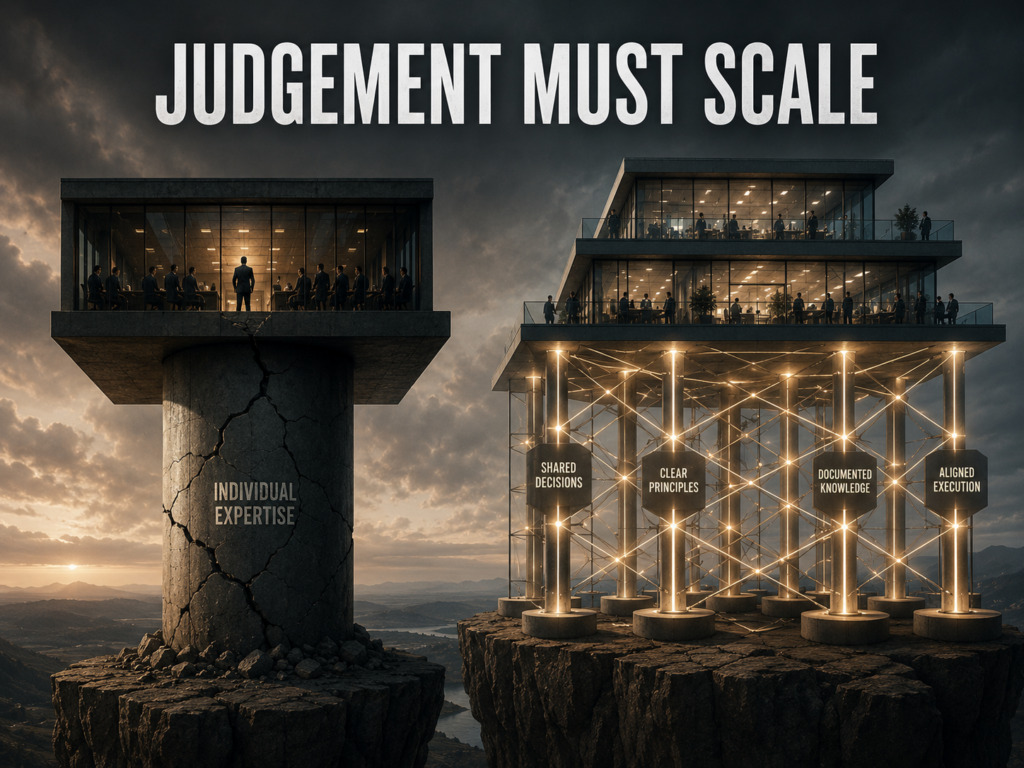
From Scattered AI Experiments to Sustainable Business Growth
Much of the discussion around AI focuses on acceleration.
Faster content.
Faster analysis.
Faster reporting.
Faster execution.
Useful outcomes, certainly.
But speed is rarely the constraint preventing businesses from growing.
Consistency is.
Businesses do not struggle because they cannot produce more activity. They struggle because important decisions become less consistent as complexity increases.
That is why isolated AI successes rarely transform an organisation.
Each initiative improves a local problem while the business continues operating from multiple interpretations of success.
The danger is not failed experimentation.
It is successful fragmentation.
Every independent AI workflow creates another version of how the business thinks unless all of them inherit the same decision architecture.
This is why AI maturity should never be measured solely by adoption rates or productivity improvements.
It should also be measured by decision consistency.
Sustainable AI growth occurs when every implementation strengthens the organisation’s shared way of making decisions.
That changes what success looks like.
Success is not deploying dozens of AI agents.
Success is creating a business where every new capability reinforces the same operating principles.
The result is something far more valuable than automation.
It is organisational memory.
Businesses that preserve consistent judgement adapt more quickly because they no longer rebuild their thinking every time circumstances change. They simply apply the same principles to new situations.
That capability compounds.
Knowledge compounds.
Decision architecture compounds.
AI compounds.
But only when each investment strengthens the same foundation.
The businesses most likely to flourish over the next decade will not necessarily possess the most advanced AI.
They will possess the clearest organisational thinking.
AI will simply allow that thinking to operate at a scale that was previously impossible.
Organisations that pursue isolated AI wins accumulate complexity. Organisations that strengthen shared decision architecture accumulate momentum.
Every month spent optimising disconnected workflows delays the creation of a business capable of compounding its knowledge.
Eventually competitors are no longer winning because they automate more. They are winning because every improvement builds upon the last.
Pro Tip
Evaluate every AI initiative using one question: Does this strengthen how the whole business makes decisions, or only improve one department?
Sustainable advantage comes from compounding organisational judgement, not isolated productivity gains.
Walk through almost any growing business and you’ll hear people say, “That’s just how we do it.”
Those six words often hide the most expensive risk in the organisation. They usually mean the business depends on memory instead of design.
The companies that outperform don’t eliminate experience—they convert experience into systems that everyone can execute.
Conclusion
Many business owners believe they are beginning an AI transformation.
Most are beginning something much more important.
They are discovering whether their business can think consistently.
AI did not create the underlying problem.
It simply removed the ability to hide it.
That is encouraging rather than discouraging.
If technology were the true competitive advantage, every organisation could eventually buy the same capability. Clear decision architecture is much harder to replicate.
The businesses that outperform during the next decade will not do so because they discovered a better prompt or adopted another AI platform before everyone else.
They will outperform because they built businesses capable of making consistently good decisions regardless of who—or what—executes the work.
That is the real transformation.
AI is not changing how businesses work.
It is changing what kind of business can compete.
The organisations that create lasting advantage will not simply adopt AI more quickly. They will make their judgement explicit enough that it can be executed consistently by both people and technology.
Information is becoming abundant. AI capability is becoming widely accessible. Clear decision architecture is becoming the scarce strategic asset.
Interestingly, this means the winners of the next decade may not look dramatically different from today’s successful businesses.
They’ll still market, sell, deliver, and serve customers. The difference will exist beneath the surface.
Their judgement will no longer depend on who happens to be in the room. It will exist as an organisational capability that every person—and every AI system—can execute consistently.
Once judgement becomes executable, every future investment reinforces the same operating model.
Knowledge compounds instead of fragmenting. AI strengthens consistency instead of introducing variation.
Growth becomes more deliberate because the business no longer depends on individual memory to maintain quality.
Your current way of operating is not fixed.
It is simply the result of decisions that have never been made explicit.
You can continue adding AI to a business that still relies on interpretation, hoping technology eventually creates alignment.
Or you can build the decision architecture that allows every future AI capability to reinforce the same strategy, the same priorities, and the same way of making decisions.
That is the choice.
Not whether to adopt AI.
Whether AI will amplify confusion—or amplify clarity.
The businesses that flourish will not be those that implemented AI first.
They will be those that made their judgement executable before everyone else.
Action Steps
Map your recurring business decisions before mapping AI opportunities.
List the decisions your leadership team makes every week—not the tasks they perform. This exposes where organisational judgement already exists and where AI can eventually reinforce consistency. The decision consequence is simple: automate decisions before they’re defined, and you automate variation.
Define the principles behind your most important processes.
Instead of documenting what happens, document why it happens. Capture the criteria used to prioritise customers, approve work, allocate resources, or resolve exceptions. Strategically, this creates a decision architecture that survives staff changes, making every future AI implementation more consistent.
Identify where different teams interpret the same goal differently.
Compare how Sales, Marketing, Operations, and Customer Success define success, quality, urgency, and customer value. Alignment at the decision level removes downstream friction that no amount of automation can fix. The consequence of ignoring this is faster execution of conflicting priorities.
Audit where your business depends on individual judgement.
Highlight the work that only certain experienced people can perform because “they just know.” Those knowledge bottlenecks represent organisational risk more than operational strength. Every undocumented decision increases dependency on individuals instead of strengthening the business itself.
Build one shared decision model before deploying multiple AI solutions.
Create a common framework that guides priorities, trade-offs, and business rules across every department. This allows future AI initiatives to reinforce the same operating logic instead of creating isolated optimisations. The decision consequence is compounding organisational intelligence rather than fragmented productivity.
Measure AI success by decision consistency, not productivity alone.
Productivity improvements matter, but they should be viewed as evidence of better organisational thinking rather than the primary objective. Businesses that optimise only for speed eventually create operational complexity; businesses that optimise for clarity create systems that improve every future decision.
FAQs
Because AI executes business logic rather than creating it. If priorities, decision rules, and operating principles remain unclear, a better AI tool simply produces inconsistent results more efficiently. Define the business first, then scale it with technology.
What does “business clarity before AI” actually mean?
It means making your decision criteria, priorities, and operating principles explicit before introducing automation. AI performs best when it can execute shared organisational thinking instead of interpreting conflicting expectations.
Why do many AI pilots succeed but fail to scale?
Pilots usually solve one clearly defined problem within one team. Scaling exposes differences in how departments make decisions, measure success, and interpret customer value. Standardise decision architecture before expanding successful pilots.
How do I know if my business is ready for AI?
Your business is ready when important decisions can be explained consistently regardless of who performs them. If experienced employees frequently answer questions with “it depends” or “that’s just how we do it,” more organisational clarity is needed before broader AI adoption.
Should we document processes or decisions first?
Start with decisions. Processes describe activities, but decisions explain why those activities happen and how exceptions are handled. Strong decision architecture creates processes that remain effective even as technology and workflows evolve.
Does this approach replace AI implementation planning?
No. It strengthens it. Implementation planning determines how technology is deployed, while decision architecture determines whether that technology reinforces consistent business outcomes or accelerates organisational inconsistency.
What is the biggest mistake businesses make when adopting AI?
Treating AI as a technology project instead of an organisational design project. The businesses creating lasting advantage are redesigning how decisions are made, then using AI to execute those decisions consistently across the organisation.
Bonus Insight: Three Shifts That Change How You Think About AI
Most businesses are trying to become better at using AI.
That sounds sensible. It is also the wrong objective.
The organisations creating lasting advantage are becoming better at understanding themselves. AI is simply the mechanism that exposes whether that understanding exists.
This is why two businesses can buy the same technology and achieve completely different outcomes. One automates work. The other redesigns how the business thinks.
The more AI evolves, the less technology becomes the differentiator. Organisational clarity does.
Here are three shifts that challenge the default way of thinking.
Stop Measuring AI Adoption. Start Measuring Decision Consistency.
Many leadership teams track how many people are using AI. They should be tracking whether important decisions are becoming more consistent across the business.
An organisation where everyone uses AI differently has not increased capability—it has increased variation.
This is what you are doing wrong: You’re measuring technology usage instead of organisational alignment.
Adoption tells you who is using AI. Decision consistency tells you whether AI is strengthening the business.
If this doesn’t change: Complexity will grow faster than capability.
Your Biggest Knowledge Asset Isn’t Information. It’s Judgement.
Businesses invest enormous effort documenting information while leaving judgement trapped inside experienced people.
Information explains what happened.
Judgement determines what should happen next.
AI becomes dramatically more valuable when it inherits judgement instead of merely accessing documents.
That’s the difference between building a searchable business and building an executable business.
If this doesn’t change: Your business will continue depending on people instead of systems.
Scale Doesn’t Come From Automation. It Comes From Shared Thinking.
Most leaders assume growth requires adding more capability.
Growth usually requires reducing interpretation.
When everyone works from the same decision architecture, every new employee, every new process, and every future AI capability strengthens the same operating model.
Momentum begins to compound because the organisation is no longer recreating its own thinking.
If this doesn’t change: Every improvement will solve a local problem while making the whole organisation harder to coordinate.
The businesses that create enduring advantage won’t simply become AI-enabled.
They’ll become organisations whose thinking is clear enough to be executed consistently—by people today and by technology tomorrow.
Other Articles
Scaling Without Losing Organizational Knowledge
Converting Meeting Notes Into Business Intelligence
Why Every Growing Business Needs an AI Knowledge Management System