
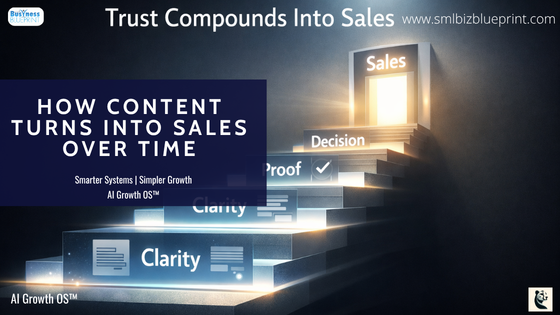

Content turns into sales by reducing buyer uncertainty across multiple, structured interactions—not single conversion events.
Buyers move when enough aligned signals accumulate to make the decision feel safe, justified, and inevitable.
When content is designed as a trust system, it compounds into predictable revenue by shortening sales cycles and improving conversion quality.
A step-by-step breakdown of how trust compounds into revenue across the buyer journey.
Most content underperforms because it is built as output while being expected to function as infrastructure.
The structural failure is not creative. It is economic.
Businesses invest in content expecting it to generate pipeline, accelerate sales, and improve conversion.
Instead, they see uneven results—engagement without movement, visibility without velocity. The issue is rarely the content itself. It is that the system producing it is not aligned with how buyers make decisions.
Content is treated as a publishing function. Sales is treated as the conversion function. Trust is left unstructured between them.
That gap creates friction.
Buyers encounter content that informs but does not resolve. They enter sales conversations partially convinced but still uncertain. Sales teams compensate by re-explaining, re-framing, and re-justifying decisions that should have been pre-processed earlier.
The business absorbs this inefficiency as longer sales cycles, lower close confidence, and inconsistent pipeline quality.
This is the hidden cost.
Content appears to be working because it generates activity. Sales appears to be working because deals still close.
But the system between them is inefficient. Each deal requires more human effort than it should. Each conversion depends on real-time persuasion instead of pre-built certainty.
That inefficiency compounds financially.
Customer acquisition cost rises because more interactions are required per deal. Sales capacity is constrained because each opportunity takes longer to convert. Conversion rates fluctuate because decision readiness varies widely across leads.
Growth becomes dependent on effort rather than system strength.
Most teams misdiagnose this.
They assume the solution is more content, better creative, or stronger calls to action. These adjustments improve surface performance, but they do not fix the structural issue.
The issue is not what content says. It is what role content plays inside the revenue system.
The architectural shift is this: content is not a marketing output. It is a trust transfer system.
Once this is clear, the objective changes. Content is no longer judged by isolated performance. It is judged by whether it reduces the next layer of buyer uncertainty and prepares the next stage of decision readiness.
Each piece must do a specific job. Each interaction must build on the last. Each signal must reinforce a coherent position.
This is what changes the economics.
When content accumulates trust before the sales conversation, the conversation itself becomes lighter. Less explanation is required. Fewer objections surface.
Decisions happen faster because the groundwork is already complete.
This is not a marginal improvement. It is a structural shift in how revenue is produced.
Ignoring this keeps the business in a cycle where growth requires constant effort: more calls, more persuasion, more manual explanation. Adopting it shifts the burden from people to system design.
Content stops being a cost centre. It becomes a leverage mechanism.
You’re publishing consistently. The message is clear. The quality is high. But sales don’t move in proportion.
That disconnect is where many established businesses sit. Content generates attention, sometimes even strong engagement, but the commercial return feels delayed, inconsistent, or unclear.
Over time, that creates pressure. The strategy starts to feel uncertain. Teams question whether content actually drives revenue or just activity.
The assumption underneath that frustration is simple: content should produce immediate results.
Publish, attract, convert.
But that assumption breaks under real buying behaviour.
Buyers do not make meaningful decisions the moment they understand something. They act when enough evidence accumulates that the decision feels safe.
That process is rarely visible in a single interaction. It builds across multiple exposures, each one reducing a different layer of uncertainty.
That is why content feels slow.
Not because it is ineffective, but because it is working on a different timeline than expected.
The risk is not just wasted effort. It is strategic misalignment. When content is judged too early, businesses abandon systems that were quietly building future conversion efficiency. They shift toward tactics that feel immediate but do not compound.
There is a better lens.
Content is not a conversion trigger. It is a system that transfers trust over time. When structured correctly, it reduces friction before the sales conversation even begins.
That is what turns content into revenue.
Why Content Fails to Convert Immediately
Content fails when it is expected to close instead of reduce resistance.
Most businesses evaluate content through a direct-response lens. Did it convert? Did it generate leads? Did it produce immediate pipeline?
That lens assumes that decision readiness exists at the moment of interaction.
In reality, most buyers are not ready.
They may understand the problem. They may even agree with the insight. But they have not resolved the internal questions that govern action: Is this the right solution? Is the timing right? Is the cost justified? What happens if we choose incorrectly?
Content that does not address those questions will not convert, regardless of quality.
This is where the misinterpretation happens.
A strong piece of content may clarify thinking, but not remove risk. Another may validate relevance, but not justify timing. Another may demonstrate capability, but not resolve cost concerns.
Each piece contributes, but none completes the process alone.
Conversion is not a moment. It is the release of accumulated certainty.
When content is judged in isolation, that accumulation is invisible. Valuable assets are labelled ineffective simply because they do not produce immediate outcomes.
That leads to a predictable pattern: teams shift toward short-term tactics, increase volume, or chase more aggressive calls to action. The system becomes louder, but not more effective.
The better approach is to evaluate content based on the resistance it removes.
Does it clarify the problem?
Does it validate the approach?
Does it reduce perceived risk?
Does it support the decision?
Each of those moves the buyer forward.
If content is not designed to reduce specific decision friction, it will generate attention without accelerating revenue.
Pro tip
Reframe performance analysis around resistance removal.
That is where conversion actually begins.
He had a content calendar filled three months ahead. Articles published weekly, videos recorded in batches, everything “consistent.” But each Monday, the pipeline looked the same—active, but not advancing.
The shift came when he realised he wasn’t building trust—he was just maintaining visibility. Nothing connected. Nothing progressed.
He stopped chasing output and started structuring intent. That’s when content stopped feeling busy—and started becoming decisive.
He stopped publishing content and started designing outcomes.
The Trust Timeline and Repeated Exposure
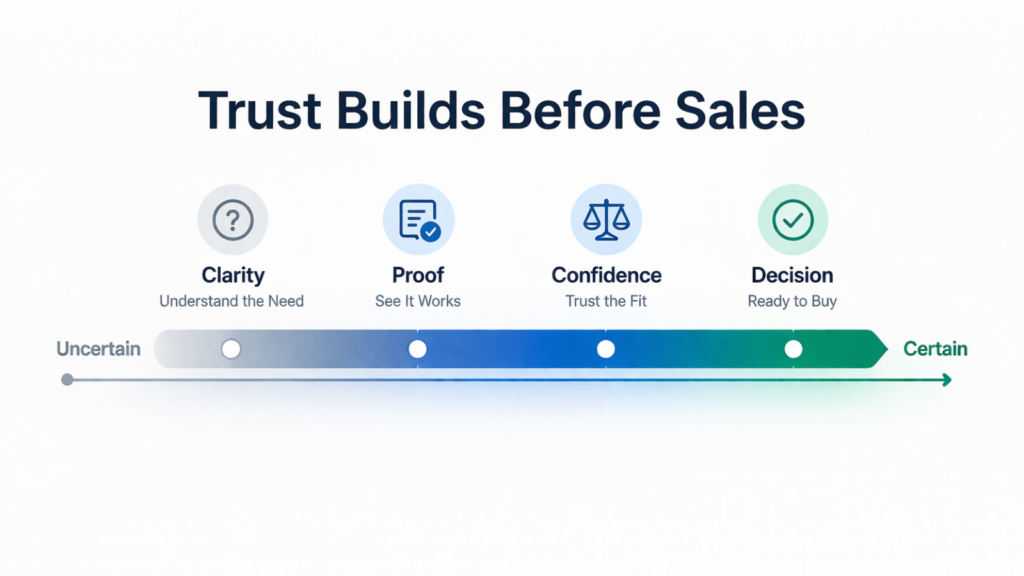
Buyers move through internal states, not funnel stages.
They begin uncertain. Then interested. Then convinced. Then ready. Each state has a different requirement, and content must match that requirement to be effective.
Most strategies ignore this. They create content around topics or formats, not around decision readiness. The result is misalignment.
High-value content reaches the buyer at the wrong moment and fails to move them forward.
Repeated exposure corrects this—but only when it is structured.
Repetition without alignment creates noise. Repetition with coherence creates pattern recognition. Pattern recognition creates confidence.
This is the mechanism.
When buyers encounter consistent messaging across multiple interactions, they stop evaluating each piece independently. They begin to recognise stability. The business appears predictable, clear, and reliable.
That perception lowers cognitive effort and reduces perceived risk.
That is why consistency matters more than volume.
A single strong interaction can create interest. A sequence of aligned interactions creates inevitability. The buyer no longer needs to re-evaluate the decision from scratch each time.
You are not publishing information. You are building confidence through consistency.
Without this, content resets trust instead of compounding it. Each new interaction becomes a fresh evaluation. Momentum disappears.
Inconsistent content extends the path to purchase, even when quality is high.
Pro tip
Review your content as a sequence, not a collection.
If it does not feel cohesive, it is not compounding.

Content Types That Actually Move Buyers
Different content types perform different roles in the decision process.
Educational content builds awareness. It explains problems and introduces concepts.
Insight content reframes thinking and positions your perspective.
Proof content reduces uncertainty by showing real outcomes and evidence.
But the most critical layer is often missing: decision content.
Decision content exists at the point where interest becomes action. It addresses the unresolved questions that prevent commitment: timing, cost, risk, and consequences of delay.
Without it, the system stalls.
Businesses often produce strong educational and insight content. They attract attention and build credibility. But when buyers reach the point of decision, the content layer disappears. The burden shifts entirely to sales.
That creates inefficiency.
Sales conversations become longer. Objections surface later. Decisions require more persuasion. Pipeline appears healthy, but conversion lags.
Decision content closes that gap.
It does not push the buyer. It enables them. It helps them justify the decision internally before they ever speak to sales.
You are not creating content for attention. You are creating content that enables action.
Without decision content, growth depends on sales effort rather than system design.
Pro tip
Identify the top objections that delay deals and build content that resolves them before the sales conversation begins.
She had strong traffic and engaged readers, but deals kept stalling late in the cycle. Prospects liked the brand—but hesitated at the point of commitment.
The change was simple but precise: introduce content that directly addressed buying hesitation—cost, timing, and risk.
Within months, conversations shifted. Less explaining. Faster decisions.
She stopped educating her audience and started enabling their decisions.
How to Sequence Content for Compounding Trust
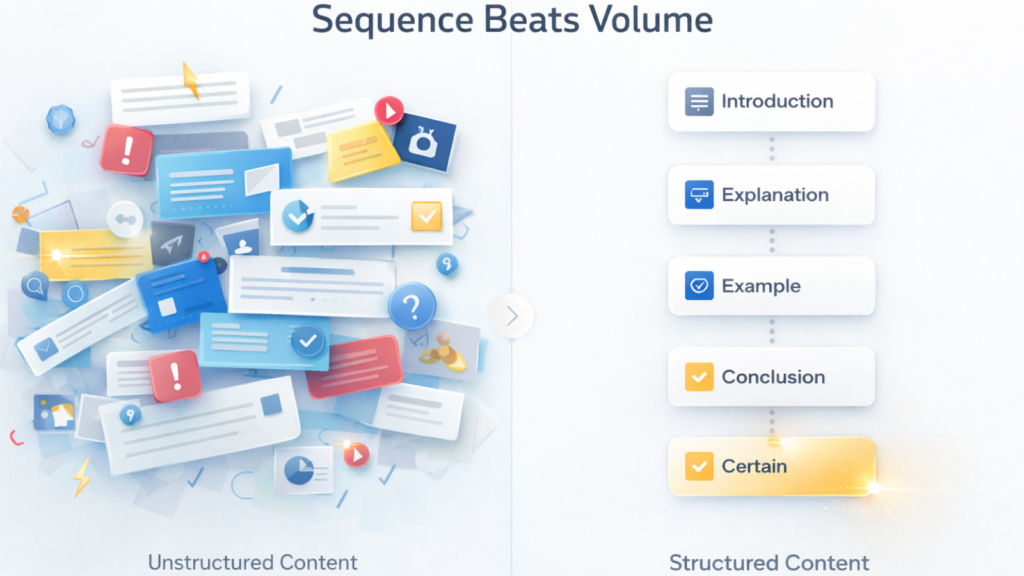
Content only compounds when it is sequenced.
Most strategies distribute content without structure. Buyers encounter pieces out of order, without context, and without progression.
Each interaction requires them to interpret, connect, and evaluate independently.
That creates friction.
Sequencing removes that friction by guiding the buyer through a logical progression of trust.
Clarity comes first. Then perspective. Then proof. Then decision support.
Each step reduces a different type of uncertainty. Each interaction prepares the next. The buyer does not need to assemble the narrative themselves.
This is where most content systems break.
They are designed for output, not progression. Content exists as a library, not a pathway. Buyers are left to navigate it alone.
The consequence is subtle but significant. Engagement exists, but momentum does not. Interest builds, but decisions stall.
Sequencing changes that.
When content is structured as a progression, the buyer experiences continuity. Each interaction feels like a continuation, not a reset. Trust accumulates without friction.
The easier the journey, the less persuasion is required to close.
Pro tip
Design content journeys, not content calendars.
The sequence determines the outcome.
Measuring When Content Is Actually Driving Sales
Most measurement frameworks fail because they isolate what is cumulative.
Content rarely drives a sale in a single interaction. It influences the decision across multiple touchpoints. Measuring only last-click conversion ignores most of that influence.
The real indicators sit in patterns.
Returning visitors.
Multi-touch journeys.
Shorter sales cycles.
Higher close rates after content exposure.
These signals show that trust is being built before the sales conversation.
There is another layer.
Content is not only influencing buyers. It is influencing systems. Search engines and AI models evaluate consistency, authority, and depth across your content.
They determine what is surfaced, summarised, and trusted.
That affects distribution.
If your content signals authority clearly, it gains visibility. If it does not, it remains hidden. This directly impacts how much trust-building exposure your business can generate at scale.
Content therefore operates on two levels: human trust and machine validation.
Both matter.
Without visibility, trust cannot scale. Without trust, visibility does not convert.
Pro tip
Track assisted conversions and sales velocity alongside traditional metrics.
That is where the real impact appears.
Turning Content Into a Predictable Revenue System
Content becomes predictable when it is designed to carry part of the sales function.
That is the shift.
Instead of relying on sales to explain, justify, and persuade in real time, content pre-processes those steps. It resolves core uncertainties before the conversation happens. It aligns expectations. It builds confidence.
The result is operational.
Sales conversations become shorter and more focused. Buyers arrive better prepared. Conversion becomes less variable because decision readiness is more consistent.
This changes the economics of growth.
Less time per deal.
Higher conversion efficiency.
Lower cost of acquisition.
Greater scalability.
That is what a content system produces.
Most businesses never reach this point because they stay in production mode. They create continuously but without structural alignment. The output increases, but the system does not improve.
Predictability does not come from more content. It comes from better design.
You are not publishing to be seen. You are building a system that makes decisions easier.
Without structural design, content remains effort-heavy and return-light.
Pro tip
Document how each piece of content contributes to decision readiness.
That is how systems scale.
Action Steps
Map Buyer Uncertainty Instead of Funnel Stages
Identify the top 5–7 doubts your buyers hold before purchasing. Build content specifically to resolve each one in sequence.
Audit Content for Trust Gaps
Review your last 20–30 pieces of content and categorise them by what resistance they remove. Identify missing layers.
Introduce Decision-Oriented Content
Create content that directly addresses timing, cost justification, and risk—not just education.
Design a Content Sequence
Structure content so each piece logically prepares the next interaction, reducing friction across exposures.
Track Multi-Touch Influence
Measure repeat visits, assisted conversions, and shortened sales cycles—not just last-click attribution.
Standardise Messaging Across Content
Ensure positioning, language, and insight remain consistent to reinforce familiarity and reduce cognitive load.
Document the Content System Logic
Define how content builds trust step-by-step so the system can scale beyond individual contributors.
Most businesses believe trust is earned through time. It isn’t. It’s earned through consistency of signal.
A buyer can trust you in weeks—or doubt you for years—depending on how clearly your content aligns.
The real risk isn’t that content takes time. It’s that misaligned content wastes it.
Clarity doesn’t speed up time—it compresses it.
Conclusion
The issue is not that content takes time. It is that most content systems are not designed to produce results over time.
That is why the effort feels disconnected from the outcome. The work is being done, but the structure that allows it to compound is missing.
Once that structure is introduced, the lag becomes meaningful. It represents trust building, not wasted effort.
Content stops being a series of isolated actions and becomes a system that reduces uncertainty, aligns decisions, and supports sales before conversations even begin.
The cost of ignoring this is not just slower growth. It is continued dependence on manual persuasion, inconsistent conversion, and a system that cannot scale cleanly.
The alternative is available.
Design content to build trust in sequence. Align it with how decisions are actually made. Measure it by the progression it creates.
The businesses that move forward will not be those that publish more. They will be those that structure content to make buying easier.
The choice is structural.
Stay in output mode, or build a system that compounds.
FAQs
Why doesn’t content convert into sales immediately?
Because buyers need multiple interactions to build enough confidence to act.
How long does content take to generate sales?
It depends on the complexity of the decision, but typically weeks or months rather than a single interaction.
What type of content drives the strongest results?
Content that reduces decision friction—especially proof and decision-focused content—has the highest impact.
Why do strong articles still fail to convert?
Because they are not aligned with the buyer’s trust stage or part of a structured sequence.
How can I tell if content is working?
Look for repeat engagement, assisted conversions, and shorter sales cycles.
How does AI affect content performance?
AI systems influence what content is surfaced and trusted, making consistency and authority critical.
How many touchpoints does it take before a buyer converts?
There is no fixed number, but most buyers require multiple exposures before making a decision.
Bonus Insight: The Layer Most Businesses Never See
Most businesses believe content is about visibility.
Say the right things, show up consistently, stay top of mind.
That assumption feels reasonable—but it quietly limits everything.
Because it frames content as communication, not as influence. As output, not as structure.
The result is subtle but costly: you produce more, but you don’t compound. You reach people, but you don’t move them.
And over time, content becomes something you maintain—not something that transforms how your business grows.
There’s a different way to look at it. Not as content strategy—but as decision architecture.
- You’re Treating Content as Expression—Not Pre-Decision Design
This is where most businesses get it wrong.
You’re creating content to say something.
But buyers don’t act because you said something—they act because a decision feels resolved.
That’s the gap.
Content is not about expressing ideas. It’s about shaping the conditions in which a decision becomes obvious. By the time a buyer reaches your sales process, their interpretation is already forming.
The conversation doesn’t create trust—it reveals whether it exists.
What this changes:
You stop asking, “What should we publish?”
And start asking, “What must the buyer believe before they decide?”
That shift turns content into something quieter, but far more powerful.
Not louder messaging—but clearer inevitability.
- Your Content Isn’t Just External—It’s Structuring How Your Business Thinks
Most leaders treat content as a marketing function. Something that sits outside the core of the business.
But watch closely.
When content is inconsistent, teams drift. Sales tells one story, marketing tells another, leadership sees something else entirely.
Confidence drops—not because the strategy is wrong, but because it isn’t clearly expressed anywhere.
Content, done properly, becomes a stabilising force.
It aligns language. It sharpens positioning. It creates a shared narrative that the entire business operates from. Not by instruction—but by repetition.
What this changes:
Content stops being something you publish.
It becomes something that organises how your business thinks.
And when thinking aligns, execution accelerates.
- The Real ROI of Content Is Not Reach—It’s Time Compression
Most people measure content by attention.
Views, clicks, impressions.
But that’s not where the real leverage sits.
The real value of content is what it removes.
Every strong piece of content answers a question before it’s asked. Resolves a doubt before it’s spoken. Clarifies a decision before it’s debated.
That doesn’t just improve marketing—it changes how time moves inside your business.
Fewer repetitive explanations.
Shorter sales cycles.
Faster decisions with less friction.
What this means is simple: content doesn’t just scale visibility—it scales understanding.
And when understanding is pre-built, growth no longer depends on how many conversations you can have. It depends on how well those conversations have already been shaped.
If you step back, the pattern becomes clear.
Content is not just what your audience sees.
It’s what your business runs on—quietly shaping decisions, internally and externally.
And once you see it that way, you stop creating content to keep up.
You start designing it to carry weight.
Other Articles
Build a Content System That Compounds Authority