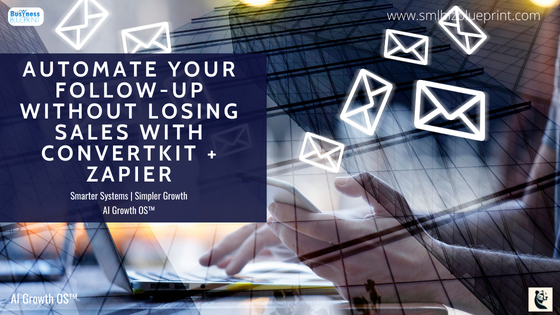

To build a follow-up system that never forgets, use ConvertKit to tag and sequence new leads automatically, then connect Zapier to trigger actions based on engagement.
This 3-step system captures every lead, sends structured follow-up emails, and alerts you only when a prospect shows buying intent.
The result is an automated, behaviour-based follow-up that increases conversions while reducing manual work for small business owners.
A simple system small businesses can use to turn every email lead into a consistent, revenue-driving follow-up.
You know the feeling: someone downloads your lead magnet, fills out a form, or books a call… and then nothing happens.
Not because you don’t care. Not because you’re disorganised. But because you’re busy running a business.
Follow-up is where revenue lives — and most small businesses lose it through inconsistency.
This guide is for founders, consultants, service providers, and small teams seeking an automated follow-up system that is simple and straightforward.
By the end, you’ll have a complete 3-step system using ConvertKit + Zapier that captures leads, triggers intelligent follow-ups, and ensures no opportunity slips through the cracks.

Why the Usual Approach Fails
Most small businesses:
Rely on memory or manual reminders
Send one email… and hope
Don’t track engagement before reaching out
What this system changes:
Every new lead triggers a structured follow-up
Engagement determines what happens next
Your system decides — not your mood or availability
Why this matters now:
Attention is shorter
Inbox competition is higher
Speed + relevance wins deals
Section 1 — What This System Will Do
Before we build it, here’s the outcome.
This 3-step system will:
Automatically tag and segment new leads
Deliver a timed follow-up sequence
Trigger actions based on engagement
Notify you only when human outreach is required
Prevent forgotten prospects
Real Business Example
A consultant offers a free strategy checklist.
Without automation:
Leads download it
Some open emails
Some don’t
The consultant guesses who to follow up with
With this system:
Download triggers a sequence
Opens/clicks apply “Engaged” tag
Engaged leads trigger a personal outreach task
Non-engaged leads receive a reactivation email
Everything is tracked
Result: Follow-up becomes systematic, not emotional.
Ready to level up your business?
Sign up for our newsletter and get expert tips delivered weekly.
Get Started Here
Section 2 — Step-by-Step Build
Step 1 — Build the Core Entry Point in ConvertKit
Goal: Capture leads and start automation immediately.
What to Do
Log into ConvertKit
Go to Grow → Landing Pages & Forms
Click Create New → Form
Choose Inline or Modal Form
Connect it to a specific tag (e.g., Lead – Checklist Download)
Tags drive automation. Without tagging, your system has no trigger logic.
Practical Example
You offer:
“Client Acquisition Blueprint”
Create:
Tag: Lead – Client Blueprint
Form connected to that tag
Optional AI Enhancement
Use AI to:
Rewrite your opt-in copy for clarity + urgency
Generate 3 subject lines for your first follow-up email
Step 2 — Create the 3-Step Follow-Up Sequence in ConvertKit
Goal: Deliver structured, timed follow-up.
What to Do
Go to Send → Sequences
Click New Sequence
Name it: 3-Step Follow-Up – Blueprint
Create:
Email 1 — Immediately
Deliver asset
Ask 1 engagement question
Email 2 — 2 days later
Share insight or case study
Include soft CTA
Email 3 — 4 days later
Direct CTA: book call / reply / apply
Most sales require multiple touches. This ensures consistency.
Exactly Where to Connect It
Go to Automate → Visual Automations
Create new automation
Trigger: “Joins Tag → Lead – Client Blueprint”
Action: “Add to Sequence → 3-Step Follow-Up”
Practical Example
Email 3 CTA:
“If this framework makes sense, reply ‘Ready’ and I’ll send next steps.”
This turns passive leads into active signals.
Optional AI Enhancement
Use AI to:
Personalise emails based on industry field
Generate variant emails for A/B testing
Step 3 — Add Engagement-Based Logic with Zapier
Now we make it intelligent.
Goal: System decides who deserves manual outreach.
What to Do
In Zapier:
Create New Zap
Trigger: ConvertKit → “Tag Added”
Trigger tag: Engaged – Blueprint
How do they get this tag?
Back in ConvertKit:
Edit Email 2 or 3
Add automation rule:
“If subscriber clicks link → Add Tag ‘Engaged – Blueprint’”
In Zapier:
Action:
Create task in ClickUp / Asana
OR send Slack notification
OR add to CRM pipeline
You only personally reach out to warm leads.
Practical Example
Zap Action:
“Create task: Call engaged lead within 24 hours.”
Now follow-up becomes opportunity-based, not random.
Optional AI Enhancement
Use AI to:
Generate personalised outreach message using lead data
Score engagement (opens + clicks) and assign priority
Section 3 — Key Metrics or Elements to Track
Your system must track:
- Open Rate
Reveals subject line effectiveness and interest. - Click Rate
Indicates intent and deeper engagement. - Tag Volume (Engaged vs Non-Engaged)
Shows quality of leads. - Time-to-Response
How quickly you reach engaged leads. - Conversion Rate (Call Booked / Sale Closed)
Measures system effectiveness, not just email performance.
Insight:
If open rates are high but clicks are low → messaging lacks clarity.
If clicks are high but no bookings → CTA is weak or misaligned.

Section 4 — Common Mistakes to Avoid
No clear CTA in each email
→ Every email should ask for one action.
Overcomplicating tags
→ Keep naming simple and consistent.
Sending too many emails too fast
→ Space builds anticipation.
No engagement logic
→ Without tagging clicks, your system is blind.
Not reviewing metrics weekly
→ Automation without optimisation becomes decay.
Manual follow-up without structure
→ If it’s not in a system, it won’t scale.
Section 5 — How to Use This System Daily, Weekly, Monthly
Daily
Check new “Engaged” task notifications
Complete outreach within 24 hours
Weekly
Review open and click rates
Identify strongest performing email
Refine weakest email
Monthly
Review conversion rates
Adjust timing if needed
Update case studies or testimonials
This keeps the system alive.
Section 6 — Optional Add-On Automations
Lead Scoring
Assign points for:
Opens
Clicks
Replies
Benefit: Prioritise high-value prospects.
Re-Engagement Loop
If no engagement after 7 days:
Move to nurture sequence
Benefit: Salvage cold leads.
CRM Pipeline Sync
Auto-create deal stage.
Benefit: Visibility across team.
SMS Reminder for Engaged Leads
Trigger SMS after strong click signal.
Benefit: Faster conversions.
Behaviour-Based Segmentation
Different follow-up for:
Downloaders
Webinar attendees
Buyers
Benefit: Relevance increases response rate.
Pro Tips
Automate the trigger, not the relationship
Tagging is the backbone of decision-making
Engagement should trigger action
Simplicity scales better than complexity
Review weekly or performance drops silently
Conclusion
You now have a follow-up system that captures leads, nurtures them automatically, and alerts you only when human intervention is required.
No more forgotten leads.
No more emotional guessing.
No more inconsistent outreach.
Just structured, intelligent follow-up that compounds over time.
FAQs
Q1: Do I need both ConvertKit and Zapier for this follow-up system to work?
A1: You can build a basic follow-up sequence entirely inside ConvertKit. However, Zapier is what makes the system intelligent. It allows you to trigger external actions — like creating CRM tasks, sending Slack notifications, or updating pipelines — based on engagement tags. If your goal is automated decision-making rather than just automated emails, using both tools creates a far more powerful system.
Q2: What’s the difference between a sequence and an automation in ConvertKit?
A2: A sequence is a timed set of emails (e.g., Day 0, Day 2, Day 4).
An automation controls the logic — what triggers the sequence and what happens based on behaviour (tags, clicks, purchases).
In this system:
The tag triggers the automation.
The automation adds the subscriber to a sequence.
Engagement inside the sequence triggers new tags.
That layered structure is what prevents leads from being forgotten.
Q3: How many follow-up emails should I include in a small-business sequence?
A3: For most service-based businesses, 3–5 emails is ideal for an initial follow-up.
The goal isn’t to overwhelm the lead — it’s to:
Deliver value
Build trust
Present a clear next step
Identify engagement
After that, leads can move into a longer nurture system if needed.
Q4: How do I know when to personally reach out to a lead?
You reach out when behaviour signals intent.
Examples:
They click a booking link
They reply to an email
They visit a pricing page (if tracked)
They receive an “Engaged” tag
This system ensures outreach is behaviour-triggered, not random. That improves close rates and saves time.
Q5: What KPIs matter most in a follow-up automation system?
A5: Focus on these core metrics:
Open Rate → Subject line effectiveness
Click Rate → Message relevance and intent
Tag Distribution → Lead quality
Time-to-Follow-Up → Speed of response
Conversion Rate → System profitability
The real metric to care about: conversion per engaged lead. That’s where revenue insight lives.
Q6: Can this system work for existing customers, not just new leads?
A6: Yes. The same structure applies to:
Post-purchase onboarding
Upsell sequences
Reactivation campaigns
Renewal reminders
The difference is simply the trigger tag. Instead of “Lead – Blueprint,” you might use “Customer – Product A.” The automation logic stays the same.
Q7: What’s the biggest mistake small businesses make with email follow-up?
A7: Overcomplication.
Too many tags.
Too many branches.
Too many emails.
A simple, behaviour-based system outperforms a complex one that isn’t maintained. Start with the 3-step structure, validate results, then layer enhancements once the core system is producing consistent conversions.
If you implement this correctly, your follow-up stops depending on memory and starts running like infrastructure.
Other Articles
Why Your Week Feels Busy but Produces Nothing
Why Your To-Do List Fails—and How to Turn Tasks Into Outcomes