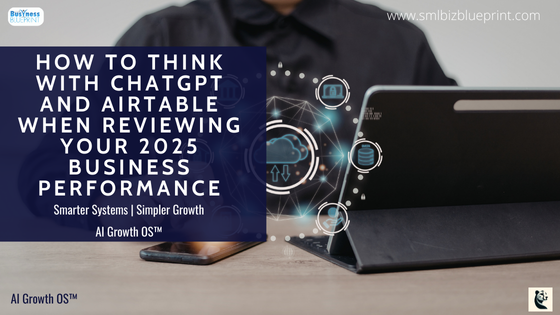

Smart operators use ChatGPT and Airtable together by structuring business data around meaningful outcomes, then asking AI interpretive questions to surface patterns, trade-offs, and hidden wins.
Instead of relying on dashboards or memory, this approach treats AI as a thinking partner that helps explain why results occurred across a full year of activity.
The result is clearer insight into what truly worked in 2025—and more confident, evidence-based decisions about what to prioritise next.
Most small businesses don’t lack data. They lack interpretation.
By the end of every year, you’re surrounded by numbers—revenue totals, campaign stats, client lists, project logs.
Yet when it’s time to make decisions, you’re still relying on memory, instinct, or whatever felt most stressful at the time.
The irony is that the answers are already there. They’re just buried under noise, fragmentation, and review processes that were never designed for clarity.
This matters now because AI has changed the economics of reflection.
What used to take days of manual analysis can now happen in minutes—if your data is structured with intent.
This article is for owners and operators who want to understand what actually worked in 2025, without turning year-end review into a second job.
By the end, you’ll have a simple but powerful system that turns your existing business data into insight: clear wins, overlooked strengths, and evidence-based direction for what to do next.

Why the Usual Approach Fails
Most year-end reviews fail for predictable reasons.
Data is spread across tools that don’t talk to each other. Reviews happen emotionally rather than analytically.
And insights arrive too late to shape meaningful decisions.
What this system changes is not the volume of data, but the structure of thinking around it.
Instead of asking “How did the year feel?”, you ask “What patterns does the evidence actually show?”
That shift matters because the businesses that compound fastest aren’t the ones doing more—they’re the ones learning faster.
What This System Will Do
At its core, this system combines Airtable as a single source of truth with ChatGPT as an interpretation layer.
The outcome is not another dashboard. It’s narrative clarity.
You’ll be able to look at your 2025 activity and answer questions like:
Which efforts quietly generated disproportionate returns?
Where did time and money leak without obvious payoff?
What patterns repeat across clients, offers, or channels?
Imagine discovering that your highest-margin work came from a smaller subset of clients you rarely prioritise, or that a marketing channel you considered “average” consistently produced better long-term outcomes.
These are the kinds of insights this system surfaces—because it looks at the whole year objectively, not just the loudest moments.
Ready to level up your business?
Sign up for our newsletter and get expert tips delivered weekly.
Step-by-Step Build
Step 1 — Create a Single Place for Truth
The first mistake businesses make is trying to analyse before they consolidate. The goal here is not perfection; it’s coherence.
Create a new base in Airtable called 2025 Business Review. This base exists for one reason: to hold the activities that mattered enough to influence results.
Each row represents a real action—an initiative, project, campaign, or client engagement.
Instead of tracking everything, track what moved the needle. Date, category, revenue impact, cost, and outcome are enough to start.
This forces you to translate fuzzy activity into concrete signals, which is where insight begins.
Step 2 — Normalise Before You Analyse
AI doesn’t struggle with complexity; it struggles with inconsistency.
Before exporting anything, clean your language. Categories should mean one thing. Revenue should always be revenue, not “about this much.”
This step feels boring, but it’s where most insight is either enabled or destroyed.
A simple example: if “marketing,” “ads,” and “email” all mean the same thing in your business, collapse them into one category.
You’re not losing nuance—you’re gaining signal.
Step 3 — Export with Intention
Once your data reflects reality, export it as a CSV. This is not a handoff; it’s a translation.
You’re preparing the data so ChatGPT can see patterns you can’t.
Filter out anything irrelevant. Keep only what supports strategic questions. Less data, clearly framed, produces better insight than more data dumped indiscriminately.
Step 4 — Ask Better Questions, Get Better Insight
Upload the CSV to ChatGPT and shift your mindset.
You’re not asking for summaries—you’re asking for interpretation.
Questions like:
“What activities delivered the highest return relative to effort?”
“Which categories underperformed despite high investment?”
“What patterns repeat across my most successful outcomes?”
This is where AI earns its place. It doesn’t replace judgment; it accelerates learning.
Patterns that would take weeks to notice emerge in minutes, because the system is finally looking at the year as a whole.
A Real Example: How a Hidden Win Actually Surfaces
To understand why this system works, it helps to see one real pattern emerge—not in theory, but in practice.
Imagine a small service business reviewing its 2025 activity.
Inside Airtable, they’ve logged just 27 rows for the year. Each row represents a meaningful initiative: client projects, campaigns, partnerships, internal improvements.
Nothing granular. Nothing noisy.
Here’s a simplified slice of what that table looks like:
Category: Client Work
Project: Retainer Client — Operations Support
Revenue: 42,000
Cost: 11,000
Outcome: Low stress, long-term engagement
Category: Marketing
Project: Paid Ads — Q3
Revenue: 58,000
Cost: 39,000
Outcome: High volume, short-term wins
Category: Partnerships
Project: Referral Partner A
Revenue: 31,000
Cost: 3,000
Outcome: Small volume, high trust
On their own, none of these rows feel surprising. This is where most reviews stop.
The shift happens when the owner exports the table and asks ChatGPT one focused question:
“Looking across all activities, which category delivered the highest return relative to effort, and what pattern explains it?”
ChatGPT doesn’t just total numbers. It compares structure.
The insight it surfaces is unexpected but decisive:
Partnership-driven work produced less total revenue than paid marketing—but delivered significantly higher margins, lower delivery stress, and longer client retention.
Every partnership-sourced project shared the same traits: faster close time, fewer revisions, and repeat engagements.
This was never obvious during the year because paid ads felt busier and louder.
The data, viewed as a whole, tells a different story.
The business decision that follows is simple—and powerful:
Reduce paid ad spend
Formalise two more referral partnerships
Design offers specifically for that channel in 2026
That’s a hidden win.
Not because the data was complex—but because the pattern only appears when the year is viewed all at once, through an interpretive lens instead of a reactive one.
This is the exact moment the system earns its value.
Don’t miss a beat in your business growth journey!
Join Pulse and stay ahead with expert tips and actionable advice every month.
Subscribe to Pulse Today
The Metrics That Actually Matter
The most useful metrics are not the flashiest ones. They’re the ones that explain cause and effect.
Revenue tells you what worked. Cost tells you what it took. Profit reveals leverage. Frequency exposes consistency versus luck.
Categories reveal structural strengths and weaknesses in the business model itself.
Together, these metrics shift your perspective from performance theatre to decision clarity.
Common Mistakes to Avoid
The most common error is treating this like a reporting exercise instead of a learning system.
Another is asking AI vague questions and expecting sharp answers.
Some businesses over-track, drowning insight in detail, while others review once and never return.
The fix is simple but non-negotiable: treat this system as a thinking tool, not a compliance task.
How to Use This System Over Time
Used properly, this isn’t a once-a-year ritual.
Daily, you log meaningful activity without commentary. Weekly, you add brief context where needed. Monthly, you export and ask strategic questions.
Over time, this creates a feedback loop where decisions improve because learning compounds.
The system works because it respects how real businesses operate: imperfectly, but consistently.
Optional Add-On Automations
Once the foundation is solid, automation becomes valuable instead of distracting.
Auto-tagging activities reduces friction.
Monthly AI-generated insight summaries create continuity.
Segmenting by client type or offer reveals positioning leverage.
Each enhancement exists to reduce cognitive load, not add complexity.
Automation is most powerful when it protects attention.
Pro Tips That Make the Difference
Track fewer things, but track them honestly.
Write insights in plain language.
Use AI to surface patterns, then apply human judgment to decide what they mean.
Most importantly, revisit conclusions—insight compounds when it’s challenged.
Conclusion
You now have a system that turns a year of scattered activity into structured understanding. Instead of guessing what mattered in 2025, you can see it.
Instead of blindly repeating effort, you can refine with intent.
The real transformation isn’t better data.
It’s better decisions—made faster, with less doubt, and grounded in reality.
Build the system once. Let it sharpen every decision that follows.
FAQs
Q1: Is this article meant to be a step-by-step guide for using ChatGPT and Airtable?
A1: No. This article is intentionally not procedural. It focuses on how to think about using ChatGPT and Airtable together as a decision system, rather than detailing which buttons to click. The goal is to build judgment and clarity, so you can adapt the approach to your own tools, data, and context.
Q2: Who is this approach best suited for?
A2: This approach is designed for business owners, operators, and leaders who already collect data but struggle to extract meaningful insight from it. It’s especially useful for those who want to improve strategic decision-making without adding more dashboards, reports, or operational overhead.
Q3: What kind of data works best with this way of thinking?
A3: High-level, outcome-oriented data works best. This includes projects, initiatives, clients, campaigns, partnerships, or operational changes—anything that represents a meaningful business decision or effort. The system is less about granular tracking and more about understanding patterns across a full period of activity.
Q4: How does ChatGPT add value compared to traditional reporting or dashboards?
A4: Traditional reports show what happened. ChatGPT helps explore why patterns exist and what they imply. When paired with structured data, it acts as an interpretation layer—surfacing relationships, contrasts, and trade-offs that are easy to miss when reviewing data manually or emotionally.
Q5: Do I need perfect or complete data for this to be useful?
A5: No. The value comes from coherence, not perfection. A smaller set of consistently structured data is far more useful than a large, messy dataset. The intent is to reduce noise and focus attention on signals that influence decisions.
Q6: How is this different from a typical annual business review?
A6: Most annual reviews are retrospective and subjective. This approach treats the review as a learning system—one that looks at the year as a whole, compares effort to outcome, and reveals leverage points. The emphasis is on interpretation and future decisions, not just summarising past performance.
Q7: What should I be able to do differently after reading this article?
A7: You should be able to:
Look at your business data more objectively
Ask better, more strategic questions of your data
Use AI as a thinking partner rather than a reporting tool
Make decisions based on patterns instead of memory or stress
Other Articles
The 3 Systems Every Business Should Start 2026 With (and How to Set Them Up Fast)
Strategic Alignment in Action: The 5-Step System to Plan 2026 With Confidence