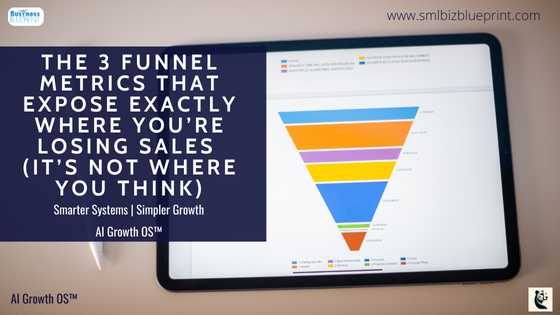

Most sales funnels don’t lose revenue because leads drop off—they lose it because momentum quietly slows down.
The three funnel metrics that reveal exactly where sales are lost are stage conversion rate (where intent breaks), time-to-conversion (where urgency dies), and revenue per lead (where monetisation underperforms).
Tracking these three together shows precisely which part of the funnel is limiting growth and what to fix first.
Most slowdowns start months before targets miss — this shows where.
You’re doing the work.
The leads are coming in.
The funnel looks fine on paper.
And yet—revenue feels heavier than it should.
Deals take longer to close. Momentum fades between stages. Forecasts feel optimistic until they aren’t.
Nothing is obviously broken, but growth keeps stalling just enough to be frustrating.
You tweak conversion rates. You add follow-ups. You ask for more leads. Still, the same pressure returns next quarter.
That’s the tension most businesses live with today: activity without traction.
What’s at risk isn’t just missed revenue. It’s confidence in your systems. Trust in your numbers. The sense that you’re steering the business—or reacting to it.
When funnels stop producing predictable outcomes, decisions slow, teams second-guess, and growth starts to feel fragile instead of earned.
Here’s the quiet truth most advice misses:
Funnels don’t usually fail because people drop out. They fail because momentum decays—slowly, invisibly, expensively.
The good news? You don’t need more dashboards, more tools, or more leads. You need a clearer lens.
In this article, we’ll break down the three funnel metrics that actually tell you where you’re losing sales—not in theory, but in practice.
You’ll see why the default approach to funnel optimisation falls short, and how to replace it with a way of measuring intent, time, and value together.
This is the shift from managing activity to leading with clarity—the point where numbers stop confusing you and start working for you.

Funnels Don’t Leak — They Slow Down and People Leave
The real problem isn’t drop-off. It’s decay.
Most businesses search for the moment prospects “fall out” of the funnel, assuming loss is sudden and visible.
In reality, sales are usually lost much earlier—when momentum fades, urgency cools, and decisions quietly slide down the priority list.
Nothing breaks. Nothing alerts you. The deal just… stalls.
That friction is subtle—and expensive.
You can have healthy-looking sales funnel metrics and still feel constant pressure because delay compounds invisibly.
Each extra day between stages gives doubt more room to grow: internal approvals creep in, alternatives look safer, and budgets get reallocated.
The funnel hasn’t leaked people; it’s absorbed energy.
Most people don’t realise they’re measuring the wrong failure mode.
Traditional sales funnel analysis treats buyers like water flowing through pipes. If volume goes in and less comes out, you look for leaks.
But buyers aren’t fluid—they’re decision-makers juggling risk, attention, and timing. When the process slows, intent doesn’t disappear; it degrades.
What that means for your business is simple:
A slow funnel requires more pipeline, more follow-up, more effort—just to stand still.
Forecasts become fragile. Teams chase activity instead of progress. Growth starts to feel heavier each quarter, even when nothing is “wrong.”
Relief comes from a different lens.
Instead of asking, “Where do people drop off?” ask, “Where does momentum die?”
When you shift from leakage to decay, you stop optimising stages in isolation and start diagnosing the flow of decisions across the whole system.
This is the moment you move from managing a funnel to reading the behaviour inside it—from reacting to numbers to interpreting signals.
The longer this stays the same, the more revenue you’ll need just to offset delay. Time becomes the hidden tax on every deal, and it compounds quietly until growth feels unreliable.
Pro tip
Track median time spent in each funnel stage, not just conversion rates.
Because speed isn’t the advantage—momentum is. When you see where decisions slow down, you gain leverage. And leverage, not volume, is what turns funnels into predictable growth engines.
It started with a spreadsheet that kept getting bigger.
Every week, more columns were added—conversion rates, drop-offs, averages—yet the pressure didn’t ease. The mistake wasn’t lack of data; it was believing that more metrics would create clarity.
The shift came when the question changed from “What’s underperforming?” to “Where is momentum actually dying?” From there, the work stopped feeling reactive and started feeling intentional.
Metric #1 — Stage Conversion Rate: Where Intent Breaks
The frustration: you’re converting leads, but they’re not committing.
Stage conversion rate tells you something uncomfortable most dashboards gloss over: people aren’t dropping out because they’re unqualified—they’re dropping out because belief breaks at a specific moment.
The funnel doesn’t fail at the top or bottom. It fails where intent turns into hesitation.
The relief comes from precision, not averages.
Stage conversion rate isolates where confidence collapses.
Instead of looking at your funnel as one blended percentage, you measure how many people move from this decision to the next one.
That’s where the truth lives. Not in benchmarks. Not in industry averages.
In the transition points where a buyer decides, “I’m not ready to move forward.”
Most people don’t realise the lowest conversion stage is rarely the real problem.
A stage with a dramatic drop-off often gets blamed, but it’s usually just where friction becomes visible.
The real issue often sits one step earlier—where expectations are set, promises are made, or complexity is introduced without enough reassurance.
High conversion earlier in the funnel can even be a warning sign: people are saying “yes” before they fully understand what comes next.
What that means for your business is clarity instead of guesswork.
When you track stage-level conversion properly, you stop asking, “How do we improve the funnel?” and start asking, “Where does intent break down—and why?” Is it uncertainty? Risk? Cognitive overload? Misalignment between what was promised and what’s required?
Each answer points to a different fix.
This is where the identity shift happens.
You stop being the operator chasing better numbers and become the strategist reading buyer psychology through data.
Conversion rates stop being performance scores and start becoming diagnostic signals.
The longer this stays the same, the more you’ll keep optimising the wrong stage.
Every week spent fixing symptoms instead of intent costs real deals that were almost ready to buy—but didn’t feel safe enough to move forward.
Pro tip
Map conversion rates between every adjacent stage, not just lead-to-customer.
Do it to reveal where belief breaks. Because conversion isn’t persuasion—it’s confidence. And the businesses that grow consistently are the ones that know exactly where confidence collapses and how to restore it.
Ready to level up your business?
Sign up for our newsletter and get expert tips delivered weekly.
Metric #2 — Time-to-Conversion: Where Momentum Quietly Dies
The frustration: deals don’t fall apart—they fade out.
Time-to-conversion reveals a loss most teams struggle to name: nothing went wrong, but nothing moved forward either. Leads stay “active.” Opportunities linger. Follow-ups keep happening. Yet urgency dissolves.
What felt promising slowly becomes optional.
The relief comes from seeing time as a signal, not a delay.
Time-to-conversion measures how long it takes a buyer to move from one decision to the next—not how busy your team is.
When deals drag, it’s rarely because buyers need more information. It’s because friction has crept in: unclear next steps, internal approvals, risk anxiety, or competing priorities.
Time exposes those forces even when conversion rates look healthy.
Most people don’t realise speed is a leading indicator of trust.
Fast movement doesn’t mean rushed decisions. It means clarity. When buyers understand what’s required, what’s at stake, and what happens next, they move. When they don’t, time stretches.
That stretch isn’t neutral—it erodes confidence, invites alternatives, and weakens commitment long before a deal is officially lost.
What that means for your business is fragility you can’t forecast.
A slow funnel demands more pipeline just to hit the same number. Cash flow becomes unpredictable. Forecasts depend on hope instead of probability.
Even strong offers struggle when decisions linger too long, because attention is the scarcest resource in any buying process.
This is the identity shift most leaders miss.
You stop asking, “How do we close faster?” and start asking, “What’s slowing decisions down?”
That move—from urgency pushing to friction removing—is what separates operators chasing deals from strategists designing momentum.
The longer this stays the same, the more deals quietly decay. Every extra week in limbo increases the chance a buyer reprioritises, delays budget, or chooses the safest alternative—not the best one.
Pro tip
Track the median time spent in each funnel stage and flag deals aging beyond your norm.
Do it to protect momentum. Because speed isn’t about pressure—it’s about clarity. And clarity is what keeps decisions alive long enough to close.
On paper, her funnel looked healthy.
Deals were closing, leads were steady—but every month felt heavier than the last. When she mapped time between stages instead of just conversion, the pattern snapped into focus: one late-stage decision dragged everything else down.
Fixing that single point didn’t just speed up sales—it reduced effort across the whole system.
Metric #3 — Revenue per Lead: Where Monetisation Quietly Underperforms
The frustration: your funnel converts—but revenue still feels thin.
Revenue per lead exposes a gap many teams don’t want to look at: you’re winning deals, but each win carries less weight than it should.
Volume is doing the heavy lifting. Margins feel tighter. Growth requires more effort every quarter, even when conversion rates improve.
The relief comes from measuring value density, not just activity.
Revenue per lead shows how much economic value your funnel creates per unit of attention.
It answers a more strategic question than conversion ever can: Are we monetising intent effectively, or just efficiently moving people through?
High conversion with low revenue per lead is often a sign of underpricing, over-discounting, or positioning that attracts “easy yeses” instead of committed buyers.
Most people don’t realise low-value conversions create false confidence.
A funnel that converts easily can feel healthy while quietly eroding leverage. Deals close, but they require more customisation, more support, and more exceptions.
The business grows—but only by running faster. Revenue per lead reveals whether growth compounds or consumes capacity.
What that means for your business is scalability—or the lack of it.
When revenue per lead is weak, every growth plan depends on more traffic, more leads, more outreach. That’s fragile.
Strong monetisation, by contrast, gives you room to breathe. It turns the funnel into a force multiplier instead of a treadmill.
You stop chasing “more customers” and start designing for better economics. You move from thinking like a marketer optimising flow to a strategist shaping value. Revenue becomes intentional, not incidental.
The longer this stays the same, the more growth demands extra volume just to maintain momentum. Every deal that closes below its true value steals capacity you’ll need later—and you don’t get it back.
Pro tip
Calculate revenue per lead by entry point and by stage, not just overall.
Use it to test your positioning. Because monetisation isn’t about charging more—it’s about attracting buyers who see the value sooner and commit more fully. That’s how funnels stop draining energy and start compounding it.

Funnel Drag: The Hidden Cost of “Almost Working”
The frustration: nothing is broken, yet everything feels heavy.
Funnel drag is what you experience when deals technically move forward, but every step takes more effort than it should.
There are calls, follow-ups, clarifications, approvals—progress, but slow and draining. The funnel “works,” yet growth feels exhausting instead of compounding.
The relief comes from naming the real enemy: accumulated friction.
Funnel drag isn’t one big problem; it’s the compound weight of many small ones. An extra approval step. A vague proposal. A delayed follow-up. A “quick question” that resets momentum.
Each friction feels reasonable on its own. Together, they absorb energy and stretch decisions until urgency evaporates.
Most people don’t realise drag hides inside normal operations.
Because no single step looks inefficient, teams normalise delay. Processes harden. Extra checks get added “just in case.” Over time, the funnel becomes safer—but slower.
And slow systems don’t fail loudly; they fail quietly by demanding more input for the same output.
What that means for your business is invisible erosion.
Drag increases time-to-conversion, lowers revenue per lead, and forces you to rely on volume instead of leverage. Forecasts get fuzzy. Teams stay busy. Results lag.
The funnel hasn’t collapsed—it’s just consuming more energy than it returns.
You stop asking, “Is this step necessary?” and start asking, “Does this step create forward motion?”
You move from managing process to designing momentum. From protecting against risk to enabling decisions.
The longer this stays the same, the more growth costs you. Every extra step that doesn’t move the buyer closer to a decision taxes your funnel—and those costs compound long before they show up as missed targets.
Pro tip
Audit your funnel for progress per interaction: after each touchpoint, ask what decision moved forward.
Do it to eliminate drag at the source. Because efficiency isn’t about fewer steps—it’s about purposeful ones. And businesses that protect momentum don’t need to push as hard to grow.
How to Identify Exactly Where You’re Losing Sales (A Practical Diagnostic)
The frustration: you know something’s wrong, but everything blurs together.
Most teams feel the drag before they can name it. Meetings turn into debates. Dashboards multiply. Everyone has a theory, but no one has a diagnosis.
The funnel feels off, yet every metric can be defended in isolation. That ambiguity is the real blocker.
You don’t need more tools to find where sales are being lost. You need to look at the funnel through three dimensions at once: conversion, time, and value.
When you map these together—stage by stage—the constraint reveals itself quickly. Not the loudest issue. The limiting one.
Most people don’t realise funnels fail at the constraint, not the average.
Averages hide extremes. One slow stage can neutralise strong performance everywhere else. One low-value entry point can drain capacity even with great conversion.
What that means for your business is this: fixing anything other than the constraint produces noise, not results.
The logic is simple, even if the insight is uncomfortable.
Pull the last 90–180 days of closed deals.
For each funnel stage, track:
Stage-to-stage conversion rate
Median time spent in stage
Revenue per deal entering that stage
Then look for imbalance:
High conversion + long time = hidden drag
Fast movement + low value = weak monetisation
Low conversion + high value = belief breakdown
The funnel will tell you where it’s losing sales—if you ask it the right questions.
You move from reacting to symptoms to isolating constraints. From chasing improvements everywhere to applying pressure where it actually releases growth.
That’s the difference between management and leadership in complex systems.
The longer this stays the same, the more time and money you’ll burn fixing the wrong things.
Every month spent optimising non-constraints delays the one change that could unlock the entire funnel.
Pro tip
Run this diagnostic quarterly and force yourself to name just one constraint to fix.
Do it to build discipline. Because growth doesn’t come from doing more—it comes from removing what’s in the way. And leaders who can identify constraints early don’t just grow faster; they grow with far less friction.
Don’t miss a beat in your business growth journey!
Join Pulse and stay ahead with expert tips and actionable advice every month.
Subscribe to Pulse Today
What to Fix First (And What to Ignore)
The frustration: everything looks improvable, so nothing truly improves.
When funnels underperform, the instinct is to optimise everywhere—copy tweaks, follow-up sequences, more tools, more meetings. Activity spikes, but results barely move. The funnel feels busy, not better.
That’s because most effort is being applied where it can’t change the outcome.
The relief comes from accepting a hard truth: funnels have constraints.
Funnel performance isn’t the sum of all improvements; it’s governed by the weakest point in the system. This is basic throughput logic. One slow, fragile, or low-value stage neutralises gains everywhere else.
Improving non-constraints feels productive but releases no capacity.
Most people don’t realise optimisation outside the constraint is wasted motion.
You can double conversion at the top and still miss targets if late-stage decisions stall. You can shorten early stages and still struggle if monetisation is weak.
What that means for your business is simple: effort without leverage creates fatigue, not growth.
The logic is to fix what limits revenue flow—not what’s easiest to change.
The right fix usually sits where three forces collide:
The stage with the longest delay
The stage handling the highest value
The stage most sensitive to friction or doubt
That’s the constraint. Fixing it releases the entire system. Everything else is noise.
You stop chasing incremental wins and start designing leverage. You move from “What can we improve?” to “What’s stopping growth right now?”
That shift is where clarity replaces overwhelm—and where momentum returns.
The longer this stays the same, the more time and money you’ll spend optimising parts of the funnel that don’t matter. Every month focused on non-constraints delays the one change that could unlock predictable growth.
Pro tip
Force prioritisation by naming one funnel constraint per quarter and ignoring everything else.
Do it to protect focus. Because growth isn’t created by constant optimisation—it’s released by removing the right obstacle at the right time.
The strongest funnels don’t feel smooth—they feel decisive.
They don’t rush buyers, but they don’t let uncertainty linger either. Most funnels fail not because people say no, but because the system allows hesitation to stretch without consequence.
Once you see that, optimisation stops being about tweaks and starts becoming about design.
Conclusion
The frustration is familiar: the funnel is busy, but growth feels heavier than it should.
You’ve tweaked conversion rates. You’ve added steps, tools, and follow-ups.
On the surface, everything looks reasonable—yet revenue still lags behind effort. That tension isn’t a personal failure or a market problem.
It’s what happens when funnels are managed as pipelines instead of understood as decision systems.
The relief comes from clarity, not more activity.
When you step back, the pattern becomes obvious. Sales are lost in three places only: where intent breaks (conversion), where momentum dies (time), and where value underperforms (revenue per lead).
Once you see the funnel through that lens, the noise drops away. You know what to measure, what to ignore, and where one focused change can release the whole system.
You move from reacting to dashboards to diagnosing behaviour. From chasing volume to designing leverage. From hoping growth returns to engineering the conditions for it.
This is what it looks like to lead with clarity instead of pressure.
Here’s the real decision in front of you.
If nothing changes, the cost compounds quietly: more pipeline to hit the same number, more effort for less return, more uncertainty in forecasts and planning.
The longer this stays the same, the more momentum you lose—and momentum, once gone, is hard to buy back.
But that state is optional.
You can keep optimising a funnel that absorbs energy.
Or you can take the next step—measure what actually matters, remove the constraint, and reclaim control of growth.
The choice is simple, even if it isn’t easy: stay stuck in activity, or move forward with clarity.
Action Steps
Stop Looking at the Funnel as One Number
Break your funnel into clear stages and review stage-to-stage conversion, not just lead-to-customer.
Blended conversion rates hide where intent actually breaks.
What that means for your business is you may be “optimising” the wrong stage entirely.
Measure Time Between Stages, Not Just Movement
Calculate the median time leads spend in each funnel stage.
Deals rarely die suddenly—they decay through delay.
The longer this stays invisible, the more urgency you lose without realising it.
Calculate Revenue per Lead by Entry Point
Look at revenue per lead by source or funnel entry, not just overall revenue.
High conversion with low revenue per lead creates false confidence.
You may be growing activity while quietly weakening economics.
Identify the Constraint (Force a Single Answer)
Ask one hard question:
Which stage most limits revenue flow right now—conversion, time, or value?
Pick one.
Funnels are governed by constraints, not averages.
Fixing anything else wastes time and creates noise.
Audit for Funnel Drag
Review each step and ask:
Does this move the buyer closer to a decision—or just add safety for us?
Most people don’t realise how much growth is lost to “reasonable” friction.
Every unnecessary step taxes momentum.
Fix the Constraint Before Touching Anything Else
Design one targeted change that directly reduces friction at the constraint:
Clearer next step
Faster response
Fewer approvals
Stronger positioning
Improving non-constraints feels productive but releases no growth.
This is where leverage lives.
Review Weekly, Not Quarterly
Create a simple weekly review with just three numbers:
Stage conversion at the constraint
Time spent at the constraint
Revenue impact of the constraint
Growth slows long before it fails.
Weekly visibility keeps you ahead of decay instead of reacting to it.
This is the shift from managing activity to engineering momentum.
From guessing where sales are lost to knowing—and fixing it with precision.
The funnel doesn’t need more optimisation.
It needs the right constraint released.
FAQs
Q1:What are the most important sales funnel metrics to track?
A1: The three that matter most are stage conversion rate, time-to-conversion, and revenue per lead. Together, they show where intent breaks, where momentum dies, and where monetisation underperforms. Tracking more metrics without these usually creates noise, not clarity.
Q2: How do I know where I’m losing sales in my funnel?
A2: You’re losing sales at the constraint—the stage where conversion slows, time stretches, or value drops disproportionately. Look for imbalance, not averages. The problem is rarely where the numbers look worst; it’s where friction limits overall flow.
Q3: Why does my funnel look healthy but revenue still feels slow?
A3: Because funnels don’t fail only through drop-off—they fail through delay. A funnel can convert well and still underperform if decisions take too long. Time-to-conversion is often the hidden reason growth feels heavier than it should.
Q4: What is funnel drag, and why does it matter?
A4: Funnel drag is the compound cost of small frictions—extra steps, unclear next actions, slow follow-ups—that individually seem reasonable but collectively drain momentum. It matters because drag forces you to rely on more volume just to maintain results.
Q5: What’s a good funnel conversion rate?
A5: There’s no universal “good” rate. A conversion rate is only meaningful in context of speed and value. A lower conversion funnel that moves fast and produces higher revenue per lead often outperforms a high-conversion funnel that moves slowly.
Q6: How can I improve funnel performance without generating more leads?
A6: Focus on releasing the constraint.
That might mean:
Reducing time between stages
Removing unnecessary steps
Clarifying decisions
Improving positioning to raise revenue per lead
Most growth comes from removing friction, not adding volume.
Q7: How often should I review funnel metrics?
A7: Weekly—at least at the constraint. Quarterly reviews are too slow to catch momentum decay. A simple weekly check on conversion, time, and value at the weakest stage keeps you ahead of revenue slowdowns instead of reacting after the fact.
Bonus: Three Subtle Forces Quietly Shaping Your Funnel (That Most Leaders Never Measure)
Most leaders believe funnel performance is a math problem.
If conversion is low, fix the offer. If revenue stalls, add volume. If deals slow down, push harder.
That logic feels reasonable—and it’s exactly why it fails.
Funnels don’t behave like spreadsheets. They behave like human systems, shaped by confidence, risk perception, and cognitive load.
What gets missed isn’t effort or intelligence—it’s the invisible forces that determine whether momentum compounds or quietly collapses.
Once you notice them, you can’t unsee them.
What follows isn’t a new checklist. It’s a shift in perspective.
Decision Energy: Why Some Deals Move Easily and Others Drain the Funnel
Two deals can close in the same time frame and have completely different downstream impact.
One moves with three clear interactions.
The other needs ten follow-ups, clarifications, and reassurance loops.
Same timeline. Radically different energy.
Most funnels track how long a deal takes, but ignore how much effort it consumes to keep it alive. That effort is a signal.
High interaction count with little progress usually means uncertainty, misalignment, or unspoken risk—not lack of interest.
Momentum isn’t just speed. It’s decisiveness. When decision energy is high, buyers move forward naturally. When it’s low, no amount of pressure creates clarity.
Imagine a funnel where each interaction advances a decision—not just maintains contact. That’s what happens when you design for confidence instead of persistence.
The Confidence Cliff: The Moment Buyers Quietly Reconsider
Most funnels don’t break gradually—they break suddenly.
There’s often a single moment where the buyer fully understands what “yes” actually means:
Pricing becomes concrete
Commitment feels long-term
Internal approval enters the picture
Implementation complexity is revealed
That moment changes the emotional equation. Conversion drops after it—but the cause happens at it.
Most funnels try to persuade through this moment instead of preparing for it. They sell the upside early, then introduce reality late—creating surprise where reassurance should have been.
A mature funnel anticipates the confidence cliff and preloads certainty before it appears. When reality arrives, it feels expected—not alarming. That’s how trust compounds instead of resets.
Polite Yeses: When High Conversion Is a Warning Signal
Not all conversions are equal—and some are actively harmful.
Polite yeses happen when buying feels easy but commitment is shallow. The deal closes, but conviction isn’t there.
These customers require more support, delay decisions later, and quietly tax the system.
High conversion rates can hide this problem.
If a funnel attracts too many easy yeses, it may be signalling weak positioning rather than strength. Friction isn’t always bad. Sometimes it’s how serious buyers self-select.
The strongest funnels don’t maximise agreement—they maximise alignment. Fewer, firmer yeses create momentum that carries beyond the close.
When you zoom out, these ideas point to the same truth:
Funnels don’t just move people forward.
They manage belief, energy, and perceived risk.
Once you start seeing funnels this way, optimisation stops being about tactics—and starts becoming about designing conditions where decisions want to happen.
Other Articles
Why Year-End Business Planning Fails — And the Smarter Way Forward
The 3 Systems Every Business Should Start 2026 With (and How to Set Them Up Fast)
Strategic Alignment in Action: The 5-Step System to Plan 2026 With Confidence