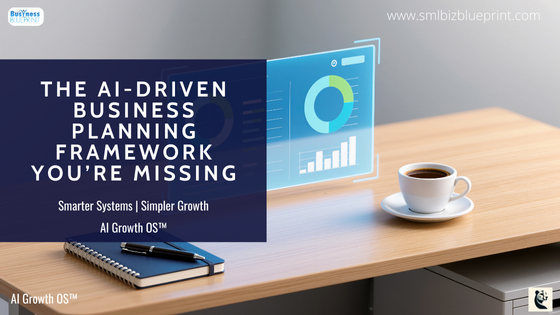

The AI-Driven Planning Framework helps business owners redesign how decisions and workflows operate so the business can run with less manual intervention.
Instead of adding more tools, the framework focuses on removing bottlenecks, automating predictable decision loops, and creating governance that keeps AI aligned with your standards.
This approach gives you a clearer, faster, and more autonomous operation—without losing control of quality or outcomes.
Discover why your systems still bottleneck—and the one framework that finally fixes it.
You know the feeling: the business is growing, but every week seems to pull you deeper into decisions you don’t have time to make.
Work piles up in inboxes. Approvals stall. Your team waits for direction. You end up juggling hundreds of small choices no one sees—but everyone depends on.
And as you look toward 2026, the truth is hard to ignore: the way you’re running the business now won’t scale another year without costing you time, margin, or your own sanity.
That pressure isn’t theoretical.
It shows up in the late-night thinking loops, the backlog that never clears, the slow drift toward being the bottleneck in a company you built to free you—not consume you.
The risk is simple: if decisions continue to rely on you or a handful of key people, growth will keep stalling at the same invisible ceiling.
But there’s a shift happening—one most businesses aren’t seeing clearly yet. AI is no longer about tools, shortcuts, or flashy automations.
In 2026, it becomes something different: an operating layer that can take on entire loops of work, not just tasks.
A way of running a business that removes friction, speeds up decisions, and creates breathing room—without giving up control.
This post lays out a new planning model: a 2026 AI-driven framework designed for owners who want systems that can think, act, and resolve predictable work so the team can move faster and you can finally step out of the bottleneck role.
It introduces a lens built for leaders who see themselves as builders, not firefighters—owners who want a business that feels intentional, self-sustaining, and intelligently run.
If you’ve been carrying the weight of decisions for too long, this is the roadmap to set it down.

AI Business Planning: Stop Buying Tools, Start Designing Decisions
The real bottleneck isn’t your tech stack—it’s the constant stream of small decisions that still depend on you.
Every time a lead needs routing, a ticket needs classification, or a proposal needs drafting, work pauses until someone steps in. That invisible friction adds hours to your week and months to your growth cycles.
The relief comes when you stop treating AI as a toolbox and start treating it as a decision system—one that can take predictable loops off your plate with control built in.
When you shift your focus from tools to decisions, you step into the identity of a leader who builds systems instead of compensating for them.
Most companies fail with AI because they start with tools—never with the decisions that shape throughput, margin, and speed.
This is the friction: AI pilots that never leave the test phase, half-built automations that don’t connect, and tools your team avoids because they weren’t designed around actual operational pain.
Decisions—not tasks—are the real levers. A business is a living network of decisions, from “Who handles this?” to “Is this approved?” to “What happens next?”
Once you map these decisions, patterns emerge. You start seeing which ones are repetitive, which follow clear rules, and which create delays only because a human is required to click, confirm, or assign.
You become the architect of a business that moves without waiting on you.
The most powerful starting point is a Decision Inventory, not an automation wishlist.
This means listing out the decisions your business makes every day—large and small—and scoring them by frequency, complexity, and impact.
AI thrives on the high-frequency, low-judgment decisions your team currently carries out manually: lead scoring, ticket routing, invoice reminders, meeting scheduling, proposal drafting.
These aren’t glamorous tasks, but they’re exactly the kind that drain speed from your operations. The release: offload these loops and you create fast, predictable throughput without sacrificing oversight.
Reframing AI planning around decisions instantly reveals where autonomy is safe, valuable, and low-risk.
Instead of asking, “What can we automate?” you ask, “Which decisions slow us down the most?” This simple shift prevents wasted spend, rushed adoption, and tool overload.
It also gives you a clean, realistic path into — where AI handles the decisions that should have never required human attention in the first place.
What that means for your business is straightforward: fewer firefights, fewer stalls, more flow.
The longer your business relies on human bottlenecks, the more invisible drag you accumulate—lost leads, delayed responses, stalled projects, slowed revenue.
Every week this stays the same, you’re paying an opportunity cost you never see on a balance sheet.
Pro Tip:
Start by mapping every operational decision made in one week—no tools, just observation.
Because the advantage isn’t automation—it’s visibility. The clearer you see your decision architecture, the faster you can redesign it. And leaders who understand their decision flows build companies that scale without burning out their people.
I once spent weeks setting up an automation stack that looked impressive on paper but barely changed the way the business operated. The team still waited on me for decisions, and work still bottlenecked in the same places.
It finally clicked when I realised the tools weren’t the problem—the decision architecture was. I had automated tasks, not the decisions shaping those tasks.
Once I redesigned the decisions first, the simplest automations created the biggest lift, and the business felt lighter almost instantly.
The AI Readiness Assessment: Where Your Business Actually Leaks Time and Profit
The real drag on your business isn’t “lack of AI”—it’s the friction you’ve been tolerating for years.
Every approval that sits in someone’s inbox, every task that needs rework, every update that gets delayed because the right person wasn’t looped in—these tiny delays stack into weeks of lost momentum.
The relief comes when you stop thinking readiness is about technical maturity and start seeing it as operational clarity.
And the moment you evaluate your business through that lens, you step into the identity of a leader who eliminates friction before scaling it.
Most AI initiatives collapse because businesses measure the wrong version of readiness.
You’ve seen this: companies try to implement AI before fixing the workflows it depends on, so the system learns the wrong patterns and creates new inconsistencies.
True AI readiness isn’t “Do we have enough data?” It’s “Do our workflows make sense?” It’s about having repeatable processes, defined decision points, predictable handoffs, and information that doesn’t live inside one person’s head.
When you structure the business this way, you’re not becoming more technical—you’re becoming more scalable.
And once those foundations are set, AI slots in without confusion, chaos, or cleanup.
A friction audit reveals the silent losses your team has normalised.
Start by examining where work slows down—not where you think the problems are, but where the cycle time expands quietly:
- High-volume tasks that require repeated human judgment (triage, classification, assignment)
- Delays caused by waiting for approvals or missing information
- Rework due to inconsistent instructions or unclear expectations
- Cognitive load tasks: reporting, summarising, chasing updates
Most people don’t realise that these micro-frictions are often consuming the equivalent of one full-time employee or more—hidden payroll, paid for but never named.
The four pillars of readiness give you a simple way to measure what’s slowing you down.
Volume friction: Tasks repeated dozens or hundreds of times per week
Delay friction: Work stuck in queues or waiting for sign-off
Accuracy friction: Mistakes and inconsistencies that require rework
Cognitive friction: The mental overhead that drains time and attention
These four categories reveal where AI can create immediate stability.
What that means for your business is clarity: you see not just what’s broken, but what’s fixable—and what can be automated safely.
Because every week you delay this audit, you continue bleeding time and money into inefficiencies your team has stopped noticing.
The longer this stays the same, the harder it becomes to cleanly integrate AI without rebuilding entire workflows from scratch.
Pro Tip:
Run a one-week friction audit by tracking every approval, rework incident, and repeated task across your team.
Because the real advantage isn’t automation—it’s awareness. The moment you see where your operational drag lives, you regain control of the business instead of reacting to it. Leaders who understand their friction map can implement AI with precision, not guesswork.
Stay ahead of the curve!
Subscribe to our newsletter and never miss the latest in business growth and marketing strategies
Build an AI Roadmap Around Bottlenecks, Not Features
The fastest way to waste money on AI is to build a roadmap around tools instead of the bottlenecks throttling your business.
You’ve felt this frustration before: a new tool gets added, your team tries it for a week, and nothing meaningfully changes.
Work still piles up. Customers still wait. Projects still stall.
The relief arrives when you flip the sequence—identify the constraint first, then match the AI capability to it.
That shift moves you from chasing features to designing flow. And in that identity, you become the leader who fixes the core problem instead of decorating it.
Most AI plans fail because they try to automate everything except the one constraint that actually limits throughput.
When you spread your attention across marketing, sales, delivery, HR, and finance, automation becomes a scattered mess with low adoption and no visible ROI.
The Theory of Constraints has been right for decades: fix the bottleneck and the whole business accelerates. AI makes this more powerful, because it can remove entire layers of drag from a single point of failure.
When you build your AI roadmap around constraints, you act like a systems architect—not a tech adopter.
And that’s when AI stops feeling like a distraction and starts becoming a multiplier.
A bottleneck-first roadmap is simple, efficient, and grounded in real operational data.
Start by identifying where work slows down the most:
- Customer support queues that grow faster than agents can resolve
- Sales follow-up delays that cause deals to cool
- Operations teams drowning in manual task assignment
- Reporting that takes hours of stitching data together
From there, match the constraint to the AI capability that solves it:
Classification models for routing
Sequencing automation for follow-ups
Draft generation for proposals and updates
Predictive patterns for forecasting workload and capacity
Most people don’t realise that a single well-chosen AI implementation at the bottleneck can unlock 25–40% more throughput with no extra headcount.
Sequence your roadmap by impact, not excitement.
Your three-tier structure becomes:
Immediate wins (low complexity → fast ROI)
Mid-term redesigns (moderate complexity → stable recurring value)
Long-term autonomous loops (high complexity → structural advantage)
This ensures the team sees value early, stays engaged, and trusts the process. What that means for your business is momentum—measurable, predictable, confidence-building momentum.
Because every month you delay bottleneck-focused planning, your team burns time fixing symptoms instead of causes.
And the longer a constraint goes unaddressed, the more cost and complexity accumulates around it—often silently.
Pro Tip:
Choose a single bottleneck and design a one-month AI project specifically to relieve that constraint—nothing more.
Because leverage—not volume—is the real edge. When you learn how to relieve constraints systematically, you build a business that scales with intention instead of brute force.
Designing Autonomous Business Systems: What a “Business That Runs Itself” Really Means
The dream of a self-running business breaks down the moment your systems still rely on humans for predictable, repetitive decisions.
You know the pattern: a task can’t move until someone assigns it, approves it, or nudges it forward. Even your “automations” still wait for a person to confirm the next step.
The relief comes when you shift from automating tasks to building closed-loop systems—processes that start, run, and finish with minimal intervention.
That’s when you step into the identity of a leader who builds systems that think, not systems that merely react.
The friction isn’t that your team is slow—it’s that your workflows still assume humans must do things AI already handles well.
Every day, your people are manually triaging emails, classifying tickets, drafting repeatable updates, chasing missing information, and routing work based on simple rules.
AI’s strength isn’t creativity—it’s pattern recognition. That means the majority of your operational “movement” work (assigning, routing, drafting, updating, checking statuses) is ready for autonomy right now.
When you design systems around AI-driven decision loops, you stop being the coordinator and become the architect of flow.
And when predictable work no longer needs you, you regain the time, focus, and strategic altitude you’ve been missing.
Closed-loop autonomy turns messy workflows into machines that move without waiting for someone to push.
A closed-loop system has five components:
Trigger: Something happens—an email arrives, a form is submitted, a task changes state.
AI inference: The system interprets what it is.
AI action: It routes, drafts, assigns, updates, or notifies.
Human oversight: Only needed when certain conditions or thresholds are met.
Completion: The system finalises the action without further intervention.
Examples already working in mid-sized businesses:
AI triages 70% of support emails, routing them with more consistency than humans.
AI drafts routine proposals using historical patterns—humans only refine and send.
AI maintains pipeline hygiene: updating statuses, generating recaps, nudging prospects automatically.
Most people don’t realise they’re already running 60–70% of a fully autonomous loop—they just haven’t connected the pieces.
The real question isn’t “Can AI replace this task?” It’s “Does this entire workflow actually need human judgment?”
If the answer is “not really,” you’re ready to build autonomy. And autonomy doesn’t mean removing humans—it means giving humans fewer low-leverage choices so they can focus on decisions that genuinely matter.
What that means for your business is freedom: fewer recurring fires, fewer bottlenecks, fewer days where everything waits on you.
Because every day your team handles predictable decisions manually, you pay twice: once in payroll, and again in lost speed.
The longer this stays the same, the more your business becomes dependent on people for work they should never be doing in the first place.
Pro Tip:
Choose one workflow that repeats daily—support triage, lead qualification, or proposal drafting—and design it as a closed-loop autonomous system.
Because autonomy isn’t built through volume—it’s built through clarity. When you learn how to construct one clean loop, you gain the blueprint to transform your entire business into a system that runs with you, not through you.
A business owner named Daniel kept adding people to handle customer inquiries, yet response times continued to slip, and morale dropped. Every issue seemed urgent, yet nothing truly moved.
When he mapped the workflow, he realised the real problem wasn’t volume—it was triage. His team was spending hours sorting instead of resolving. AI took over the classification and routing, and the system finally had room to breathe.
Within weeks, Daniel wasn’t managing chaos anymore; he was leading from clarity. His team operated with confidence, and customers noticed the difference immediately.
AI Governance as a Competitive Advantage, Not a Legal Afterthought
The biggest risk in adopting AI isn’t losing control—it’s pretending control will happen on its own.
You’ve likely felt this tension already: workflows get automated faster than guardrails get defined, decisions happen “somewhere inside the system,” and the team isn’t sure when to trust the output.
The relief comes when you realise governance isn’t bureaucracy—it’s clarity. It’s the operating manual for how AI should behave inside your business.
And when you adopt that mindset, you step into the identity of a leader who scales with intention, not improvisation.
Most AI rollouts fail because companies focus on capability and skip the rules that make capability safe, consistent, and scalable.
AI starts making recommendations the team doesn’t understand. Outputs drift. Exceptions go unnoticed. People override the system silently, and leadership loses visibility.
AI governance is simply the process of defining who decides what, under which conditions, and with what authority. It’s a lightweight set of rules that keep the system aligned with your standards.
When you own this layer, you become the architect of predictable decision-making—across humans and machines.
With clear guardrails, AI becomes something your team trusts and your customers never question.
Governance gives AI shape, boundaries, and a repeatable logic the entire team can follow.
There are four governance pillars every mid-sized business needs:
Decision boundaries: What AI can decide alone versus what must be reviewed.
Escalation rules: When and how humans step in—based on risk, context, or thresholds.
Override protocol: What happens when humans disagree, and how the system learns from corrections.
Feedback loops: Regular tuning based on real performance, not assumptions.
Concrete examples already working in the field:
AI can approve discounts up to 10%, but anything beyond that is paused for human review.
AI drafts proposals automatically, but humans approve or edit before sending.
If AI misroutes a task, the override gets logged, and the rule is reranked in the system weekly.
Most people don’t realise governance isn’t about controlling AI—it’s about giving humans confidence so adoption accelerates instead of stalls.
The real shift happens when governance becomes part of your operating system, not a footnote.
Governance transforms AI from “helpful but inconsistent” to “reliable and trustworthy.” It makes the rules visible. It removes ambiguity. It ensures your standards scale faster than your headcount.
What that means for your business is long-term defensibility: competitors may adopt the same tools, but few will build the discipline that turns those tools into a strategic advantage.
Because without governance, every automation you add increases the risk of drift, errors, and inconsistent customer experiences.
The longer this stays undefined, the harder it becomes to regain control once systems start making decisions you didn’t intend.
Pro Tip:
Create a simple “AI Decision Matrix” listing what AI can do autonomously, what it can only draft, and what always requires human approval.
Because clarity is the real accelerator. When your team knows exactly when to trust the system and when to step in, AI becomes a force multiplier—not a source of uncertainty. Leaders who define the rules early build companies that scale cleanly instead of chaotically.

From Annual Plan to Living AI Operating System
Static annual plans fail because your business changes faster than your planning cycle.
You’ve lived the frustration: you build a plan in December, but by March the assumptions have shifted, the workload looks different, customer behaviour has changed, and your roadmap is already outdated.
The relief comes when you stop treating planning as a once-a-year ritual and instead build a living operating system—a cadence that evolves with your data, workflows, and customer patterns.
That’s when you step into the identity of a leader who runs a business that adjusts itself, not one you must constantly re-steer.
Traditional planning collapses because it assumes stability—AI planning succeeds because it assumes change.
A static plan can’t keep up with real-world shifts: delayed projects, unexpected demand, capacity changes, new customer behaviours.
AI-driven operations rely on a different rhythm—continuous monitoring, weekly course correction, and monthly tuning. Instead of resetting once a year, you adjust in real time.
When you adopt this cadence, you become a leader who manages trajectory, not tasks.
And your business becomes responsive, predictable, and forward-moving even when conditions shift.
A living AI operating system uses rhythm—not rigidity—to keep the business aligned.
There are four essential rhythms that replace the yearly reset:
Weekly exception review: Monitor spikes in errors, delays, or overruns. AI systems drift like humans do—they need light steering, not micromanagement.
Monthly workflow tuning: Review performance, adjust prompts, update rules, refine sequences. Small tweaks prevent large problems.
Quarterly loop expansion: Once one autonomous loop stabilizes, add the next. The business becomes more efficient in layers, not leaps.
Annual strategic realignment: Focus on market direction, high-level strategy, new opportunities—not operational cleanup.
Most people don’t realise that this rhythm mirrors how high-performing companies already operate—AI just makes it easier, faster, and more measurable.
Dashboards become your new command centre—not for micromanaging, but for guiding the system.
AI-powered dashboards track:
Exception rates
Decision latency
SLA compliance
Capacity demands
Workflow health
This isn’t reporting—it’s early detection. It shows you where the business is slowing before customers feel it.
What that means for your business is anticipation: you see problems early enough to fix them without burnout, backlogs, or last-minute fire drills.
A living OS turns AI from a tool into a stabilising force that makes the business more predictable every quarter.
This is the promise of 2026: you don’t just automate tasks—you automate adaptation.
You get a company that tells you where it’s slipping, where it’s drifting, where it’s improving, and where it needs reinforcement.
And that gives you something few leaders ever get: the ability to run the business with altitude instead of urgency.
Because every month you rely on static plans, your team absorbs the cost of unpredictability—frantic weeks, missed deadlines, stalled initiatives, and slow reactions to signals you didn’t see in time.
The longer this stays the same, the more you pay in volatility and invisible waste.
Pro Tip:
Set up a weekly “exception review” dashboard that tracks delays, overrides, and workflow disruptions across your AI-assisted processes.
Because the gain isn’t automation—it’s foresight. Leaders who monitor drift early don’t just run smoother businesses—they build companies that evolve before problems become patterns.
Most leaders assume growth stalls because they lack time, talent, or tools—but those are symptoms, not causes. Companies don’t slow down because they’re under-resourced; they slow down because their systems require constant human babysitting.
The turning point is when you stop asking, “How do I scale my team?” and start asking, “How do I scale my decisions?” That single shift reframes everything.
With decision-scaled systems, growth stops feeling like weight and starts feeling like momentum—because your business finally moves as intelligently as you do.
Conclusion
You’re not imagining it—the business really is heavier than it should be.
Decisions pile up faster than you can clear them. Projects slow down not because of complexity, but because too many small tasks still depend on you or a few key people.
That pressure builds silently, week after week, until growth feels like something you have to push, not something the business naturally pulls forward.
But relief comes the moment you realise the weight isn’t the work itself—it’s the way decisions move through your business.
And once you shift from tool-first thinking to a decision-first, constraint-focused, autonomy-building model, the ground gets steadier. Work moves with more predictability. Teams act with fewer bottlenecks.
Your systems begin taking on the repetitive loops that have been draining your energy for years.
This is where you step into the identity you’ve been growing toward all along: the builder of a business designed to run with you, not through you.
Each piece of this framework—decision design, friction auditing, bottleneck mapping, autonomous loops, governance, and a living operating rhythm—gives you back control by removing the parts of the business that shouldn’t require you anymore.
What that means for your business is momentum. What it means for you is breathing room.
And here’s the quiet truth underneath all of this: staying where you are has a cost. Every month without these systems is another month of lost speed, hidden payroll waste, delayed opportunities, and an operational ceiling that won’t move on its own.
The longer this stays the same, the more the business relies on the parts of you that should be freed, not stretched.
But this state isn’t permanent. It’s optional.
You can decide to keep carrying the business decision by decision…
or you can build the infrastructure that lets it run itself—with you leading from altitude, not exhaustion.
If you’re ready to make that shift, start with one step: redesign one decision loop. Set the business on a new trajectory.
Choose the path where your systems carry the weight, and you finally get to operate like the leader you’ve always been building toward.
Don’t miss a beat in your business growth journey!
Join Pulse and stay ahead with expert tips and actionable advice every month.
Subscribe to Pulse Today
Action Steps
Map Every Decision Your Business Makes in a Week
Identify the real source of operational drag: the decisions, not the tasks.
Write down every approval, classification, assignment, status check, or follow-up.
This gives you your first Decision Inventory—the foundation for all AI planning.
Run a One-Week Friction Audit
Track where work gets stuck, delayed, reworked, or repeated.
Look for volume friction (high-frequency tasks), delay friction (bottlenecks), accuracy friction (errors), and cognitive friction (mental load).
This reveals your hidden operational cost.
Identify Your Primary Bottleneck
Pinpoint the single point where work consistently slows down—support, sales, delivery, or admin.
This becomes your first leverage point.
Fixing it creates system-wide acceleration.
Choose One Workflow to Turn Into a Closed-Loop Autonomous System
Pick a workflow with clear rules and high repetition:
lead routing, ticket triage, proposal drafting, status updates, follow-ups.
Design the loop: trigger → AI interpretation → AI action → human oversight → completion.
This becomes your first autonomous engine.
Create Lightweight AI Governance Rules
Document what AI can decide, what requires approval, what must be escalated, and how overrides are logged.
This prevents drift, builds trust, and stabilises adoption across your team.
Set Up a Weekly “Exception Review” Rhythm
Monitor errors, overrides, delays, or unexpected decisions.
This serves as early detection—your AI health check.
Make small, frequent adjustments instead of big, annual resets.
Build Your Roadmap by Sequencing AI Projects by Impact, Not Excitement
Start with:
High impact + low complexity (quick wins)
Then expand to:
Moderate complexity + recurring value
Then layer in:
High complexity + long-term autonomy
This gives you predictable, expanding control rather than scattered automation.
FAQs
Q1: What is an AI-driven planning framework for 2026?
A1: It’s a strategic model that uses AI to redesign how decisions, workflows, and operational loops function across the business. Instead of adding tools, you build systems that can interpret information, act on predictable tasks, escalate exceptions, and improve over time. The framework helps you move from manual decision-making to bounded autonomy—where AI handles the repetitive loops and you handle the high-value judgment.
Q2: How do I know if my business is ready for AI-driven operations?
A2: You’re ready when your workflows are consistent enough for AI to follow. Look for signs like repeated tasks, approval delays, rework, slow handoffs, and information gaps. A one-week friction audit will quickly show the patterns: anywhere work repeats or stalls is a strong candidate for automation.
Q3: Which parts of my business can be automated or made autonomous first?
A3: Start with high-frequency, low-judgment decisions such as:
lead qualification
ticket triage
meeting scheduling
proposal drafting
task routing
These are predictable, rules-based, and create substantial time savings once automated.
Q4: What’s the difference between automation and autonomy?
A4: Automation completes tasks; autonomy completes loops of work.
Automation sends an email reminder.
Autonomy detects a stalled deal, drafts the follow-up, schedules a call, and alerts the owner only if the pattern breaks.
Autonomy reduces the need for oversight and clears entire categories of work from your team’s day.
Q5: Why is AI governance essential for mid-sized businesses?
A5: Governance keeps AI predictable, compliant, and aligned with your standards. It defines the rules:
what AI can decide alone
when humans must review
how exceptions are handled
how the system learns from overrides
Without governance, AI becomes inconsistent and hard to trust. With governance, it becomes a stable operating asset.
Q6: How often should I update or tune my AI systems?
A6: AI systems need light, ongoing tuning.
Use these rhythms:
weekly: review exceptions and errors
monthly: update prompts, rules, and workflows
quarterly: add new autonomous loops
This keeps the system aligned with real-world changes and prevents drift.
Q7: What’s the first step if I want to build a business that runs itself?
A7: Begin with a Decision Inventory: list every decision made in a typical week. Identify which are repetitive, predictable, or low judgment. Then choose one workflow and redesign it as a closed-loop autonomous system. Start small—consistency builds capability.
Bonus Section: The Unconventional Levers Most Leaders Overlook
Most leaders approach AI with the same mindset they bring to software: install it, configure it, hope for lift.
But the deeper truth is this—AI doesn’t transform a business because it’s powerful. It transforms a business because it exposes what’s been quietly holding it back.
The tension is that many owners focus on what AI can do, while ignoring the patterns in their own operations that reveal where AI should do the work.
And that’s where the subtle shift happens. Once you stop looking at AI as a tool and start seeing it as a lens, whole parts of the business become visible for the first time.
You start noticing the hidden friction in everyday behaviours, the unspoken decision rules your team follows, the predictable patterns your systems react to.
You see not just what’s broken, but what’s possible. And in that moment, curiosity becomes a strategic advantage.
Treat Internal Interruptions as Data, Not Distraction
Interruptions feel like noise, but they’re actually the clearest map of how your business really runs.
Every question your team asks, every clarification they need, every “quick check” they send—these aren’t productivity problems. They’re breadcrumbs leading straight to the places your systems lack clarity or structure.
When you begin collecting these interruptions, patterns emerge.
You realise how much your business relies on memory instead of process. You see where team members hesitate, where instructions repeat, and where judgments vary.
Imagine turning these micro-moments into clean rules, templates, and training signals—fuel for the first AI loops that give your team freedom from repetitive uncertainty.
Build a Shadow Workflow of Exceptions Before Automating Anything
Most automations fail not because the logic is wrong, but because the exceptions weren’t mapped.
The “99% of the time it works” isn’t the problem. It’s the 1% that derails trust, breaks momentum, and forces humans to fix what the system didn’t anticipate.
Catalogue every unusual case, every workaround, every “we handle it differently when…” scenario.
This shadow workflow is often larger and more insightful than the happy path.
When you understand your exceptions, you build AI systems that feel shockingly stable—because they’re architected for real life, not ideal conditions.
Make AI Responsible for Its Own Maintenance Through Self-Monitoring Loops
The biggest fear about AI is that it will “run off course.” But the truth is, AI can monitor itself more consistently than humans ever will.
It can detect drift, flag anomalies, surface patterns, and highlight weak points long before anyone notices.
When AI watches its own behaviour—tracking exceptions, measuring error rates, identifying overridden decisions—you get a system that quietly improves in the background.
Picture an operation where you’re not reacting to problems, but reviewing insights. A business where issues surface early, drift reports arrive automatically, and your systems learn from every correction your team makes.
These unconventional levers aren’t shortcuts—they’re vantage points. They help you see your business with sharper edges, cleaner lines, and clearer priorities.
And once you start noticing these hidden signals, you won’t be able to unsee them.
It’s the moment when leading the business stops feeling reactive and starts feeling intentional.
Other Articles
Why a Behaviour-Driven AI Sales Funnel Wins Every Time