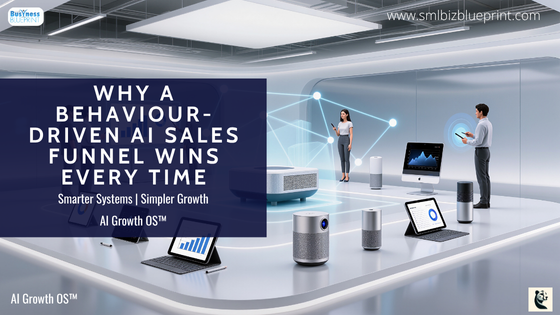

The AI Funnel Blueprint helps you double conversions without increasing ad spend by replacing fixed, time-based sequences with behaviour-driven systems that learn from your buyers.
It reveals where leads hesitate, what signals show real intent, and which friction points quietly limit your revenue.
This blueprint gives business owners a clear, adaptive path that boosts conversions, sharpens follow-up, and turns your funnel into a system that explains itself—not one you keep guessing at.
The smarter, more precise method leaders use to make their funnels learn, adapt, and convert on their behalf.
You know this feeling far too well: you’re doing everything right—posting, emailing, tweaking, showing up every day—yet the numbers refuse to move.
Your traffic holds steady. Your pipeline looks full. But conversions?
They stall, slip, and soften at the exact moment you need them to rise.
It’s the quiet pressure every business owner carries—because effort isn’t translating into outcomes, and you can’t point to a single clear reason why.
That gap creates its own tension.
It forces you into late-night dashboard checks, second-guessing your offer, and the sinking suspicion that you’re leaving money on the table—but you can’t see where.
You start wondering if you need to spend more on ads, rebuild your website, rewrite your emails, or overhaul your entire marketing engine.
And beneath it all sits the risk that matters most: drifting into December with momentum leaking instead of compounding.
Here’s the truth you already sense but haven’t yet articulated:
You don’t have a traffic problem.
You have an intelligence problem—a lack of visibility into where your funnel is failing, who’s actually ready to buy, and what’s holding them back.
That’s where the AI sales funnel changes everything—not as another tool, but as a lens.
A system that watches your buyer’s behaviour, learns from their signals, and adjusts in real time.
A system that replaces guesswork with clarity, and replaces pressure with precision. A system that doubles conversions without adding a dollar to your acquisition spend.
Because leaders who scale past the plateaus don’t push harder—they see differently.
They stop treating their funnel like plumbing and start treating it like a learning engine.
In this article, you’ll learn the AI funnel blueprint built specifically for business owners —
seven steps that reveal where revenue leaks, tighten every stage of your buyer journey, and rebuild your funnel around behaviour instead of hope.
It’s practical. It’s strategic. And it’s built to give you back control of your momentum.
- If the old way feels heavy, this is your relief.
- If the old results feel fragile, this is your foundation.
- Let’s make your funnel work as intelligently as you do.

Why “More Traffic” Is the Most Expensive Fix for a Broken AI Sales Funnel
The core truth: More traffic doesn’t fix a broken system—it multiplies the symptoms you’re already struggling with.
You’ve felt this frustration before: your team suggests upping the ad spend, refreshing creative, or widening targeting because “we just need more eyeballs.”
But deep down, you know the real issue isn’t visibility—it’s conversion.
More traffic only increases the pressure on a funnel that already leaks.
Relief arrives the moment you flip the question from “How do we get more people in?” to “Why aren’t the right people converting?”
That’s the shift business owners make when they’re ready to run a company built on precision rather than momentum swings.
Most businesses assume traffic is the lever because it’s the easiest one to see.
But traffic amplifies whatever system you have—functional or flawed. When your funnel lacks intelligence, behavioural insight, or clear diagnostic signals, every new visitor enters a journey that isn’t ready for them.
Leaders who scale into the next tier don’t chase noise—they engineer outcomes.
When you stop treating visibility as the answer, and instead inspect the conversion engine beneath it, you regain control of growth without inflating costs.
The real problem is misalignment, not volume.
Your buyer is more sophisticated than your funnel is prepared for. They don’t want more messages—they want relevance.
And relevance doesn’t come from traffic; it comes from understanding behaviour, timing, and friction points.
If the funnel doesn’t adapt, every extra dollar spent on ads works against you.
Picture this:
Two companies both spend $20,000 per month on ads.
One has a static funnel with generic follow-ups and no behavioural signals.
The other uses an AI sales funnel that tracks buyer readiness, diagnoses hesitation, and adjusts follow-ups with precision.
They receive the same number of leads.
The first company converts 2%.
The second converts 5%.
Nothing changed except the intelligence of the system.
Most people don’t realise their conversion rate is the multiplier that dictates whether traffic is an expense or an asset.
And every week this stays the same, you’re not just losing leads—you’re losing clarity on the real bottleneck holding your revenue back.
Because continuing to pour money into traffic without upgrading your funnel is the fastest way to compress margins, exhaust your team, and plateau your revenue.
What that means for your business is simple: the longer the leak remains invisible, the more expensive every month becomes.
Pro Tip
Before increasing traffic, run a 7-day AI-powered diagnostic on your current funnel. Look for intent gaps, drop-off patterns, and email behaviours.
Because scaling traffic before fixing friction doesn’t grow your business—it magnifies the cracks. In high-performing companies, intelligence always precedes volume. That’s the difference between businesses that burn budget and businesses that compound momentum.
I once spent an entire week rewriting a sales page because conversions dipped — only to realise later the real problem was a tiny moment where readers hesitated and scrolled back up.
I kept fixing the visible parts because they were easier to reach, not because they were the cause.
The shift happened the day I saw a behaviour heatmap showing exactly where attention dropped.
It felt like someone had finally turned the lights on.
Since then, I stopped “optimising everything” and started fixing the thing that actually mattered — the hesitation point.
Redefining the AI Conversion Funnel: From Linear Path to Learning System
Your funnel frustrates you because it treats every buyer the same—even though none of your buyers behave the same.
That’s the silent friction in most businesses: your funnel runs as a straight line while your customers move like a pattern.
Relief comes when you stop forcing buyers through fixed steps and start letting your funnel learn from their behaviour.
That shift—moving from a rigid pipeline to a responsive system—is the moment you stop managing traffic and start engineering momentum.
The traditional sales funnel assumes your buyer moves through stages in a predictable sequence: awareness → interest → evaluation → decision.
But today’s buyers don’t behave in order. They jump between pages. They revisit pricing without rereading features. They binge testimonials before ever joining your list.
A linear funnel can’t keep up with nonlinear behaviour.
An AI conversion funnel does the opposite. It observes patterns, detects readiness signals, adapts messaging, and reorganizes the journey in real time. It becomes a feedback loop—not a staircase.
When you run a learning-based funnel, you operate like a leader who builds systems that think, not funnels that hope.
The moment your funnel becomes adaptive, you stop wondering “Where did the lead go?” and start seeing exactly what they need next.
The core problem is rigidity.
Most small businesses build funnels based on assumed behaviour rather than actual behaviour. That leads to mismatched messaging, mistimed follow-ups, and missed opportunities.
Here’s the better lens:
Your funnel shouldn’t guide the buyer—
your buyer should guide the funnel.
Imagine this:
A prospect visits your pricing page twice in one afternoon, but hasn’t opened your last email.
A traditional funnel does nothing different.
An AI funnel blueprint triggers a relevant case study, surfaces a risk-reversal offer, or prompts a short video walking through implementation.
The system adjusts automatically.
No guesswork.
No static sequences.
No “spray-and-pray” messaging.
Most people don’t realise that every click, scroll, pause, and repeat visit is a behavioural signal telling your funnel what to do next—and traditional funnels ignore all of it.
Because the longer your funnel behaves like a fixed staircase, the more you force buyers into steps that don’t match their psychology.
What that means for your business is simple: you lose deals not because of your product, but because your funnel refuses to evolve with your buyer.
Pro Tip
Map the top five behaviours that signal buyer intent (e.g., pricing page revisits, testimonial bingeing, email reopens at night). Tell your AI to trigger different responses for each.
Because intelligence—not structure—is what drives conversions now. When your funnel learns from behaviour, you stop building “journeys” and start building systems that respond to reality. That’s the shift leaders make when they scale with clarity instead of chaos.
Stay ahead of the curve!
Subscribe to our newsletter and never miss the latest in business growth and marketing strategies
Data Before Drama: The Minimum Viable Dataset for AI Funnel Optimisation
You’re frustrated because you’re trying to optimise a funnel without trusting the numbers that feed it.
And if you’re honest, most of your data is scattered—some in your CRM, some in your inbox, some in spreadsheets you don’t want to open, and some trapped inside tools that don’t talk to each other.
Relief begins the moment you understand that AI doesn’t fix messy data—it exposes it.
When your data becomes clean, connected, and consistent, your entire funnel becomes predictable. That’s the identity shift: moving from a business owner who reacts to reports to a leader who builds systems that think.
Most businesses rely on partial data: missing timestamps, inconsistent lead sources, no clear reasons for lost deals, and fragmented tagging. AI can’t generate clarity from chaos. If the inputs are inconsistent, the insights collapse.
An AI sales funnel only becomes intelligent when it receives structured inputs it can learn from:
- accurate lead source
- stage progression logs
- behavioural markers (opens, clicks, scroll depth)
- offer viewed
- reason for outcome (won or lost)
This Minimum Viable Dataset isn’t optional—it’s the foundation that turns AI from automation into intelligence.
Leaders who scale don’t capture more data—they capture better data. Because better data sharpens decisions, and sharp decisions compound.
Once your dataset becomes clean and complete, your funnel stops guessing. It starts diagnosing.
The real issue is that partial data leads to partial insight.
And partial insight leads to wasted spend, misaligned messaging, and inconsistent conversions.
Most people don’t realize their funnel struggles not because of the tool—but because the tool never receives the context required to make accurate predictions.
Here’s a real example:
Two businesses implement the same AI funnel optimization platform.
One has clear lead sources, clean CRM fields, and consistent labeling of outcomes.
The other has three versions of the same contact, vague tags like “interested,” and no tracking of what content the lead engaged with.
After six weeks:
The first business gets accurate predictions about buyer readiness and can automate high-precision follow-ups.
The second receives unreliable, generic insights—because the AI had nothing clear to learn from.
Same tool.
Different reality.
Data integrity decides who wins.
Every week this stays the same, you lose leads you never even know you had—because your funnel can’t see the patterns living inside your own traffic.
Because continuing with inconsistent data guarantees that your decisions stay reactive, your funnel stays unpredictable, and your acquisition cost quietly climbs. What that means for your business is simple: you won’t scale intelligence on top of disorder.
Pro Tip
Standardize your top five CRM fields: lead source, first-touch date, last-touch date, primary objection, and outcome reason. Make these mandatory.
Because AI doesn’t create clarity—it amplifies it. When your data becomes coherent, your decisions sharpen, your patterns reveal themselves, and your funnel becomes a system that learns instead of a system that guesses. Leaders who scale act on truth, not noise.
Buyer Readiness Signals: Let Behaviour, Not Your Calendar, Decide When to Follow Up
Your follow-up feels inconsistent because you’re relying on timing instead of behaviour.
And that’s the source of your frustration—your automation runs on a calendar, while your buyer runs on intent.
Relief comes when you stop guessing when someone is ready and start reading the signals they’re already giving you.
That’s the moment you operate like a leader who aligns action with psychology instead of hope.
Traditional follow-up sequences run on fixed intervals—Day 1, Day 3, Day 7—regardless of what the buyer actually does. This creates a mismatch: some people need faster follow-up, some need more clarity, and some need to be left alone for a moment.
By ignoring behaviour, your funnel introduces friction at the very moment precision is required.
An AI conversion funnel replaces arbitrary timing with behavioural intelligence.
It watches:
- repeat visits to your pricing page
- late-night email reopens
- high scroll depth on testimonials
- return visits to the same offer
- video watch patterns
These buyer readiness signals show you when someone is leaning in—even if they don’t say a word. When your funnel acts on these cues, follow-up becomes timely, personal, and natural.
This is how strategic operators behave: they move when the buyer’s mind opens, not when their automation fires. They follow the signal, not the calendar.
You reclaim momentum because your follow-up becomes aligned with the buyer’s internal window of attention, not your system’s external schedule.
The real friction is mistimed communication.
Most people don’t realise that timing—more than copy, more than design, more than the offer—creates the majority of conversion lift. By relying on fixed intervals, businesses unintentionally interrupt buyers who aren’t ready and ignore buyers who are.
Imagine this real scenario:
A prospect reopens your proposal three times in one evening but doesn’t respond.
A traditional funnel sends a follow-up two days later—long after the moment passed.
An AI funnel triggers a short message within an hour:
“Quick question—want a simpler version of the package you were reviewing?”
That’s behaviour-based timing.
And it converts because it aligns with the buyer’s psychological window.
This isn’t guessing—it’s pattern recognition.
Most people don’t realize their highest-intent buyers often give off subtle signals days before they ever reply.
And every week this stays the same, you miss deals you could have closed simply because your follow-up arrived after their interest faded.
Because misaligned timing is one of the largest invisible revenue leaks in small businesses. What that means for your business is direct: the longer your follow-up is tied to a calendar, the more opportunities you quietly lose.
Pro Tip
Identify the top three readiness signals in your funnel (e.g., pricing page revisits, proposal reopens, testimonial bingeing). Automate a follow-up trigger for each.
Because timing isn’t a task—it’s a competitive advantage. When your funnel responds to behaviour in real time, you stop chasing leads and start meeting buyers in the exact moment they’re most likely to move. That’s the level of precision leaders operate from when they scale with confidence instead of chance.
Jordan, who runs a service business, thought he needed new ads to fix his slowing pipeline — until he noticed prospects always paused at the same part of his offer page.
Nothing was “wrong,” but something felt unclear.
Once he smoothed that single hesitation moment, his follow-up emails landed at the exact time prospects returned to re-read pricing.
In just two weeks, his sales cycle shortened by 30% with no extra leads.
He went from firefighting to forecasting — a shift he didn’t know was possible before.
AI Lead Scoring Is a Hypothesis Engine, Not a Truth Machine
You’re frustrated because your current lead scoring feels arbitrary—you assign points, your team reviews the list, but the “hot leads” don’t always buy and the “cold leads” sometimes surprise you.
That inconsistency creates doubt, wasted follow-up effort, and unpredictable revenue.
The relief comes when you stop treating lead scoring as a verdict and start treating it as a hypothesis. That’s the shift you make when you operate like a leader who values accuracy over assumptions.
Traditional lead scoring is rigid. It assigns fixed points to actions—webinar attended (+10), pricing page visited (+20), no response (-10). It assumes all behaviours carry the same meaning across all buyers.
But intent is contextual.
A pricing page visit might mean curiosity for one person and real readiness for another.
Static scoring ignores nuance and produces misleading signals.
An AI lead scoring model behaves differently. It doesn’t rely on fixed assumptions—it learns continuously from behaviour patterns.
It watches how fast someone moves between pages, how often they return to your offer, how they interact with specific content, and how they behave compared to past buyers who converted.
It evolves as your business evolves. AI doesn’t claim “this lead is hot.” It proposes: “Based on the pattern, this lead resembles buyers who closed.”
Leaders who scale don’t chase certainty—they chase accuracy. They treat every insight as a hypothesis worth testing, refining, and strengthening.
When you use AI to score leads, your pipeline stops being a guess and becomes a probability model you can trust.
The real issue is static assumptions in a dynamic environment.
Most people don’t realize their lead scoring fails because it freezes human behaviour into a formula—and human behaviour is never static.
A high-value prospect may open your proposal only once but spend an hour on it. A low-value prospect may open your emails 12 times because they’re indecisive, not ready.
Here’s a real scenario:
Two prospects download your guide.
Prospect A reads it once and revisits your site three times in two days.
Prospect B opens it 11 times over three weeks but never explores anything else.
Traditional lead scoring ranks B higher because of volume.
An AI funnel blueprint ranks A higher because of velocity and breadth of behaviour.
Velocity > volume.
Breadth > frequency.
Pattern > points.
Most people don’t realise that the scoring model itself is more important than the score.
Once you shift to pattern-based scoring, your follow-up becomes sharper, your pipeline becomes cleaner, and your team focuses on the real opportunities—not the noisy ones.
Because every week you rely on static scoring, your team wastes hours chasing the wrong leads while the right ones cool down. What that means for your business is predictable: missed timing, misallocated effort, and misleading dashboards.
Pro Tip
Tag every won and lost deal with the top three behaviours that preceded the outcome. Feed these back into your AI scoring system weekly.
Because the power isn’t in scoring leads—it’s in understanding patterns. When your model learns from real outcomes instead of outdated formulas, your funnel becomes a system that evolves with your market instead of lagging behind it. Leaders who scale don’t rely on fixed numbers—they rely on learning systems.

Use AI to Map Friction, Not Just Personalise Messages
You’re frustrated because you keep personalising your messaging, but conversion still feels unpredictable and fragile.
You change subject lines, tweak headlines, adjust CTAs, and add dynamic fields—yet nothing moves consistently.
Relief comes the moment you realise the hard truth: personalisation doesn’t fix friction. It only decorates it.
The identity shift happens when you stop polishing the funnel and start diagnosing where buyers get stuck.
Most funnels fail not because the message is wrong, but because the experience is heavy.
Your buyer hits moments of confusion, risk, or overwhelm that your team never sees. These invisible friction points—pricing ambiguity, unclear value hierarchy, too much cognitive load, poor offer sequencing—halt momentum long before messaging does.
An AI conversion funnel maps these micro-frictions by watching behaviour at scale.
It identifies:
- pages where scroll depth suddenly drops
- CTAs that attract clicks but repel conversions
- email sections where engagement stalls
- content patterns that cause hesitation
- objections appearing across segments
AI sees what humans miss because it reads the patterns behind the patterns. Eliminating friction accelerates momentum more than any personalisation tactic ever could.
Leaders who scale don’t decorate problems—they remove them. They build funnels that feel inevitable, not effortful.
When friction disappears, personalisation becomes amplification instead of compensation. Your funnel finally converts because the path is clear, not because the message is louder.
The real issue is assuming friction is obvious.
Most people don’t realise friction hides inside well-designed funnels.
It hides in the delay between pages. It hides in the offer that feels too big for a first step. It hides in testimonial sections that don’t match buyer concerns.
AI exposes the moments where buyers mentally pause—even if they never click away.
A real example:
A business noticed that lead quality dropped after switching to a new landing page—yet the design looked cleaner and more modern.
AI heatmaps revealed that buyers consistently paused on a single sentence:
“Implementation typically takes 4–6 weeks.”
This created subconscious resistance. Once rephrased to “Set up your first workflow in under 60 minutes,” conversions jumped.
The friction wasn’t the offer.
The friction was the interpretation of the offer.
Most people don’t realise their buyers aren’t saying “no”—they’re simply hesitating in silence.
And every week this stays the same, you lose leads you never even see because friction kills momentum before your follow-up has a chance.
Because friction is the most expensive leak in your business. What that means is stark: the longer friction stays invisible, the more profit slips through cracks you didn’t even know existed.
Pro Tip
Run an AI-driven friction audit every quarter—identify the top three drop-off points and rewrite those steps before touching anything else.
Because growth doesn’t come from louder messaging—it comes from removing resistance. When you treat friction as your true adversary, your funnel becomes a system that flows, not a system that fights back. Leaders who scale don’t optimise for attention—they optimise for momentum.
The Uncommon Angle — Turn “No” Into an Objection Intelligence System
You’re frustrated because every “no” feels like a dead end—another lead gone, another conversation closed, another opportunity slipping out of reach.
But the real relief comes when you realise the most valuable data in your entire funnel isn’t found in the leads who say yes—it’s found in the patterns behind those who say no.
That’s the moment you step into the identity of a leader who treats every outcome as information, not failure.
Most businesses treat objections as obstacles. They log them vaguely (“not ready,” “not interested,” “too expensive”), push the lead back into long-term nurture, and move on.
This reactive habit blinds you to the underlying truth: objections are structured, predictable, and deeply diagnostic.
When you ignore them, you lose the roadmap to higher conversions.
An AI conversion funnel transforms objections into intelligence. It clusters the language leads use when they hesitate—price, timing, risk, complexity—and maps these patterns to friction points in your funnel.
It can tell you:
which objections appear before certain offers
which questions slow buyers at specific stages
which segments hesitate for different reasons
which objections precede wins vs. losses
AI converts “no” into data, and data into clarity. Your funnel becomes a self-correcting system.
Leaders who scale don’t fear objections—they study them. They use every hesitation to sharpen their offer, messaging, and sequencing.
When objections stop being threats, they become fuel. They show you exactly where to adjust, when to intervene, and how to frame your next conversation with authority.
The real issue is treating “no” as the end of the conversation instead of the beginning of insight.
Most people don’t realise objections are the most honest feedback buyers ever give you.
They’re the purest window into the gap between what you’re offering and what the buyer perceives. And because objections repeat in predictable clusters, they’re your fastest route to dialling in your funnel with precision.
Here’s a practical example:
A business struggles with slow conversions.
AI analyses six months of lost deals and clusters the objections into four themes:
Unclear implementation timeline
Fear of internal workload
Uncertainty about ROI
Confusion about the offer sequence
The company doesn’t guess.
It addresses each objection systematically:
adds a 14-day setup roadmap
reduces onboarding steps
adds ROI case studies
simplifies the first offer
Result?
Conversion lifts 22% in eight weeks—without changing traffic, pricing, or ad spend.
Not because the product changed.
Because the objection intelligence changed.
Most people don’t realise that objections are signals, not setbacks—and the longer you ignore them, the longer your conversion ceiling stays locked.
Because every “no” you fail to analyse is a missed blueprint for improving your funnel.
What that means for your business is stark: you’re not losing leads because your offer is weak—you’re losing them because you haven’t used their objections to strengthen it.
Pro Tip
Tag every lost deal with a specific objection and feed these into your AI system weekly. Look for patterns every 30 days.
Because objections aren’t noise—they’re navigation. The businesses that scale fastest don’t silence objections; they systemise them into insight. When you treat hesitation as data, you turn uncertainty into direction—and that’s the advantage leaders operate from when they build funnels that evolve instead of stagnate.
Don’t miss a beat in your business growth journey!
Join Pulse and stay ahead with expert tips and actionable advice every month.
Subscribe to Pulse Today
The New Baseline — Your Funnel Is Underperforming Until It Can Explain Itself
You’re frustrated because your funnel tells you what happened—but never why it happened.
You see the numbers: opens, clicks, conversions, drop-offs. But you don’t see the narrative behind them. You don’t see which message caused hesitation, which page triggered confusion, or which segment needed reassurance.
Relief begins the moment you realise reporting is not insight—explanation is.
That’s the identity shift: moving from a business owner who manages dashboards to a leader who runs a decision-making system.
Traditional analytics only show historical performance. They tell you conversions dropped 15% or leads slowed this quarter, but they never reveal why.
You’re left guessing whether the issue lives in the offer, timing, traffic quality, market noise, or internal execution.
Without causal understanding, your team spends weeks running experiments based on instinct rather than intelligence.
An AI funnel blueprint solves this by generating explanatory intelligence.
AI doesn’t just report numbers—it interprets patterns:
- “Conversions dropped because pricing-checkers saw fewer testimonials.”
- “Lead quality dipped because organic traffic shifted to lower-intent keywords.”
- “Deals slowed because high-intent leads opened emails late at night, not during the day.”
- “Segment B hesitates more when the case study isn’t surfaced early.”
This is reasoning, not reporting. AI connects behaviour, content, timing, and offer structure into a coherent story that explains outcomes.
Leaders who scale operate from causal clarity. They don’t react to numbers—they respond to patterns.
When your funnel can explain itself, decisions accelerate, focus sharpens, and momentum becomes repeatable instead of unpredictable.
The real issue is relying on analytics that don’t interpret, only measure.
Most people don’t realise how much time they waste trying to reverse-engineer cause and effect. They stare at charts, compare weeks, guess at hypotheses, and run low-confidence tests.
But a funnel that explains itself removes the ambiguity. It tells you exactly which lever to pull and which road to stop traveling.
Here’s a real example:
A company sees a sudden dip in conversions from its core landing page. The team spends two weeks rewriting headlines and adjusting the hero section.
AI analysis reveals the issue wasn’t the page—it was the CTA. A new offer was introduced, but it wasn’t aligned with the segment clicking through.
Once reversed, conversions rebounded in 24 hours.
The funnel didn’t need redesigning.
It needed explaining.
Most people don’t realise that a lack of explanation forces you to work harder, not smarter—and the longer that stays the same, the more your decisions lag behind your market’s behaviour.
Because guessing drains time, money, mental bandwidth, and team confidence. What that means for your business is simple: unless your funnel explains itself, you will always optimise based on symptoms, not causes.
Pro Tip
Add a weekly “funnel reasoning review” where you ask your AI system to summarise the top three behavioural drivers behind your results.
Because growth doesn’t come from monitoring KPIs—it comes from understanding causality. When your funnel becomes a source of explanation instead of confusion, you stop reacting and start directing. That’s the advantage leaders gain when they build systems that think instead of systems that merely track.
Conclusion
You’ve been living with the same frustration for too long: doing more, trying harder, showing up every day—yet your funnel still feels inconsistent, fragile, and unpredictable.
You push traffic, tweak messaging, refresh creative, and still wonder why the results don’t match the effort.
That tension—between high activity and low yield—is the silent tax on every business owner who’s built their growth on willpower instead of intelligence.
Here’s your relief: nothing in your business is broken—your funnel has simply been operating blind.
Once you shift from static sequences to an AI sales funnel that learns, adapts, and responds to real buyer behaviour, everything becomes easier.
Conversions feel stable. Follow-up becomes timely. Data begins to explain itself. You see the patterns you never could see before.
And for the first time in a long time, your growth feels earned instead of accidental.
And this is the identity shift waiting for you:
Leaders who scale don’t guess—they diagnose. They don’t chase—they interpret. They build systems that think, not systems that depend on them to think.
That’s the business you are becoming.
Across this blueprint you learned seven truths that redefine how a modern funnel works:
- more traffic multiplies inefficiency
- a funnel must learn, not assume
- clean data beats more data
- behaviour outranks timing
- lead scoring must evolve, not calcify
- friction—not messaging—is your true adversary
- “no” is intelligence disguised as rejection
- and every high-performing funnel must explain itself
These aren’t tactics. They’re the architecture of a business that scales cleanly, confidently, and predictably—without burning time, money, or energy on noise.
But here’s the strategic reality you can’t ignore:
Every month you delay moving to an intelligent, behaviour-driven funnel is a month you pay for mistakes you already solved today.
The longer the system stays static, the more you lose leads you never see, opportunities you never realise, and momentum you never feel.
Here’s the part no one tells you—your current state is optional.
You don’t need to keep building funnels that rely on hope.
You don’t need to keep chasing buyers instead of reading their signals.
You don’t need to keep running a business where decisions feel reactive instead of informed.
This is your moment of choice:
Stay stuck in a system that hides its leaks—or step into a funnel that learns, adapts, and compounds.
Hold onto the frustration of effort without yield—or move forward with clarity, precision, and control.
If you’re ready to build the kind of funnel that finally works as intelligently as you do, now is the time to act.
The next step isn’t more work—
it’s a better system.
Action Steps
Audit Your Current Funnel for Hidden Friction
Identify the points where buyers slow down, get confused, or abandon the journey.
Check: landing pages, pricing pages, emails, CTAs, load times, and onboarding steps.
Remove resistance first—optimisation begins with clarity, not more content.
Map the Top Buyer Readiness Signals
Document the behaviours that indicate interest or momentum:
pricing page revisits
late-night proposal opens
deep scroll on testimonials
return visits to the offer
These signals are more accurate than demographics or superficial engagement.
Clean Your Data Before Adding More Tools
Align your CRM fields and standardise your inputs.
The minimum fields: lead source, touch history, objection reason, offer viewed, outcome.
AI only becomes intelligent when your data becomes consistent.
Replace Time-Based Follow-Up With Behaviour-Based Triggers
Shift from “send on Day 3” to “send when the buyer leans in.”
Automate messages triggered by actions, not calendars.
This is how you contact buyers when their psychology—not your system—is open.
Upgrade Lead Scoring From Points to Patterns
Stop treating every action as equal.
Use velocity, breadth, and recency of behaviour to shape your scoring model.
High-value leads move faster and touch more meaningful assets—not more assets.
Turn Objections Into an Intelligence Loop
Tag every lost deal with a specific objection.
Feed those objections back into your AI or CRM monthly.
Patterns reveal where your funnel needs clarity, reassurance, or restructuring.
Build a Funnel That Explains Itself, Not One You Keep Guessing At
Use AI tools to interpret why your results shifted.
Ask weekly:
What drove conversions this week?
What created friction?
Where did attention drop?
Your funnel should produce explanations—not leave you reading charts alone at night.
FAQs
Q1: What is an AI sales funnel, and how is it different from a traditional funnel?
A1: An AI sales funnel adapts to buyer behaviour in real time instead of following a fixed sequence. Traditional funnels rely on linear steps and time-based follow-up. An AI funnel responds to readiness signals—pricing page revisits, proposal reopens, testimonial scroll depth—and adjusts messaging, timing, and next steps automatically. This makes conversions more predictable and reduces wasted effort.
Q2: How does AI help improve conversion rates without increasing ad spend?
A2: AI removes friction, improves timing, and identifies high-intent patterns inside your existing traffic. Instead of pushing more visitors through a rigid sequence, AI pinpoints the moments where leads hesitate and aligns follow-up with psychological readiness. Better timing + fewer friction points = higher conversions without more spend.
Q3: Do I need perfect data before using an AI funnel?
A3: You don’t need perfect data—but you do need consistent data. AI relies on clean, structured inputs to make accurate predictions. Standardising your CRM fields (lead source, offer viewed, objection reason, outcome) is enough to give AI a reliable foundation. It’s about clarity, not volume.
Q4: What buyer behaviour signals matter most for AI funnel optimisation?
A4: The strongest signals include:
repeat visits to the pricing page
proposal reopens (especially within short time windows)
deep engagement with testimonials or case studies
video watch time
returning to the same offer multiple times
These signals indicate readiness more accurately than simple clicks or email opens.
Q5: How does AI lead scoring work, and why is it more reliable?
A5: AI lead scoring is pattern-based, not points-based. Instead of assigning fixed values to actions (e.g., +10 for webinar attendance), AI looks at behaviour clusters that historically lead to sales—velocity, recency, depth of engagement, and similarities to past buyers. This produces scores grounded in evidence, not assumptions.
Q6: What does it mean to “map friction” in the funnel?
A6: Mapping friction means identifying the places where buyers slow down, hesitate, or stop—confusing copy, unclear pricing, overwhelming forms, long load times, or missing proof. AI identifies these micro-friction points using behaviour patterns and drop-off signals. Eliminating friction produces faster, smoother conversions.
Q7: Why is objection intelligence a powerful tool for improving conversions?
A7: Lost deals contain the clearest clues for improvement. When objections are logged, clustered, and analysed, you gain visibility into hidden gaps in your messaging, offer structure, or positioning. Objection intelligence turns “no” into insight. This reduces repeat mistakes, sharpens your funnel, and makes your offer feel safer and clearer.
Here’s the part almost no one admits: most funnels don’t fail because of strategy — they fail because the business stops learning while the buyer keeps evolving.
Teams update copy, but behaviour keeps shifting underneath the surface.
The turning point comes when you realise your funnel should be learning faster than you are — spotting patterns you’d never catch manually.
Once you see your funnel as a living system instead of a static sequence, optimisation becomes effortless and continuous.
That’s the moment businesses shift from reacting to designing their growth.
Bonus Section: The Intelligence Layer Most Funnels Never Reach
Most leaders believe they’re making data-driven decisions, but what they’re actually doing is interpreting surface behaviour—opens, clicks, page visits—without questioning the deeper signals underneath.
They optimise based on what buyers do, not why they do it. It’s a subtle trap that keeps funnels functional but not intelligent, active but not aligned.
And as the pressure to convert rises, this surface-level visibility limits how much clarity, accuracy, and growth a business can access.
Here’s the quiet truth: the most valuable signals in your funnel are the ones you’re not tracking yet. They sit underneath the obvious patterns, shaping decisions, timing, and momentum in ways most dashboards never reveal.
When you begin to look at your funnel through the lens of deeper intelligence—energy, hesitation, silence—you realise your buyer’s intent isn’t hidden. You’ve just been listening at the wrong volume.
What follows are three unconventional insights that expand how you think about funnels—not to fix a problem, but to unlock a better way of seeing.
Buyer Energy Tracking: The Pattern Behind the Pattern
Your buyer’s most important signals aren’t their actions—they’re their energy rhythms.
Most funnels track mechanical behaviours: “they clicked here,” “they visited this page,” “they reopened the proposal.” But the deeper intelligence comes from when those actions occur.
Buyers have emotional windows: late-night reopens fueled by overthinking, weekend browsing driven by planning, mid-morning spikes when their guard is down and decisions feel lighter.
Once you start tracking energy—not just activity—you see the invisible currents guiding your buyer’s decisions. Patterns emerge that no demographic field could ever explain.
This is the shift leaders make when they stop treating buyers as data points and start seeing them as humans with rhythms, not rules. Funnels become intuitive instead of reactive.
Hesitation Style Segmentation: The Most Accurate Predictor of Conversion
Your buyers don’t hesitate for the same reasons—and that hesitation matters more than any demographic field.
Most segmentation is built on company size, budget, industry, or timeline.
But the real conversion driver is the buyer’s hesitation style: Do they overthink? Do they need proof? Do they fear risk? Do they move fast but pause at the finish line?
These patterns repeat across every market and define what your buyer needs—not who they are.
When you segment by hesitation style, your messaging cuts deeper, your follow-up becomes sharper, and your positioning feels tailored without feeling personalised. You stop persuading everyone and start supporting individuals.
This is how leaders build funnels that feel alive—systems that meet buyers at the edge of their doubt and move them past it with clarity and confidence.
Predictive Silence Windows: When “Nothing Happened” Is the Signal
Silence isn’t a lack of behaviour—it’s a behavioural pattern.
Most businesses treat silence as disengagement. But silence has texture. Some silence is “healthy”—it means the buyer is thinking, comparing, processing.
Other silence is “cold”—a quiet signal that the deal is already lost, mentally, even if the CRM hasn’t caught up.
AI can detect the difference by reading timing, pacing, and the emotional arc of prior behaviour.
When you begin to see silence as data, you unlock a new dimension of insight. You realise your buyer speaks even when they say nothing. They communicate through timing, not replies.
This is the level of intelligence leaders access when they treat the funnel as a conversation, not a sequence. They intervene gently, wisely, and at the exact moment the buyer needs it.
The edge doesn’t come from more tools or more traffic.
It comes from learning to see what others overlook.
When you begin reading energy, hesitation, and silence, your funnel shifts from mechanical to perceptive—and your growth shifts from effortful to inevitable.
Other Articles
How to Build a Lead Closing System That Runs Itself
Why Most Outreach Fails (and How to Use AI Prompts to Warm Cold Leads)