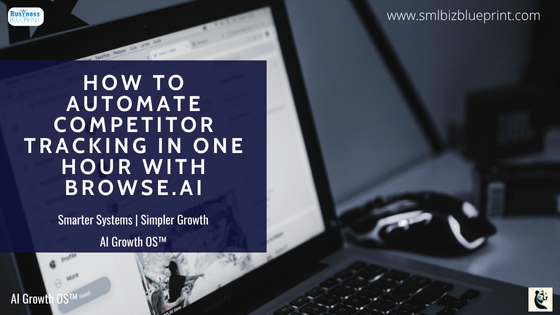

Small businesses can automate competitor tracking in under an hour using Browse AI — a no-code tool that monitors competitor websites for price, feature, and promotion changes.
Instead of manually checking sites, Browse AI uses machine-learning vision to detect updates and send real-time alerts straight to Google Sheets or Slack.
This lets owners react faster, protect margins, and make data-driven decisions without extra staff or complex systems.
Set up once, save hours every week, and let AI do the watching for you.
Imagine this: you’re the owner of a $4-million business operating in a crowded niche.
Competitors are quietly tweaking their pricing, adding new tiers, re-configuring their product offers — while you’re still relying on quarterly spreadsheets and a monthly “check-in” with your team.
You only discover a major competitor promotion after it’s eaten three of your best leads.
Sound familiar?
That’s the default approach: manual competitor tracking, vague “intel” reports, gut-feel decisions.
For SMBs in the $2M-$10M range, this is exactly where you stumble—because you shouldn’t be doing enterprise-scale CI (competitive intelligence) without enterprise investment, yet you can’t afford to ignore it either.
In this post, we’re going to challenge the default:
- Why your current approach to competitor tracking fails you.
- How to rethink the problem using first principles.
- How you can use Browse AI to build an automated competitor-tracking system in under an hour—so you shift from reaction to proactive.
Let’s dive in.

Mindset: The Strategic “Why”
Before we geek out on tools, let’s step back and ask the strategic question: Why do we want to track competitors at all?
Why this matters
Risk of being surprised – Every time a competitor quietly changes a price, adds a tier, or launches a flash sale, you’re reacting rather than orchestrating.
You’re losing margin, bargaining power and strategic clarity.
Opportunity-leakage – When you don’t see shifts in the market, you miss opportunities to lean in: maybe a competitor has abandoned a segment you could own, or is weakening their positioning, which you could exploit early.
Positioning maintenance – Your market doesn’t wait. Competitors shift, customers compare. If you’re relying solely on your own internal roadmap, you may find your value proposition becomes stale or misaligned.
Efficiency of resources – For a $2M-$10M business, you don’t have a full competitor-intel team. You need a smarter, leaner way to monitor without sacrificing insight.
Why the default fails
Manual checks (once a week/month) are too slow. By the time you see a competitor’s move, the impact is baked.
Spreadsheet-based tracking is fragile: you’ll miss subtle changes in design, feature packaging, copy, and tiers.
Generic competitor tools often focus on things like traffic or backlinks—not the nuanced shifts in pricing, packaging, site copy or launch campaigns that affect your business directly.
The myth: “We’ll just keep an eye on them.” → That only works if they’re static (they’re not). In truth, you need live alerts, structured data, and automation.
So what’s the better lens?
First-principles lens
Fundamental unit = change in competitor behaviour that impacts your business (price, packaging, feature, promotion).
Detection → Insight → Response: It’s not enough to see a change — you need to interpret it and respond quickly.
Automate the routine: Repetitive tracking tasks should be automated. You want to spend human time only on insights & decisions, not data collection.
Scalable, yet lean: You don’t need a giant intelligence function. You need a lean monitoring system tuned to what matters for your business.
That sets the mindset. Now let’s move to the tool.
Ready to level up your business?
Sign up for our newsletter and get expert tips delivered weekly.
What It Is / Core Concepts
Let’s define what Browse AI actually is — in plain business language.
Definition
Browse AI is a no-code/low-code web-automation platform that allows you to create “robots” (or automated workflows) that monitor websites for changes, extract data (text, pricing, feature lists, screenshots), and send alerts into tools you already use (Google Sheets, Slack, Zapier, webhooks).
Key concepts
Robot / Task: the automated job you configure (e.g., visit competitor.com/pricing, capture pricing tiers).
Monitoring: you schedule a robot to run repeatedly (hourly, daily, weekly) and look for changes.
Change-detection: when the robot detects that an element has changed (price, tier label, feature list) it triggers an alert. Browse AI claims the AI “automatically adapts to website changes” (e.g., layout change) so your robot doesn’t break.
Extraction: capturing structured data (e.g., five competitor products and their prices) or screenshots of full pages.
Integration: data output to CSV/Google Sheets/BI dashboards/Zapier so you can pipeline it into your systems.
In simpler terms
Think of it like: “I tell the system: keep an eye on competitor X’s pricing page. If anything changes — insert a new plan, change a number, remove a feature — I want to know.
Then that alert goes into my Slack/Google Sheet so I can decide: Do I need to adjust our offer, pricing or positioning?”
And the key: you set it once, and it runs automatically without you manually re-checking every day.
When to Use It (and When Not To)
When you should use it
You are in a competitive market where pricing, feature packaging or promotions are fluid (i.e., not locked).
You have a focused set of competitors (3 to 10) that materially impact your growth/positioning.
You want faster insight into competitor moves (hours/days, not weeks).
You have internal mechanisms to act on the intel (e.g., your sales team can respond; your marketing can adjust copy; you can adjust packaging).
You’re running a business where margin, offer clarity and feature-ceiling matter — common in $2M-$10M B2B/online/product/retail firms.
When you should not use it
If your competitive landscape is large and highly fragmented (e.g., hundreds of tiny competitors) and you don’t have capacity to respond to alerts -> you’ll generate noise.
If you don’t have an internal process/decision-flow to act on what you detect — detection without action = wasted effort.
If your offer is so differentiated and niche that competitors’ moves seldom affect you (i.e., you’re in a “blue ocean” rather than red).
If you don’t have the resources to interpret or act on the data (the tool doesn’t replace strategic thinking, only amplify it).
How It Works / Basics of Setup
Here’s a simple, relatable workflow for a small business — get it live in under an hour.
Workflow Example: Tracking competitor pricing
Let’s say your company is a subscription-based service (or product with tiers). You want to monitor competitor A’s pricing page.
Login to Browse AI – create an account.
Build new robot:
Choose “Extract structured data” (point & click).
Enter competitor’s pricing page URL (e.g., competitor.com/pricing).
Highlight the pricing tiers, pricing amounts, features lists, plan names.
Also take a screenshot of the page for reference.
Review robot output – test one run; ensure you’re capturing the correct fields (tier name, monthly price, annual price, key features).
Set monitoring schedule – e.g., run daily (or hourly if high-risk).
Configure alert – choose “Notify me when any field changes.” Output goes to a destination (Google Sheet or Slack channel).
Connect downstream system – e.g., the Google Sheet feeds into your internal “competitive dashboard” or triggers a Slack message to your product/pricing lead.
Review process & integrate – agree how your team will act: “If competitor lowers price by 20% -> we’ll review our next week’s campaign.”
Expand scope – add other competitor URLs (features page, promotions page, blog announcements, sitemap). For large sites, you can use sitemap extraction to monitor all pages.
That’s basically it—set it up, let it run, then focus on interpreting the alerts and responding.

How AI Actually Works Here
Most people hear “AI” and assume marketing hype.
In Browse AI’s case, the intelligence is real — but practical. Traditional scrapers follow fixed code instructions: if a competitor changes their layout, your bot breaks.
Browse AI uses machine-learning vision and pattern recognition to understand a web page — identifying elements like prices, product names, and feature blocks even when the page design shifts.
It compares versions over time to surface only meaningful changes, not raw noise.
The result?
Reliable monitoring that adapts automatically — saving hours of re-work and keeping your competitive data clean and current.
Comparison (Free vs Paid / vs Other Tools)
Vs traditional competitor tools
Many “competitor analysis” platforms (e.g., those listed in Zapier’s best competitor analysis tools) focus on traffic, backlinks, social metrics—not the live-changes in pricing/features/promotions that impact your strategy.
Browse AI shifts the lens from “what are they doing historically” to “what just changed and how should I respond now?”
Free vs paid tiers
Browse AI offers a free tier (or at least a starter) so you can experiment.
Paid tiers unlock higher volumes (hundreds of URLs, frequent checks), advanced features (sitemap extraction, enterprise monitoring) and integrations for scale.
For a $2M-$10M business you likely start with a modest tier and scale only as you see value.
When it might not be the best tool
If you only need high-level insights (e.g., “how much traffic does competitor X get?”), a tool like Ahrefs or Semrush may suffice.
If you lack internal systems for action, any tool could produce “alert fatigue.”
If your competitor moves are predominantly offline and you cannot monitor via web.
Practical Business Example: Before & After
Before
A mid-sized service business (~$5M revenue) relied on monthly manual review of competitor websites.
They found out a major competitor introduced a “Premium Plus” tier only when it appeared in sales losses.
They lost three enterprise deals before figuring out the new tier offered significantly more features for a price close to their own top plan.
They scrambled to adjust price but were always behind.
After implementing Browse AI
They set up robots to monitor competitor pricing pages and feature lists. Within days, they got the alert: “Competitor X added ‘AI-Insights’ to their Premium tier and cut price by 15%.”
Because it came early morning, the sales team updated their messaging by late morning, emphasising their own “Analytics Suite – still exclusive” and offering a loyalty discount.
They preserved the deals, maintained margin, and used the insight to launch a refreshed package one week later.
Their internal “competitive update” meeting moved from monthly to a weekly 20-minute session, focused on alerts and action.
Impact: Lower reaction time (hours instead of weeks), better margin retention, improved win-rate in contested deals.
Tips & Pitfalls
Tips for success
Focus on your “super-important” competitors first – don’t try to track everyone. Pick the 3-5 that matter most.
Define what you care about – clearly identify the fields you’ll monitor (price, tier name, feature list, promotion banner).
Build an action process – alerts are only useful if someone picks them up and acts. Define who gets notified and what they do.
Integrate into your workflow – e.g., alerts into Slack + Google Sheet + weekly review. Make it part of your rhythm.
Schedule regular review – automate is good, but humans still need to interpret. Weekly 20-minute review works well.
Build historical data – track changes over time so you can spot patterns (e.g., seasonal promotions).
Use automation wisely – whenever a change occurs, you can trigger downstream tasks (email to sales team, update competitor logs, adjust pricing model).
Scale gradually – start with key pages, then expand to sitemap-based monitoring.
Pitfalls to avoid
Alert overload – if you monitor too many pages or too frequently with weak filters, you’ll get noise. Your team will ignore alerts.
No action path – even the best alert is useless if it just sits in a spreadsheet.
Monitoring everything, acting on nothing – you must prioritise alerts by business impact.
Ignoring competitor context – a price drop isn’t always a war-move; it could be a clearance or market exit. Don’t over-react.
Assuming robots are set-and-forget – websites change layouts; even with AI detection, occasionally check your robots.
Over-automating without human interpretation – automation gives you data, humans give you insight. Both matter.
Stay in the know!
Pulse is your go-to resource for the latest trends and proven tactics to grow your business. Subscribe today!
Get Pulse Here
Conclusion
You’ve felt it — that constant frustration of chasing competitors who always seem one move ahead.
The endless tabs, late-night searches, and half-finished spreadsheets aren’t proof of diligence — they’re symptoms of a system built on reaction, not intelligence.
But there’s another way. With automation, the noise quiets. Instead of guessing, you see patterns forming. Instead of scrambling, you act with purpose.
That’s the relief of moving from uncertainty to clarity — when your business starts working for you, not the other way around.
Because this isn’t just about tracking competitors — it’s about reclaiming control. It’s about being the business that spots opportunity early and turns data into direction.
Right now, you have a choice: stay stuck in the cycle of reacting, or step forward into a system that sees for you.
One keeps you chasing. The other makes you the one to chase.
Build your edge today — automate competitor tracking and start leading your market.
FAQs
Q1: Is using Browse AI legal and safe for competitor tracking?
A1: Yes — Browse AI only tracks publicly available information on competitor websites, which is completely legal and ethical. It doesn’t bypass paywalls, logins, or private systems. Think of it as structured monitoring, not scraping for hidden data. Still, it’s wise to respect site terms and limit frequency to avoid overloading servers. The goal is insight, not intrusion.
Q2: Do I need technical or coding skills to use it?
A2: Not at all. Browse AI was built for business users, not developers. You simply highlight the information you want, and the tool does the rest. The interface works visually — like telling a staff member, “Keep an eye on these prices.” That’s what makes it practical for smaller teams without an in-house data specialist.
Q3: How many competitors or pages can I realistically monitor?
A3: You can start with as few as three competitors and scale as needed. Most $2M–$10M businesses see strong results tracking 10–20 pages across 3–5 competitors. The free or entry plan can cover your top categories (e.g., sinks, taps, ovens). As your needs grow, higher tiers allow hundreds of pages and faster checks. Start small; expand once you’ve built a weekly decision rhythm around the alerts.
Q4: What if a competitor redesigns their website or moves their pricing?
A4: That’s where the “AI” part of Browse AI matters. Traditional scrapers break when page layouts shift. Browse AI uses pattern recognition to re-identify elements like prices and features even after a redesign. You may still need to check occasionally, but it reduces downtime from “broken bots” by a huge margin. The AI adapts so you don’t have to rebuild from scratch.
Q5: How often should I run these checks or reviews?
A5: It depends on your market’s pace. Daily checks make sense in highly competitive e-commerce (where pricing changes often). Weekly works for slower-moving categories like high-end fixtures or appliances. What matters most is consistency — reviewing alerts at a set time, so your team turns detection into action. A 15-minute Monday review works wonders.
Q6: Can Browse AI integrate with my existing tools or CRM?
A6: Yes — integration is one of its biggest strengths. You can connect Browse AI to Google Sheets, Slack, Airtable, or any CRM via Zapier or webhooks. That means competitor alerts flow straight into your systems — for example, a Slack ping to marketing when a price changes, or automatic logging of new promotions in your shared dashboard. It keeps the workflow hands-free.
Q7: How does Browse AI fit with other pricing tools like Prisync?
A7: Browse AI gives you breadth — tracking promotions, feature changes, and competitor offers across any web page. Prisync gives you depth — SKU-level pricing data and automated repricing rules. Many businesses use both: Browse AI for strategic awareness and Prisync for tactical pricing control. Together, they provide a complete visibility system for your market.
Action Steps
Define What Matters Most
Don’t try to track everything. Identify your top 3–5 competitors and the specific changes that impact your business most — pricing, promotions, features, or new launches. Start with one category (e.g., sinks) before expanding.
Choose the Right Lens — Price or Insight
Use Browse AI for flexible competitor monitoring (pricing pages, promotions, category changes) and Prisync for structured SKU-based pricing intelligence. The goal isn’t more data — it’s faster clarity.
Build Your First Robot in Browse AI
Pick one competitor’s pricing or product page. In Browse AI, highlight the elements you care about (price, feature list, offer banner). Set the robot to check daily and export results to Google Sheets.
→ You’ve now automated your first competitor monitor.
Connect Alerts to Your Workflow
Use Zapier or Slack integrations to send alerts directly to the people who can act — marketing, pricing, or sales. Don’t let intel die in a spreadsheet. Every alert should have an owner and an action path.
Review Competitor Movements Weekly
Create a short, focused “competitive pulse” meeting each week. Review what changed, why it matters, and what you’ll do about it. This keeps the system lean and insights actionable.
Expand and Segment Your Monitoring
Once your first robot works, replicate it for other categories (taps, ovens, cooktops, home décor). Group competitors by market type — direct, premium, discount — to see pricing and positioning patterns more clearly.
Integrate Insights into Decisions
Feed competitor trends into your promotional planning, bundle strategy, and product updates. Over time, your Browse AI data becomes a strategic radar — revealing shifts before they hit your bottom line.
Other Articles
The Secret to Effortless Projects: n8n Workflow Automation for Client Management
How GPT-5 for SMBs Finally Delivers Real ROI
How to Automate Lead Follow-Up in Make and Stop Losing Sales