

GPT-5 brings unified “fast + deep” reasoning, longer memory, and multimodal capability, making it far more practical for SMBs than prior models.
But the real value lies not in the features — it’s in how you design workflows around it.
For a $2M–$10M firm, success means knowing which problems to hand off to GPT-5 (and which not), anchoring around your data and feedback loops, and layering it into business operations rather than chasing novelty.
Discover the smarter, simpler way to turn GPT-5 into profit — without adding new staff or chaos.
Imagine this: your marketing manager tells you they’ll “pilot GPT” to write email campaigns.
Three months later, open rates are flat, occasional hallucinations leak into client-facing content, and the model has no memory of past brand decisions. You ask, “Why bother?”
You quietly shelve the project and revert to the old agency or internal team.
That’s the default fate of many AI pilots in SMBs. The hype cycle hands you shiny features, but the gap between feature and business value remains wide.
Most companies lack the structural thinking to close it.
If we keep following the same path — pick models, try widgets, hope for breakthroughs — small businesses will continue to underachieve.
It’s time to challenge the default approach.
Let’s reconstruct from first principles — define what “intelligent automation” should mean for a small business — and then see where GPT-5 fits.

Mindset: Start with the Strategic Why
Before you ever think about APIs or prompts, you need a mental framework.
Because what most firms do (mistakenly) is reverse: pick technology first, then squeeze business problems into it. That’s backward.
Instead, think in these steps:
Define leverage points — where is your constraint today? Marketing, operations, support, product development, forecasting?
Define intelligence tasks — which pieces of those leverage points need “thinking” (pattern recognition, inference, creative synthesis), not just rules-based processing.
Design feedback loops and guardrails — how will you monitor, correct, and evolve output quality?
Embed, don’t attach — the AI layer must become part of your operating system, not a side-gadget.
Under this mindset, GPT-5 isn’t a magic content generator — it’s a reasoning engine you compose into your systems.
If you skip that mindset, you’ll fail on hallucinations, drift, or poor ROI.
Ready to level up your business? Sign up for our newsletter and get expert tips delivered weekly.
What It Is / Core Concepts
Here are the key capabilities and concepts of GPT-5 — translated into business language:
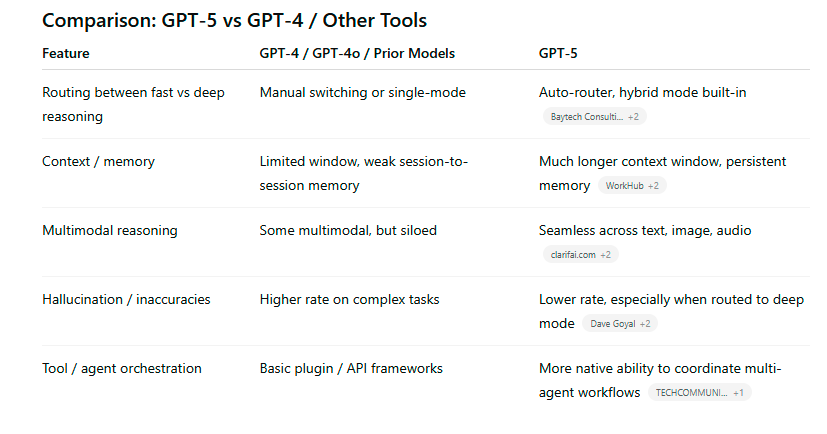
Unified model with dynamic routing: GPT-5 internally routes your query to a “fast mode” or “thinking mode” depending on complexity. You don’t need to choose manually.
Longer context and memory persistence: It can maintain state, recall context across many interactions, and remember preferences.
Multimodal capabilities: GPT-5 can ingest and reason across text, image, audio — e.g. take a product design sketch + notes + customer feedback and propose next versions.
Higher reasoning accuracy, lower hallucination: Error rates drop significantly with “thinking” mode.
Tool integrations and agentic workflows: GPT-5 is better equipped to call external tools, APIs, or agents to execute parts of workflows.
Put simply: GPT-5 is less “chatbot” and more “relentlessly capable reasoning engine + interface.”
When to Use It (and When Not To)
When You Should Use GPT-5
Complex, multi-step tasks: Strategic plans, scenario modelling, proposal drafting, diagnosis tasks (e.g. root-cause in ops).
Blending modalities: Tasks that mix visuals, text, audio (e.g. product feedback, design review).
Memory-intensive workflows: Where prior context matters (e.g. multi-month project threads, client history).
Prototyping or ideation: Early drafts of campaigns, experiments, strategic seeds.
Augmenting expert roles: Have GPT-5 assist your domain experts (e.g. finance, engineering) rather than replace novices.
When You Should Not Use It
Simple, repetitive rule-based tasks: Data entry, standard templated emails, fixed workflows are still better handled by low-code automation or scripts.
Regulated, high-risk decisions without supervision: Don’t let GPT-5 alone decide financial, legal, or compliance outputs without human review.
Black-box parts of core differentiators: If your IP is your secret sauce, you may not want it running generative logic in public or exposed to drift.
Unscoped, unfocused experiments: If you don’t have success metrics, guardrails, or a clear problem, GPT-5 use becomes a cost sink.

How It Works / Basics of Setup (Relatable Workflow Example)
Let’s walk through a simple yet real workflow in a marketing agency context:
Goal: Create and optimise a client nurture email series tailored per segment.
Data ingestion: You feed GPT-5 (via API or platform) your past campaign performance, segment definitions, customer demographics, and tone guidelines.
Prompt / definition: You ask: “Draft a 6-email nurture series for Segment A (mid-market, risk-averse) with a soft-sell tone, using prior performance data, and propose A/B tests for subject lines.”
Reasoning + generation: GPT-5’s router decides this is complex, routes to thoughtful mode, and produces email drafts, subject-line tests, and a rationale.
Human review & feedback: Your marketer refines, tweaks, injects brand voice, and tags corrections. That feedback is logged.
Iteration with memory: The system remembers the edits and evolves future drafts to better match your brand’s voice.
Execution + tracking: You deploy via your email tool (e.g. via API or import). Later, you feed performance back into the system so that next time it suggests tweaks.
Here’s the crux: you don’t treat GPT-5 like a content “generate once” tool.
You fold it into a loop: draft → human review → feedback → learn.
Comparison: GPT-5 vs GPT-4 / Other Tools
Versus pure automation platforms like Zapier or no-code tools: those are bullet-proof where rules suffice.
GPT-5 is not a replacement for rules — it’s a complement for the “grey zone” where rules don’t reach.
Practical Business Example: Before / After
Before (2025)
A professional services firm’s content team writes 12 industry newsletters per year. They outsource two per quarter because they lack capacity. The process is slow: draft, review, rewrite, align voice. A/B testing is manual. ROI is modest.
After (2026, with GPT-5)
GPT-5 assists in ideation: it takes existing newsletters, past engagement, trend data, and proposes new angles.
For each issue, the human reviews and edits, which feeds into memory for future adaptation.
Subject lines, email intros, summary snippets are auto-generated and A/B tested variants proposed.
Because of automation, the business scales from 12 to 24 high-quality newsletters per year, plus spin-off blog posts or micro-content, all with one content lead instead of two hires.
Engagement improves, and content becomes more consistent. Over 12 months, the margin lift offsets the GPT-5 subscription/API costs by 3–5×.
The qualitative shift: content becomes a strategic lever rather than a constraining bottleneck.
Transform your business with insights that matter.
Subscribe to Pulse for exclusive strategies designed to drive your success.
Join Pulse Now
Tips & Pitfalls (How to Succeed and Avoid Mistakes)
Tips for Success
Start small with one domain — pick a single workflow (e.g. email, proposals, diagnostics) and optimise it before scaling.
Enforce human-in-the-loop — always review and correct early — this builds your memory/training corpus.
Version & backup everything — track generations vs edits so you can roll back and understand drift.
Monitor error rates and bias drift — periodically audit outputs for factual accuracy, style drift, or unintended tone.
Rate-limit and guard undesired outputs — build filters, content safety checks, approval gates for public content.
Feed performance back into the system — deliver back results data (open rates, conversion, client feedback) to refine future outputs.
Common Pitfalls & How They Kill Momentum
“Let it run free” — if you delegate core client content to GPT-5 without oversight, hallucinations creep in.
No feedback loop — then the model never improves; you stay stuck in the zero version.
Overuse across every process — stretch too far, and everything degrades (lack of maintenance).
Using GPT-5 to replace your differentiator — if your niche value is in specialized content, let humans keep lead control.
Ignoring cost per token/usage creep — downstream usage can balloon costs if not controlled.
Conclusion
GPT-5 is more than just another AI upgrade. For medium-sized businesses, it’s a new paradigm for embedding reasoning, memory, and multimodal intelligence into operations.
But without the right mindset, process architecture, and guardrails, it will underdeliver — or worse, cause chaos.
You don’t need to adopt everything at once. Start by identifying the most compelling workflow, rig a feedback loop, and let us help you embed it intelligently.
If you’d like a partner to design your pilot, calibrate prompts, and manage quality, we’re ready — reach out, and let’s make sure GPT-5 becomes your competitive advantage, not a reactive experiment.
FAQs
Q1: Is GPT-5 safe enough to send client-facing content without review?
A1: No. While GPT-5 is a big leap forward, hallucination and tone drift still exist. Always maintain human review, especially in client-facing or regulated content.
Q2: Will GPT-5 replace my marketing or content team?
A2: Not at scale. It’s a force multiplier — it accelerates your team but doesn’t (yet) replace domain judgment, brand sense, or strategy.
Q3: What is the cost structure/licensing?
A3: GPT-5 typically operates via subscription or API tiers. Full “thinking mode” access may require Pro/Enterprise-level subscriptions. (OpenAI’s pricing tiers reflect this. )
Q4: How do I mitigate brand voice drift?
A4: Capture edited outputs, maintain a style-guide reference, enforce constraints in prompts (e.g. tone, length, vocabulary), and feed edits back into memory. In time, the model self-aligns closer to your voice.
Q5: What about data privacy and proprietary content exposure?
A5: Architect it so sensitive data is not exposed to inference logs (where possible). Use private API modes or enterprise deployments. Mask or abstract proprietary IP where needed.
Q6: How long before I see ROI?
A6: In a well-scoped pilot, you could see ROI inside 3–6 months — more content output, fewer hours spent per unit, plus more experimentation capacity.
Q7: Will GPT-6 obsolete this soon?
A7: Perhaps — but the core lessons (feedback loops, composability, embedding into operations) will still apply. Don’t wait for GPT-6; deploy well now and you’ll be ahead of the curve when the next upgrade arrives.
Other Articles
How to Use AI to Improve Focus at Work (Without Burning Out Again)
The Hidden Reason You’re Always Busy But Never Advancing — And What to Do About It