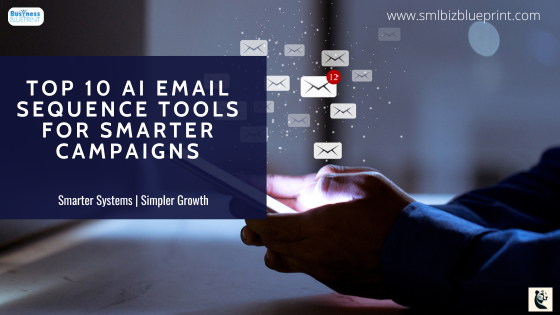

Email marketing is still one of the most powerful channels for driving conversions, building relationships, and scaling your business.
But crafting, scheduling, and optimising email sequences manually is time-consuming and prone to human error.
That’s where AI tools step in.
AI-powered email automation tools don’t just send emails. They learn, adapt, and optimise your email sequences based on user behaviour, campaign performance, and predictive analytics.
The result?
Smarter sequences that convert more leads with less effort.
In this guide, we’ll break down 10 of the best AI tools for automating email sequences—each one chosen for its specific strength, whether you’re a solopreneur, agency, or growing team.
🔍 Why Use AI for Email Automation?
- Save Time: AI can automatically write subject lines, build workflows, segment lists, and optimise send times.
- Improve Performance: Machine learning improves open and click-through rates by personalising messages at scale.
- Scale Efficiently: AI adapts as your audience grows, keeping campaigns relevant without needing a larger team.

Top 10 AI Tools for Email Sequence Automation
#1 ActiveCampaign
Overview:
A robust marketing automation platform combining email, CRM, and AI-powered insights for small and mid-sized businesses.
Key Features:
Predictive email sending
Conditional email content
Built-in CRM
Smart audience segmentation
Pros:
Excellent automation builder
Integrates deeply with CRM and sales
AI-generated send-time optimisation
Cons:
Learning curve for beginners
Pricing scales quickly with list size
Ideal Use Cases:
Perfect for businesses wanting to combine marketing and sales automation under one roof, especially in B2B or service sectors.
Ready to level up your business?
Sign up for our newsletter and get expert tips delivered weekly.
#2 Mailchimp
Overview:
An all-in-one marketing platform known for its intuitive interface and beginner-friendly AI tools.
Key Features:
AI-generated subject lines
Smart recommendations for send times
Predictive demographics
Behavioural triggers
Pros:
Easy to use
Rich templates and design tools
Good for e-commerce and small businesses
Cons:
Fewer advanced AI capabilities than others
Gets expensive as your list grows
Ideal Use Cases:
Great for solopreneurs, creators, and eCommerce brands who need fast, smart automation with minimal setup.
#3 ConvertKit
Overview:
A platform tailored for creators, offering simple but powerful automation and tagging systems enhanced by AI tools.
Key Features:
Automated workflows
Smart audience segmentation
Creator-focused templates
AI-enhanced subject suggestions
Pros:
Clear visual automation builder
Designed for creators and info-product businesses
Strong personalisation tools
Cons:
Limited features compared to larger platforms
Fewer AI capabilities beyond writing support
Ideal Use Cases:
Ideal for coaches, authors, and online educators wanting to nurture their audience with personal, timely messages.
#4 Brevo (formerly Sendinblue)
Overview:
A growing alternative to traditional email tools, offering powerful automation, SMS marketing, and AI-driven personalisation.
Key Features:
Email + SMS workflows
AI send-time optimisation
A/B testing with machine learning
Custom event triggers
Pros:
All-in-one communication hub
Flexible pricing with pay-as-you-go options
AI-enhanced analytics
Cons:
Interface isn’t as polished.
Less intuitive for complex sequences
Ideal Use Cases:
Best for businesses that want to combine email and SMS marketing with cost-effective automation.

#5 Smartwriter.ai
Overview:
An AI-powered outreach tool focused on hyper-personalised cold emails and LinkedIn messages using deep research.
Key Features:
AI-written cold email sequences
LinkedIn outreach automation
Website and social scraping for personalisation
Pros:
Excellent for outbound sales
Creates ultra-personalised first emails
Time-saving research automation
Cons:
Limited to outreach (not nurturing or newsletters)
Needs manual review of generated content
Ideal Use Cases:
Ideal for B2B agencies, SaaS founders, or sales teams doing cold email campaigns at scale.
#6 Instantly.ai
Overview:
Designed for cold outreach and sales automation, Instantly uses AI to generate, test, and optimise sequences across multiple inboxes.
Key Features:
Unlimited email accounts
AI warm-up tool
AI campaign optimisation
Smart lead scoring
Pros:
Powerful for cold lead generation
Built-in deliverability tools
Great analytics dashboard
Cons:
Less suited for inbound nurturing
Requires external CRM integrations
Ideal Use Cases:
Great for founders, SDR teams, and agency sales teams needing to run outreach at scale.
Transform your business with insights that matter.
Subscribe to Pulse for exclusive strategies designed to drive your success.”
Join Pulse Now
#7 Jasper Email Templates
Overview:
Jasper is best known for long-form AI content, but it also has an expanding range of email writing templates and automation integrations.
Key Features:
AI-powered email sequence templates
Tone-specific generation (e.g., witty, professional)
Team collaboration
Pros:
Fast, high-quality copy
Custom brand voice integration
Ideal for teams that want to create engaging sequences quickly
Cons:
Needs pairing with email software (no sending features)
No visual automation builder
Ideal Use Cases:
Perfect for marketers, copywriters, and agencies creating high-converting email content at scale.
#8 HubSpot Marketing Hub
Overview:
A full-stack CRM and marketing automation platform with powerful AI features for lead nurturing and email sequencing.
Key Features:
AI subject line testing
Lead scoring & predictive analytics
CRM-integrated workflows
Chat + email + content automation
Pros:
Deep integration between CRM and marketing
Advanced AI insights
High scalability
Cons:
Premium pricing
Can be overwhelming without training
Ideal Use Cases:
Ideal for mid-sized to large businesses scaling their marketing operations and lead pipelines with AI precision.
#9 Customer.io
Overview:
A behaviour-driven messaging platform with powerful segmentation and developer-level flexibility, backed by strong AI logic.
Key Features:
Real-time behaviour triggers
Multi-channel messaging (email, SMS, push)
AI-powered A/B testing and predictions
Pros:
Advanced segmentation and API integration
Great for tech-savvy teams
High level of personalisation
Cons:
Not beginner-friendly
Requires some dev support for full potential
Ideal Use Cases:
SaaS, fintech, or app-based businesses that need deep logic and real-time triggers.
#10 Klaviyo
Overview:
An eCommerce-focused email marketing tool that pairs seamlessly with Shopify and uses AI to boost conversions.
Key Features:
Smart product recommendations
AI audience segmentation
Predictive analytics for customer lifetime value
Automated win-back campaigns
Pros:
Tailored for online stores
Strong Shopify integration
Predictive churn and purchase modelling
Cons:
Focused only on e-commerce
Less flexibility outside that niche
Ideal Use Cases:
Best for eCommerce brands looking to personalise email flows based on shopping behaviour.
Tool Comparison: Which One’s Right for You?

Conclusion
AI is transforming email marketing by automating what used to take hours—while producing better results.
Whether you’re trying to generate leads, onboard new customers, or increase repeat purchases, there’s an AI tool tailored for your goals.
Don’t waste time guessing what to write, when to send, or how to scale. Let AI handle the heavy lifting so you can focus on strategy and growth.
FAQs
Q1: What are AI tools for email automation?
A1: AI tools for email automation use machine learning and predictive analytics to optimise email sequences. They automate tasks like list segmentation, content personalisation, subject line generation, and send-time optimisation to increase open and conversion rates.
Q2: What is the best AI email tool for small businesses?
A2: For small businesses, ConvertKit, Mailchimp, and ActiveCampaign are popular choices. ConvertKit is ideal for creators, Mailchimp offers a simple all-in-one platform, and ActiveCampaign provides deeper automation for growing teams.
Q3: Can AI write and send emails automatically?
A3: Yes. Tools like Jasper can write persuasive emails, while platforms like ActiveCampaign, HubSpot, and Klaviyo automate sending based on user behaviour, timing, and campaign triggers.
Q4: How do AI tools improve email marketing performance?
A4: AI improves performance by:
Predicting optimal send times
Personalising content based on user behaviour
Running automatic A/B tests
Recommending the best-performing subject lines
This leads to higher open rates, better click-through rates, and more conversions.
Q5: What’s the difference between email automation and AI email marketing?
A5: Email automation follows pre-built workflows. AI email marketing goes further by learning from behaviour, optimising content and timing, and adjusting campaigns in real time to improve performance.
Q6: Are AI email tools worth the investment?
A6: Yes. AI tools save hours of manual work, reduce human error, and generate better ROI by improving deliverability and engagement. Many tools offer flexible pricing to match your business size and growth.
Q7: Which AI tool is best for cold email outreach?
A7: Instantly.ai and Smartwriter.ai are excellent for cold outreach. They specialise in high-volume, personalised email sequences and can research leads, generate unique intros, and maintain high deliverability.
Other Articles
How to Run a One-Person Marketing Team That Works