
A 3-Part Marketing System is a simple weekend framework that helps small businesses automate their marketing for consistent results.
It’s built around three core components—Foundation (clarity), Engine (automation), and Dashboard (control)—that work together to capture leads, nurture them, and measure performance without constant effort.
By focusing on one promise, one path, and one page, you can reclaim time, improve follow-up, and build a marketing system that runs itself.
Follow this simple, step-by-step framework to reclaim clarity, automate results, and never start from scratch again.
You’re doing everything right—posting, emailing, tweaking, showing up every day.
But somehow, the results still don’t reflect the effort.
Every campaign feels like it starts from scratch. Every follow-up depends on you remembering. Every win fades before it compounds.
You tell yourself it’s just a busy season… but deep down, you know it’s not busyness—it’s fragmentation.
Your marketing lives in pieces: one part in your inbox, another in your notes, a dozen more scattered across half-set-up tools.
And that scattered energy has a cost.
It’s not just the time lost—it’s the clarity you trade away each time you try to rebuild momentum from memory.
That’s the quiet tax of “doing more.” The harder you push, the slower it all feels.
But what if you could take one weekend—just two days—and turn that chaos into a closed loop?
A system that captures leads, follows up automatically, and shows you exactly what’s working—without adding another tool or another layer of stress.
This is that system.
A simple, 3-part marketing framework you can build in a weekend.
Not a hack, not a new app—a shift in how you think about work, clarity, and control.
Because you’re not someone who needs more hustle.
You’re someone ready to build something that runs even when you don’t.
In this article, we’ll walk through:
- The three core parts of a marketing system that actually sustains momentum.
- How to automate your next best step instead of manually chasing leads.
- The five metrics that restore control—and reveal what truly moves the needle.
- By the end, you’ll see how a single weekend can transform your marketing from reaction to rhythm.

What Is a 3-Part Marketing System (and Why It Beats “Do More” Marketing)?
You don’t need more marketing. You need a system that stops you from starting over every week.
Most small business owners mistake effort for structure. They post more, email more, and add another tool hoping it’ll be “the one” that finally connects everything.
But activity isn’t progress—it’s noise without direction.
The result?
Constant motion with no momentum.
Every campaign feels like déjà vu. You start from zero, rebuild what you did last month, and call it “iteration.”
Systems beat sprints because they replace memory with automation. A 3-part marketing system—Foundation, Engine, and Dashboard—turns chaos into continuity.
You stop being a firefighter reacting to tasks and start becoming a strategist building compounding results.
Once you see your marketing as a self-feeding loop rather than a checklist, momentum stops depending on your energy.
Part 1: Foundation — The Clarity Layer
Start with one promise, one path, one page.
That’s your foundation. It forces simplicity—because every layer of clarity you skip today becomes a bottleneck tomorrow.
One Promise: Define a single transformation your audience wants. Not three features or twelve benefits—one clear, memorable outcome.
One Path: Pick one entry channel (email, lead magnet, referral) and double down. Multi-channel before mastery just multiplies confusion.
One Page: A single landing page that presents the promise, captures interest, and leads to the next step. No navigation. No distraction.
When you reduce your marketing to one clear loop, you multiply your leverage.
That’s why companies that focus on clear, conversion-driven pages see up to 220% higher lead generation rates compared to those with generic pages. (Source: HubSpot, 2025)
Every extra decision point is a silent tax on conversion. The longer clarity stays optional, the more momentum leaks through confusion.
Part 2: Engine — The Consistency Layer
Automation isn’t about replacing people—it’s about removing lag.
Once your foundation is built, your next move is to install the Engine—a sequence that ensures follow-up happens without your involvement.
Lead → Nurture: Send a welcome email immediately after signup. Add a 3-part series that delivers one insight, one proof point, and one low-friction offer.
Nurture → Conversion: Trigger a time-boxed call-to-action when engagement peaks. Don’t guess—let behaviour set the pace.
Conversion → Expansion: After purchase or signup, trigger a thank-you, request feedback, and introduce the next relevant step.
Businesses that automate lead nurturing see up to 451% more qualified leads, according to Annuitas Group.
Automation builds trust through rhythm—people feel your reliability long before they meet you.
The longer follow-up depends on your memory; the more deals die quietly. Most people don’t realize—speed isn’t the secret, consistency is.
Part 3: Dashboard — The Control Layer
You don’t need 50 metrics. You need five that drive change.
A dashboard gives visibility without overwhelm—it replaces “I think” with “I know.”
Track only what prompts action:
- Visitors to page (Are you visible?)
- Email captures (Is your message resonating?)
- Engagement rate (Is your nurture relevant?)
- Conversions (Is your offer aligned?)
- Time to first response (Is your momentum intact?)
If a number doesn’t trigger a decision, it doesn’t belong.
That’s why companies focusing on fewer key metrics outperform competitors by over 60% in decision velocity (McKinsey, 2024).
The longer you chase vanity metrics, the more clarity you lose. What that means for your business is simple—data should inform, not intimidate.
You’re not just a marketer. You’re a system builder.
Someone who understands that focus isn’t a limitation—it’s leverage.
Pro Tip:
Use automation tools like Zapier or n8n to connect your lead form to your email sequence instantly.
Because automation isn’t about saving minutes—it’s about saving mental bandwidth. Every manual step you remove gives you back the clarity to think strategically. That’s where real growth happens.
Ready to level up your business?
Sign up for our newsletter and get expert tips delivered weekly
How to Build a Marketing System in a Weekend (Step-by-Step)
You’re doing too much that doesn’t connect.
In two focused days, you can replace scattered tasks with a repeatable system.
You’re not chasing tactics anymore—you’re engineering momentum.
Saturday: Build the Foundation — Create Clarity
Core takeaway: Simplicity scales faster than complexity.
Start with one promise, one path, and one page. It sounds too simple, but that’s the point—clarity forces depth.
One Promise: Write down a single transformation your customer wants. Not what your product does—what it changes. Most businesses bury clarity under adjectives.
Strip until you reach truth. Example: “Go from scattered marketing to a system that runs itself.”
One Path: Choose one way in.
Email signup, demo booking, lead magnet—just one. The fastest way to lose traction is to split focus across platforms that don’t talk to each other.
One Page: Create a landing page with only one job: convert interest into intent.
Remove every distraction—navigation bars, unrelated offers, vague CTAs. Keep one clear message and one button that says what happens next.
When you focus this way, everything else accelerates.
Companies with a single, optimized landing page often see 200%+ more conversions than those that scatter effort across multiple links (HubSpot, 2025).
Every extra decision you give a visitor is a chance for them to leave. The longer your message stays fragmented, the more silent exits you’ll never measure.
Sunday Morning: Build the Engine — Automate the Follow-Up
Most leads die in the gap between interest and response. You promise to follow up, but the inbox fills, and the moment’s gone.
Automate that gap. The goal isn’t to send more—it’s to send on time.
A simple 3-email sequence works better than sporadic genius.
Welcome Email (Immediate): Deliver value right away—a free insight, checklist, or clarity statement. It’s your first impression; make it generous, not salesy.
Nurture Sequence (Days 2–5): Tell a story of transformation. Show proof. Resolve one objection. Then, pivot to your offer.
Conversion Trigger (Day 7): Invite action with urgency rooted in purpose—“This week, install your system and start freeing up hours.”
Automation isn’t about removing you from your marketing—it’s about ensuring you show up exactly when it matters most.
Once it’s running, every new lead enters a rhythm that never depends on your memory again.
Businesses that automate nurture sequences see 451% more qualified leads and up to 80% faster conversion cycles (Annuitas Group, 2024).
That’s not because automation is clever—it’s because it’s consistent.
Every week this stays manual, you lose leads you never even see. Momentum dies quietly in the delay between “interested” and “followed up.”
Sunday Evening: Build the Dashboard — Regain Control
Core takeaway: You can’t steer what you can’t see.
End your weekend by creating a 5-number dashboard—the simplest system for clarity and control.
Track only what changes your behavior next week:
- Visitors – Are you visible enough?
- Email Captures – Is your promise landing?
- Engagement – Are people opening, clicking, replying?
- Conversions – Is your offer working?
- Response Time – Are you reacting before momentum dies?
Ignore everything else. Metrics that don’t lead to a decision are distractions disguised as data.
Businesses that focus on a few key metrics make decisions 60% faster and outperform their competitors (McKinsey, 2024).
The longer your data stays messy, the longer you fly blind. What that means for your business is more effort with less clarity—and no way to tell if progress is real or just motion.
You’re not building campaigns anymore—you’re building capacity.
Your weekend isn’t about speed; it’s about reclaiming control.
Pro Tip:
Use a free dashboard tool like Google Looker Studio or Airtable to visualise your five metrics in one place.
Because visibility isn’t vanity—it’s leverage. The faster you see what’s working, the sooner you can double down. Clarity compounds.
What Tools Do You Actually Need to Automate Marketing?
You’ve tried every tool, but nothing feels connected.
The right system isn’t about having more software—it’s about fewer, smarter links between them.
You’re not chasing trends anymore. You’re architecting flow.
Core Takeaway: Tools Don’t Build Systems—Connections Do
Most marketing setups collapse not because they lack tools, but because the tools don’t talk to each other.
One app captures leads, another sends emails, another tracks analytics—and you, somewhere in the middle, become the manual link. That’s where progress stalls.
Automation should feel invisible.
The real goal isn’t “more automation,” it’s seamless cause and effect—a trigger happens, the next step fires, and momentum continues without interruption.
You only need three types of tools to make that happen:
Landing Page + Form Capture — where attention becomes a lead.
Email Automation — where the relationship is built.
Workflow Connector — where triggers ensure nothing falls through.
Everything else—social schedulers, CRMs, analytics suites—is secondary. Start lean, then layer.
Every unnecessary platform is another password between you and progress. The longer your workflow stays fragmented, the more you spend time managing marketing instead of doing it.
Most business owners keep adding tools to solve old problems, but each addition creates a new layer of friction.
A better lens is system literacy, not software loyalty. Once you define your workflow, the tool choice becomes obvious.
You stop being a tech juggler and start being a process designer. You know what every click in your system does and why it exists.
The peace comes not from having the newest app, but from knowing that every part of your system has purpose—and every trigger has an outcome.
Minimal Tool Stack Example:
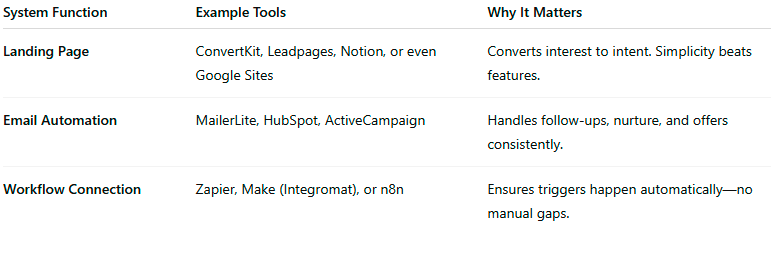
Most people don’t realise that 80% of automation gains come from connecting the first two tools.
The third one—the connector—is what transforms a set of apps into a functioning system.
The longer you delay connecting these three, the more leads slip through unnoticed. What that means for your business is lost time, lost attention, and eventually, lost trust.
Example in Practice:
Imagine someone downloads your free checklist.
Here’s what happens next in a real system:
Landing page form (ConvertKit) captures their email.
Automation (MailerLite) sends an immediate welcome email.
Workflow (Zapier) logs the lead in a Google Sheet and notifies you on Slack.
Follow-up (HubSpot or Gmail) triggers a reminder to check in three days later.
That’s it—one flow, no manual follow-up, and zero dependency on your attention span.
Now imagine doing that across your lead magnet, consultation bookings, and customer onboarding.
The compounding time saved each week is worth more than any “new feature” most tools advertise.
Every unlinked step is a slow leak. The longer that leak continues, the more invisible effort drains away—quietly eating your time and clarity.
You’re not trying to automate yourself out of your business—you’re trying to reclaim the part of yourself buried under repetitive tasks.
The more seamless your systems become, the more you return to strategy, creativity, and growth—the parts only you can do.
Pro Tip:
Start your automation with one simple “if-this-then-that” trigger—like “if someone fills the form, send an email.” Build upward from there.
Because automation isn’t about doing everything faster—it’s about removing the need to think about the same thing twice. The less time you spend resetting, the more time you spend refining. That’s how system builders scale.

How Do You Measure Marketing Performance Without Drowning in Data?
You’re tracking everything but trusting nothing.
You don’t need more metrics—you need five that drive change.
You’re not an analyst; you’re an architect of momentum.
Core Takeaway: Data Should Guide, Not Dictate
Most marketers treat data like a flood—impressive on dashboards, useless in decisions.
They spend hours staring at numbers without knowing which ones move the business forward.
The real power of data isn’t in how much you collect but in how quickly you can act on what matters.
A 3-part marketing system isn’t just about automation—it’s about feedback loops.
Your dashboard is the final piece of that loop: it tells you where your energy’s leaking and where it compounds.
That’s why the world’s top-performing small businesses track only five key metrics. These aren’t vanity stats—they’re vital signs of a healthy system.
The longer you measure everything, the less you see anything clearly. What that means for your business is decision fatigue disguised as “data-driven marketing.”
When you can’t tell if your marketing is working, you start guessing. You adjust copy, swap images, or rebuild campaigns without real evidence. That’s not optimisation—it’s roulette.
A simple dashboard gives you control.
With five numbers, you know exactly where the system stalls. Each one ties to a specific decision or fix.
Visitors to Page – Are people finding you?
If traffic’s low, focus on visibility: SEO, outreach, partnerships.
Email Captures – Are they saying yes to connection?
If capture rates dip, test headlines or form placement.
Engagement (Opens, Clicks, Replies) – Is your message resonating?
Engagement below 25% signals relevance decay—your tone may be off.
Conversions (Purchases or Bookings) – Is your offer aligned?
Small tweaks in framing often beat big product changes.
Response Time – Are you matching your customer’s momentum?
Studies show leads contacted within 24 hours are 60x more likely to convert.
You stop being reactive—you become diagnostic. Each number becomes a signal, not a judgment. You’re leading with precision, not panic.
With this five-number view, you reclaim both control and calm. Decisions shrink from overwhelming possibilities to focused actions.
The longer you delay building a simple dashboard, the longer you’ll rely on gut instinct dressed up as strategy. Every week you do, you waste hours chasing symptoms instead of fixing causes.
The Hidden Metric Most Ignore: Maintenance Load
Every system decays. Automation sequences break, pages get outdated, links fail.
What separates the sustainable from the struggling is how often they review, not how perfectly they build.
Schedule a 30-minute weekly review: glance at your five metrics, fix one thing, and move on.
This single habit prevents silent decay—the kind that costs you leads long before you notice them missing.
McKinsey found that teams with consistent review rhythms make decisions 60% faster and sustain improvements 80% longer.
That’s not from having better dashboards—it’s from looking at them more consistently.
Most people don’t realise systems fail quietly before they fail publicly. The longer you ignore maintenance, the more invisible erosion you invite.
You’re not trying to predict the future—you’re building the ability to respond faster than anyone else.
Clarity isn’t about knowing everything; it’s about knowing what to fix first.
Pro Tip:
Build your 5-number dashboard in Airtable or Google Sheets. Use conditional formatting to highlight metrics that drop below thresholds.
Because clarity isn’t a report—it’s a rhythm. The faster you see what’s changing, the quicker you adapt, and adaptation is the only true marketing advantage that compounds.
How Do You Keep Momentum Without Constant Activity?
You’re working harder but feeling further behind.
True momentum isn’t built from constant motion—it’s built from consistency.
You’re not just maintaining a system anymore—you’re leading one.
Core Takeaway: Momentum Comes from Maintenance, Not Hustle
Most business owners mistake activity for momentum. They fill their week with marketing tasks—posting, replying, tweaking—believing that busyness equals progress.
But constant motion without direction isn’t momentum; it’s friction disguised as productivity.
Real growth happens when your marketing keeps moving even when you don’t.
That requires designing for predictable maintenance, not perpetual effort. A simple rhythm—thirty minutes of review each week—does more for momentum than twelve new campaigns launched without reflection.
This shift from doing to maintaining is where sustainable momentum lives. It transforms “marketing management” into “marketing leadership.”
The longer you equate momentum with effort, the more exhausted your results will become.
What that means for your business is a cycle of bursts and breakdowns instead of steady, scalable flow.
You finish a campaign, and within days, everything slows again. Leads cool off. Energy dips. You rebuild—again.
That’s not a traffic issue—it’s a system rhythm issue. Your marketing doesn’t need more energy; it needs scheduled alignment. Set a recurring “maintenance block” every week.
Review your five dashboard numbers. Update one email or headline. Fix one friction point.
You move from firefighter to forecaster. The system runs because you’ve installed a feedback loop that keeps it breathing.
Instead of sprinting, you’re steering—making minor course corrections that prevent major collapses.
Businesses that adopt fixed review rhythms are 33% more likely to sustain growth year-over-year (Forrester, 2025). It’s not luck—it’s maintenance as a management strategy.
The longer you postpone maintenance, the faster momentum decays. Every skipped review compounds invisibly until results drop—and by then, it’s too late to recover easily.
Momentum Is Predictable When You Control the Load
Momentum isn’t about acceleration—it’s about inertia. Once a system is moving, your job is to remove resistance, not add more force.
That’s what the Maintenance SLA (Service Level Agreement) is for: a commitment to light but regular upkeep.
Here’s how to structure it:
Time: 30 minutes every Monday morning.
Focus: Review 5 key metrics, update 1 message, optimise 1 micro-step.
Outcome: Each week, one improvement compounds without breaking flow.
Over a quarter, that’s 12 incremental optimisations—no burnout, no rebuilds.
Most people don’t realise that systems don’t die dramatically—they fade slowly through neglect. The longer it stays unmonitored, the harder it becomes to restart momentum from a standstill.
Friction vs. Flow: The Emotional Equation
Friction feels like forcing progress every week.
Flow feels like confidence that progress is happening even when you’re not watching.
When you maintain your system rhythm, you buy back peace of mind—the rarest currency in business.
Your marketing stops being a stress cycle and becomes a system of trust.
The longer you work without flow, the more energy you waste rebuilding confidence instead of reinforcing results.
You’re no longer reacting to the market—you’re orchestrating it.
You’ve built momentum that no longer depends on your mood, energy, or availability. That’s the quiet power of systems leadership.
Pro Tip:
Create a recurring 30-minute “System Check-In” calendar block labelled “Momentum Maintenance.” Treat it as sacred.
Because consistency isn’t the opposite of creativity—it’s the structure that protects it. The steadier your system’s rhythm, the more mental space you free for innovation. That’s how leaders build stability that scales.
Transform your business with insights that matter.
Subscribe to Pulse for exclusive strategies designed to drive your success.
Join Pulse Now
Conclusion
You’ve been working harder, trying every new tactic, juggling tools, chasing trends—yet progress still feels fragile.
The moment you stop pushing, it all slows down again. Each week becomes another rebuild, another sprint to stay visible.
You know this cycle isn’t sustainable—but it’s become the rhythm of your business.
It doesn’t have to be. You don’t need more effort; you need a loop that sustains itself.
The 3-Part Marketing System—Foundation, Engine, Dashboard—isn’t a project. It’s a pattern for control.
One that reclaims your time, removes guesswork, and keeps your marketing in motion even when you’re focused elsewhere.
Once it’s built, momentum is no longer something you chase—it’s something you maintain.
This is where you step out of reactive marketing and into leadership. You stop being the operator and start being the architect—the one who designs systems that compound, not tasks that consume.
Because clarity isn’t a luxury; it’s leverage.
You now have the blueprint:
Foundation for clarity—one promise, one path, one page.
Engine for consistency—automation that never forgets.
Dashboard for control—five numbers that tell you what’s working.
Maintenance rhythm for momentum—thirty minutes a week to keep the system breathing.
That’s not theory—it’s the structure of a business that runs with precision instead of panic.
The longer you postpone structure, the more you spend fixing symptoms instead of causes. Every week you wait is another week lost to friction and fatigue.
You have a choice now.
You can keep living in the cycle of “do more, get less,” or you can install a system that works when you don’t.
You can stay stuck in effort—or move forward with design.
Because your marketing doesn’t need more of you.
It needs what you’ve just built:
A clear promise, a closed loop, and a steady rhythm that turns activity into growth.
Take the next step.
Block one weekend. Build your system.
Because the only thing more exhausting than building from scratch—
is never building at all.
Identity anchor: You’re not just a marketer anymore—you’re a builder of systems that create freedom, not fatigue.
Action Steps
These aren’t theoretical—each step helps you build or refine a marketing system that runs itself, giving you back control, clarity, and time.
Clarify One Promise, One Path, One Page
Strip your offer to its essence. Define one clear promise your audience wants, choose one path of entry (email signup, lead magnet, or demo), and build one focused landing page around it.
Every extra message, button, or channel divides attention—and divided attention kills conversions.
Automate the Next Best Step
Map what happens after someone engages: immediate welcome email, follow-up sequence, then a time-boxed CTA. Use simple automation (ConvertKit, MailerLite, or Zapier) to make it happen without you.
Every day follow-up depends on memory, you lose leads you never see.
Build a 5-Number Dashboard for Control
Track only the five metrics that trigger action: visitors, email captures, engagement, conversions, and response time. Use a basic Google Sheet or Airtable view—keep it visible and simple.
If a number doesn’t change your next move, it’s noise, not insight.
Schedule a 30-Minute Weekly Review
Momentum isn’t built in bursts—it’s maintained in rhythms. Block one slot each week to review metrics, fix one issue, and update one message.
The longer you delay maintenance, the faster momentum fades.
Connect, Then Simplify Your Tools
Use three core tools—landing page, email automation, workflow connector—and integrate them. Resist adding more until these run smoothly.
Complexity doesn’t scale; connection does. Fewer moving parts mean fewer breakdowns.
Document the System as You Build
Write down your triggers, timing, and tools. Create a “System Map” you can hand off or revisit later.
Documentation turns your marketing from tribal knowledge into a transferable structure.
Protect Your Focus—Operate as the Architect
Your role isn’t to chase leads; it’s to design the system that attracts them. Review data, adjust rhythm, and let automation handle the rest.
Why it matters: You don’t win by working more—you win by thinking longer.
Next Step:
Choose one of these today.
Because every week you wait to connect the pieces, the gap between your effort and your results grows wider.
Build the loop this weekend—and watch your marketing start to move on its own.
FAQs
Q1: What exactly is a 3-Part Marketing System?
A1: A 3-Part Marketing System is a simple, closed-loop framework made up of three layers: Foundation (clarity), Engine (automation), and Dashboard (control). It helps you capture leads, nurture them automatically, and track what’s working—all without constant manual effort.
Think of it as a marketing rhythm, not a campaign. Once it’s running, it doesn’t rely on your daily energy to stay in motion.
Q2: How long does it really take to build?
A2: You can create the first version in a single weekend—one day for structure, one day for automation. The key isn’t perfection but completion. Build something functional, then refine it over the next few weeks through your weekly maintenance rhythm.
Most people spend months planning what they could execute in two focused days.
Q3: What tools do I need to set it up?
A3: You only need three core tools:
A landing page builder (like ConvertKit or Leadpages)
An email automation platform (like MailerLite or HubSpot)
A workflow connector (like Zapier, n8n, or Make)
Everything else is optional. Simplicity creates sustainability.
Q4: What should I track once it’s running?
A4: Focus on five key numbers: visitors, email captures, engagement, conversions, and response time.
These metrics form your system’s heartbeat—they tell you where to adjust and what to ignore.
If a metric doesn’t influence your next decision, it’s a distraction.
Q5: How do I maintain momentum after setup?
A5: Momentum comes from rhythm, not effort. Set a 30-minute weekly review to check your dashboard, fix one bottleneck, and update one message.
The longer you skip maintenance, the more invisible erosion builds up in your system.
Q6: Can automation make my marketing feel impersonal?
A6: Not if you design it intentionally. Personalisation isn’t about handwriting every message—it’s about relevance. Use your voice in automated emails, reference the reader’s journey, and make timing your advantage.
Automation amplifies empathy when done with clarity and intent.
Q7: What’s the biggest mistake people make when trying to automate?
A7: They start with tools instead of systems. Most business owners overbuild, connect too much, and lose sight of the purpose.
Start small, master one loop, and expand only after it works.
The longer you chase new apps, the more disconnected your marketing becomes.
Q8: What results can I expect once it’s running?
A8: Most businesses see faster lead response times, more consistent follow-ups, and a clear sense of control. The result isn’t just higher conversions—it’s lower stress.
You stop chasing tasks and start steering your system.
Final Takeaway:
The 3-Part Marketing System is more than a weekend project—it’s the framework that turns chaos into clarity. Build it once, maintain it weekly, and your marketing becomes predictable, measurable, and scalable.
Because the question isn’t whether you have time to build it.
It’s whether you can afford to keep rebuilding everything without it.
Bonus Section: Beyond the System — Three Unconventional Shifts That Redefine Growth
Most leaders believe progress means adding more: more campaigns, more tools, more output.
The assumption is that scale comes from expansion. But here’s the quiet truth — most marketing systems don’t fail from lack of action; they collapse under the weight of too much of it.
The hardest part of building a self-sustaining system isn’t wiring automations — it’s resisting the reflex to add noise when silence would serve you better.
Because once your marketing starts running smoothly, the real question changes.
It’s no longer “How do I grow faster?” but “How do I stay aligned as I grow?” That’s where the next level begins — not in complexity, but in awareness.
These unconventional ideas aren’t about doing more. They’re about seeing differently.
The Stop-Doing Audit — Subtraction Is a System Skill
Efficiency doesn’t start with automation; it starts with elimination. Before you build your system, pause and write down every marketing activity you do weekly. Then ask: “If I stopped this for 30 days, what would actually break?”
You’ll find most of what you’re protecting isn’t essential — it’s habitual.
The hardest decisions in growth aren’t what to start — they’re what to stop. Simplicity isn’t the absence of ambition; it’s the discipline of relevance. Every unnecessary step you remove gives more space for what compounds.
Great systems aren’t built by people who do everything — they’re built by people who do what matters deeply and repeatedly.
Pro Tip: Schedule a 15-minute “Stop-Doing Review” every quarter. You’ll be surprised how much momentum returns when clutter leaves.
The Silent System Test — Can It Run Without You?
True automation isn’t about speed — it’s about independence. Once your 3-Part Marketing System is live, step away for seven days. No manual posts, no follow-ups, no interventions.
Let silence test what structure usually hides.
Most business owners confuse momentum with presence. But when your system runs without you, that’s not absence — it’s evidence. It shows you’ve built something durable enough to breathe without your daily attention.
The goal isn’t to disappear from your marketing — it’s to appear by design instead of by effort. Your presence becomes intentional, not constant.
Pro Tip: Use this test quarterly. Each time, note what continued working. That’s your foundation. Strengthen it; don’t replace it.
The One Hour a Month Reset Rule — Reflection Is a Growth Mechanic
The faster your system runs, the more often it drifts off course. Complexity creeps in slowly — a few new automations, a half-written campaign, an extra tool. One hour of stillness resets direction faster than a month of activity.
Spend one hour each month asking three questions — What’s still working? What feels heavy? What can I simplify? This isn’t performance review; it’s course correction.
Momentum without reflection becomes misalignment in disguise.
The leaders who scale sustainably don’t just automate tasks — they automate awareness. They know that the system isn’t finished once it’s built; it evolves every time they pause long enough to think.
Pro Tip: Treat reflection as part of your workflow, not an afterthought. Growth accelerates when clarity becomes a habit, not a rescue mission.
Most people think building a system is about saving time. It’s not. It’s about redistributing attention — from constant activity to conscious refinement.
The real growth edge isn’t automation or data or tools. It’s the rare discipline to pause, observe, and adjust before the noise returns.
Because mastery isn’t adding more — it’s knowing what can finally be left alone.
Other Articles
How to Organise Your Week Around Focus, Not Fatigue
How to Automate This Week and Reclaim 5 Hours of Calm, Focused Time